

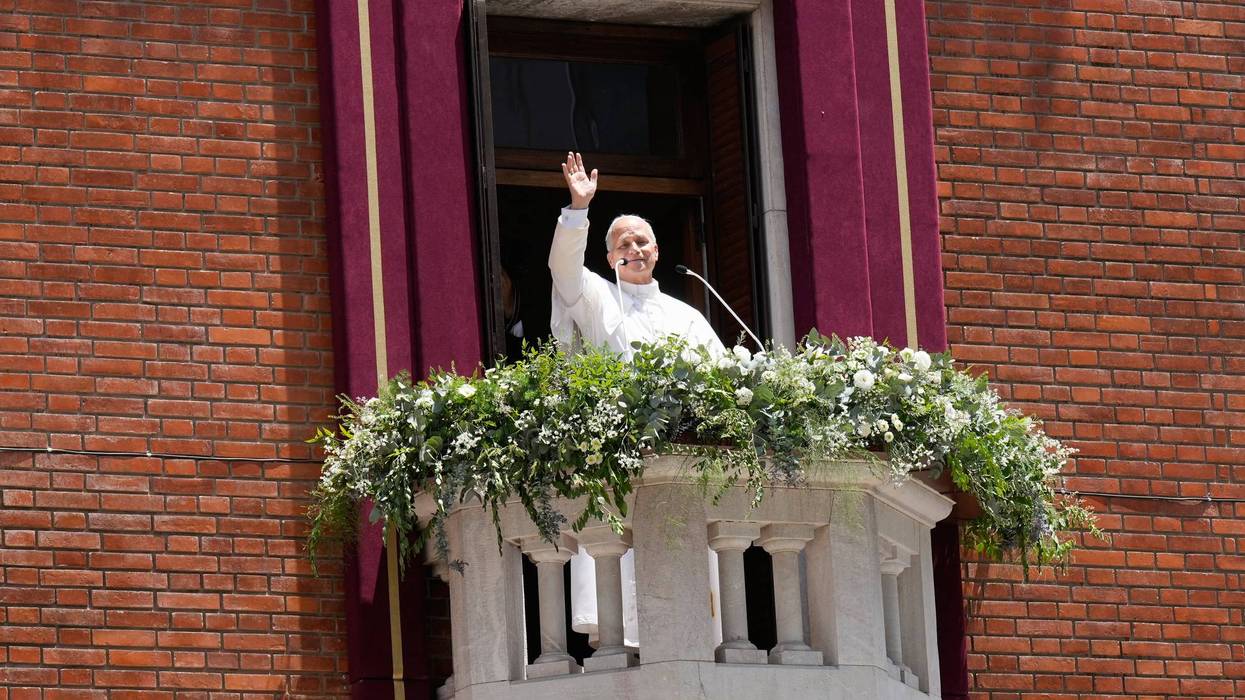

BUENOS AIRES, Argentina (AP) — Pope Leo XIV urged Argentines on Tuesday to follow the holy example of the country's best-known saints as he drew an estimated 650,000 people to the central city of Córdoba for Mass and an estimated 1 million more for a nighttime vigil in the capital Buenos Aires.
Faithful from all over Argentina drove hours to be on hand for the Córdoba service, from the farthest north of the country to southern Patagonia and points in between. After nearly 40 years without a papal visit, Córdoba was chosen to host Leo because of its central location.
Leo told them that Córdoba was a “land of saints,” home to some of Argentina’s best-known missionaries. They include St. José Gabriel del Rosario Brochero, known as the “ Gaucho priest,” and “Mama Antula,” who in 2024 became Argentina’s first female saint. They were both canonized by the Argentine Pope Francis.
Leo urged Argentines today to follow their example.
“We are all called to holiness,” he said. "These saints and blesseds have already fulfilled their mission on Earth. Today, it is our turn to follow the radiant example of holiness they have left with us.”
Late Tuesday, Leo presided over a massive youth vigil at the Monumento de los Españoles, an intersection of Buenos Aires' grand boulevards that were packed for the nighttime vigil. It was the same place where Leo drew 2.5 million people on Monday for his main Mass in Buenos Aires, a record for his still-young pontificate.
The Vatican estimated 1 million people had turned out for the nighttime vigil.
“We young people lack motivation," said Emilia Caroti, who found a spot to watch the pope's vigil from a nearby park, where large screens were broadcasting for the overflow crowd.
"We are a generation that is deeply marked by what we see from the past and the little hope there is for the future, and we hope the Pope can renew our faith in ourselves a bit, that he leaves a message of motivation.”
A site that recalls the dictatorship
The site for the Córdoba liturgy was the grounds of the Argentine Aircraft Factory, a plant run by the air force for much of the 20th century that built the attack planes Argentina’s military first used in late 1975 to strike leftist guerrillas.
That counterinsurgency campaign was a prelude to the state terror unleashed under the 1976-1983 military dictatorship, in which human rights groups estimate that around 30,000 people were killed or disappeared.
After Mass, Leo met privately with 20 people chosen by the archbishop, among them Alba Camargo, whose father, stepmother, aunt and uncle all disappeared under Argentina’s 1976-1983 military dictatorship.
Camargo said she told the pope she had come on behalf of relatives still searching for victims’ remains at La Perla, a former clandestine detention center outside Córdoba, and handed him a folder with photos of the excavations and the names of those identified so far.
“He was nodding, as if he knew all about it, and, looking deep in my eyes, took me by the hand and blessed the Franciscan crosses I had brought him,” she told The Associated Press.
Many others in the group, which included a rural worker, a soup kitchen organizer and a human trafficking survivor, were so overcome with emotion they could barely speak, she said. “It was unbelievably powerful to feel him so human, listening to you like that from 15 centimeters away.”
Camargo, 64, who herself was detained by security forces in 1976 at age 13, said the mere meeting was a "gesture showing that he sees us.”
Two weeks ago, forensic anthropologists found and identified the remains of nine missing people from La Perla, one of the dictatorship’s largest clandestine detention and torture centers.
Camargo said that she hoped Tuesday’s meeting “would bring change” at a time when President Javier Milei’s government has gutted funding for dictatorship memorial sites and organizations searching for the disappeared, and has promoted a revisionist account that casts the military’s crimes as little more than excesses in a war against leftist guerrillas.
“It’s exhausting to have people constantly telling you that what you’ve lived through your entire life isn’t true,” Camargo said.
Leo has made only a passing reference to Argentina's painful history
Leo has only made a passing reference to the dictatorship while in Argentina. In his first speech delivered Sunday to President Javier Milei and government authorities, he spoke of Argentina’s history that included “reasons for gratitude and painful memories.”
He said then that it was up to each generation to “discern what deserves to be preserved, to confront past injustices and to add to its shared material and spiritual patrimony,” in comments seen as referring to the dictatorship.
While Leo’s Córdoba homily focused on faith and holiness Tuesday, his more pointed social calls during his first two days in Argentina were still reverberating in Buenos Aires.
Four senators from Milei’s party began preparing Tuesday to take up a stalled bill banning online gambling ads, which Milei has opposed and the church has promoted as a way to protect children. Argentina’s top diplomat defended the administration’s record against critics interpreting the pope’s words as a rebuke of Milei’s austerity, insisting Leo’s message to protect the vulnerable was meant for everyone.
But Foreign Minister Pablo Quirno also acknowledged that his remarks exposed the country’s shortcomings.
"It challenges the entire political class, the leadership class, it challenges us as a society and delivers a message about what we lack,” Quirno told Argentine TV channel TN. “We are working every day to address the pope’s message and what we lack.”
___
Visual journalist Cristian Kovadloff contributed from Buenos Aires.
___
Associated Press religion coverage receives support through the AP’s collaboration with The Conversation US, with funding from Lilly Endowment Inc. The AP is solely responsible for this content.