


BOSTON (AP) — Climate change has been the backdrop to Charles Hughes’ entire life, from kindergarten lessons about disappearing habitats to wildfire smoke billowing through the air he breathed while growing up in Colorado. But now that he's a college student in Massachusetts, he said global warming is rarely a top issue.
“Honestly, it doesn’t come up as much,” said Hughes, who chairs the state's chapter of the College Democrats.
What a difference six years makes.
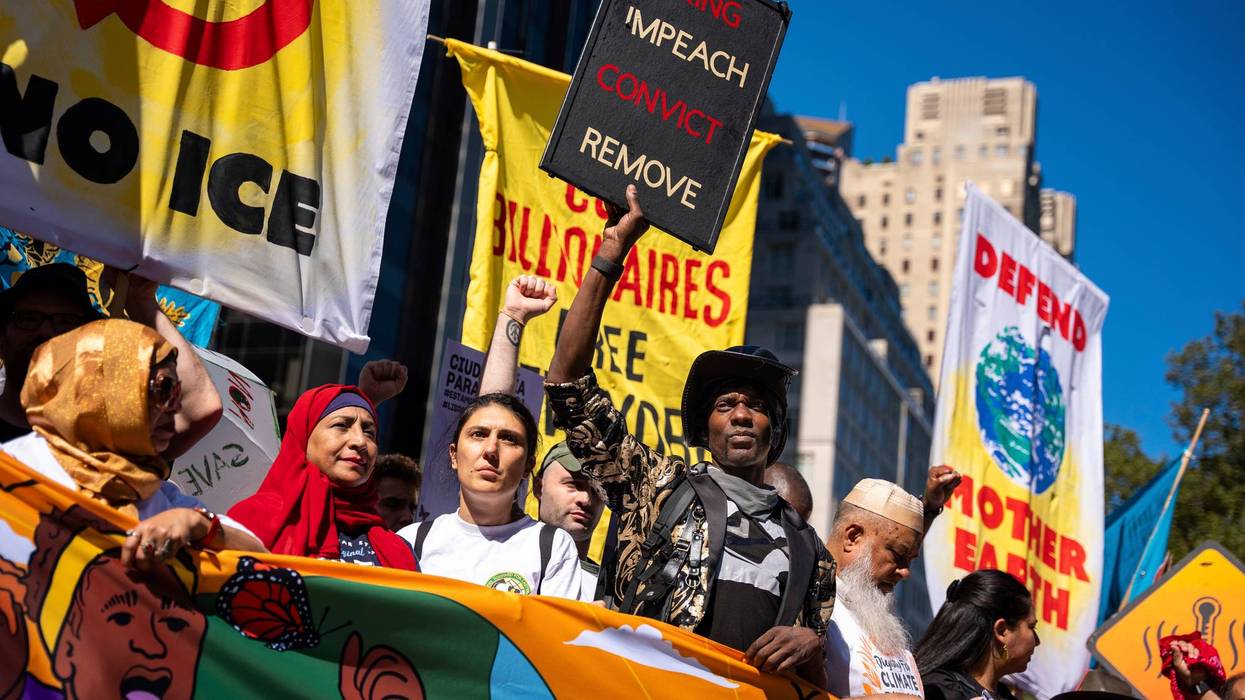
During President Donald Trump’s first term and especially during the Democratic primaries to determine who would run against him in 2020, Democrats spoke constantly about climate change. They used it to rally young voters such as Hughes, fueling protests and sweeping demands to remake the economy with proposals like the Green New Deal.
But there has been a national shift in the conversation that is sharp enough for some researchers to coin the term "climate hushing” to describe it. The Searchlight Institute, a Democratic think tank, urged the party to stop mentioning climate change because it is not a priority for voters. The Sunrise Movement, a left-wing group that pushed global warming as a top issue for young people, switched its mission last fall to a broader mandate of fighting the Republican president.
The shift is encapsulated by the Democratic primary for U.S. Senate in Massachusetts on Tuesday as the incumbent, Ed Markey, 80, tries to fend off a challenge from U.S. Rep. Seth Moulton, 47. Although Markey still talks about sponsoring the Green New Deal, his campaign is more focused on other issues to burnish his left-wing bona fides and prove to voters that he is not too old for the job.
It is the latest example of how climate change has been eclipsed by issues such as affordability, U.S. support for Israel and, above all, how to confront Trump.
“Six years ago, Green New Deal was every phrase out of Ed Markey’s mouth every chance he got. That is not the case now,” said Mary Anne Marsh, a veteran Democratic strategist in Massachusetts. “It’s about who’s best to fight. Period, full stop. Everything falls under that.”
‘People are increasingly freaked out about other issues’
Even if the political discussion on climate change has quieted, the planet has not. Scientists say there is an increasing chance that by the end of the year, 2026 could be the hottest year on record, or at least come close. A strengthening El Nino is forecast to be off the charts, spiking global temperatures.
Some advocates expect the issue to return to center stage if Democrats retake the U.S. House in November and climate-sparked disasters dominate the winter.
U.S. Sen. Sheldon Whitehouse of Rhode Island, a prominent Democratic voice on climate change, said in an interview that ignoring the issue is a major strategic “blunder.”
“Climate change has moved from the science department into the economics department," he said. "It's now battering people’s home insurance, property values, pocketbook concerns. So I think it’s a very powerful argument.”
Trump has falsely claimed climate change is “a hoax," and his party has regularly scoffed at Democratic proposals such as the Green New Deal.
The Sunrise Movement, founded in 2017 to mobilize young voters over climate issues, announced in October that it was shifting to a broader fight against “fascism.” The group’s executive director, Aru Shiney-Ajay, said that was a prescient move because of reports that federal agents infiltrated protest meetings during Trump’s immigration raids in Minneapolis.
“We just live in a significantly more authoritarian country. Because of that, a lot of the Democratic primaries are about more existential questions,” Shiney-Ajay, whose network generally backs left-wing Democrats, said in an interview. “It has felt less like people care less about climate and more like people are increasingly freaked out about other issues.”
About 6 in 10 Democrats say climate change is “a very big problem” for the country, according to a Pew Research Center poll from April. That is roughly the same as in 2016. Still, climate has often taken a back seat to other issues in Democratic voters' priorities, such as inflation, healthcare affordability and the role of money in politics.
Affordability concerns have dominated the political debate this year.
McKenzie Wilson of Blue Rose Research, a Democratic data firm, said voters have called for sweeping changes in response to economic discontent, demonstrating a level of anger not seen in years.
“In that kind of environment it’s hard to think about long-term, existential problems,” Wilson said. “If we don’t talk and focus our attention on the number one thing the electorate wants to talk about, as we saw in 2024, we’re not going to be connecting with the electorate.”
'Don't say climate change'
That view was summed up by the Searchlight Institute, a Democratic think tank that last year released a provocative suggestion: “The First Rule About Solving Climate Change: Don’t Say Climate Change.”
It contended that voters saw it as such an intimidating, complex issue that Democrats were more likely to win by focusing on other subjects — thus enabling them to regain power and tackle the crisis that they were not talking about.
Leah Stokes, a political scientist at the University of California, Santa Barbara and author of “The Carbon Wave,” a book about Democratic President Joe Biden's domestic agenda, said it was “galling” when politicians made the issue less of a priority.
“The climate crisis is accelerating and we can’t really not talk about it for like a decade, because the planet will be even more on fire if we do that,” she said.
Anthony Leiserowitz, director of the Yale Program on Climate Change Communication, agreed with those concerns.
“What happens over the course of the next decade will profoundly shape the habitability of the planet for literally thousands of years to come,” he said.
Some are making climate an affordability issue
Climate has come up as part of the national backlash to data centers, but it is only one part of the conversation about the projects' impact. Many climate advocates are adjusting how they talk about the issue, stressing how green energy can lower prices and ease insurance costs.
“What we’re seeing right now is, whether you’re advocating for healthcare reform or climate action or some niche tech issue, everything is filtered through some cost frame,” said Jared Leopold, a veteran Democratic strategist who has long focused on climate change.
That is how the Green New Deal came up at a recent debate between Markey and Moulton, when a voter asked how each candidate would reduce energy prices. Notably, the questioner asked about increasing nuclear or gas generation, not clean energy, to deal with cost. Markey turned the opportunity into a slam against the president.
“There was a plan in place in order to have a strong, clean affordable energy future for our commonwealth,” Markey said, “and Trump attacked it.”
Tatishe Nteta, a political scientist at the University of Massachusetts Amherst, said that is how Markey has used climate change this election — to signal his willingness to fight Trump as well as his alliance with the left flank of the Democratic Party, which has run up a series of primary wins this year. But other issues have become even more useful in doing that.
“The definition in where you’re at in terms of a progressive candidate and a progressive elected official is your viewpoint on Israel,” Nteta said. “You’re not hearing this in most races, that I’m the candidate who’s going to protect and save our planet.”
Massachusetts’ summer has been the hottest that Eileen Cefail can recall in the 30 years she has worked in the Roofers Local 33 office. “The roofers are tough as nails, and they work so hard, and their work is so grueling,” she said. “This heat has been horrendous for them.”
Cefail is backing Markey in the primary, but climate, she said, was not the main reason.
“He’s always been a union guy,” Cefail said. “He’s just for the labor.”
_____
Riccardi reported from Denver and McDermott from Providence, R.I. Associated Press writer Linley Sanders in Washington contributed to this report.
___
The Associated Press’ climate and environmental coverage receives financial support from multiple private foundations. AP is solely responsible for all content. Find AP’s standards for working with philanthropies, a list of supporters and funded coverage areas at AP.org.