



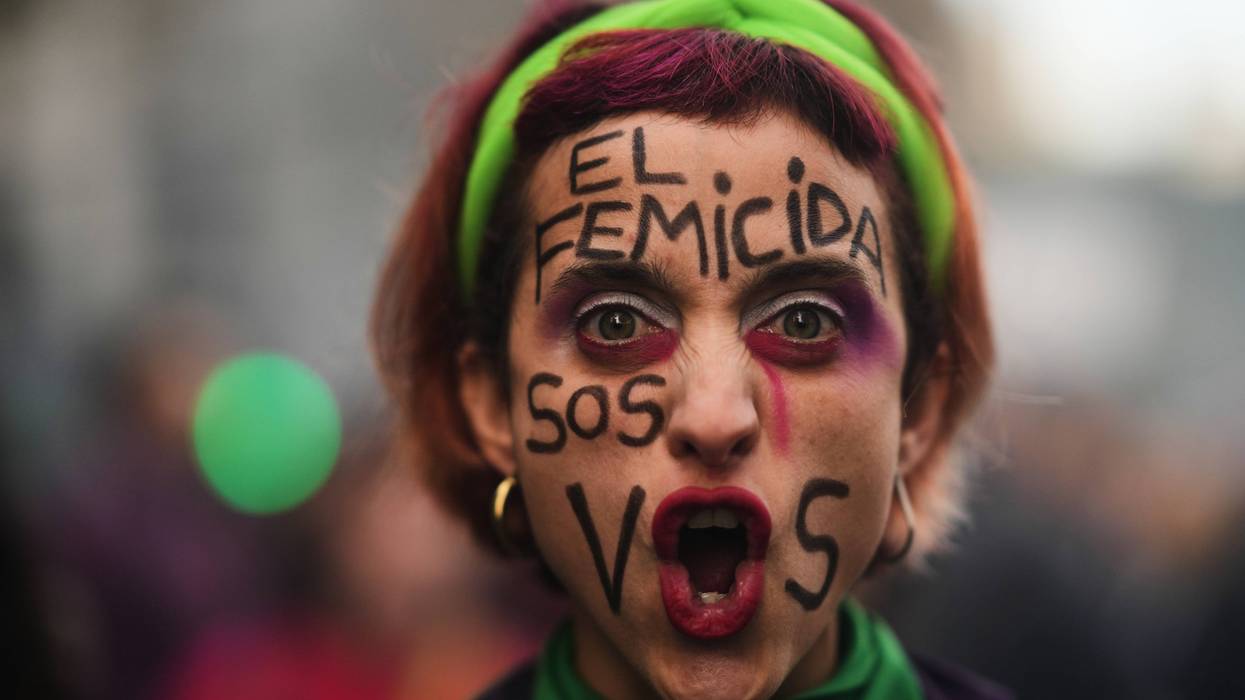

BUENOS AIRES, Argentina (AP) — In May 2015, the grisly killing of a pregnant 14-year-old girl named Chiara Páez by her 16-year-old boyfriend triggered massive protests in Argentina that evolved into a generation-defining movement throughout Latin America under the motto of “ Ni Una Menos," or “Not One Woman Less."
Now, 11 years after the first Ni Una Menos protest created a collective consciousness about what would come to be known as femicide — the killing of women and girls because of their gender — the nation is convulsing with anger once again.
This time, it's over the killing of 14-year-old Agostina Vega, in the central city of Cordoba. She arrived at a family friend's home the night of May 23, expecting to pick up a gift for her mother. Instead, she was sexually assaulted and hanged, initial autopsy results indicate, her body dismembered with a kitchen knife.
Her remains were found in a drainage ditch Saturday, a week after her disappearance, as vigils in her home province erupted into clashes with police.
The outrage has reverberated across the country, and on Wednesday, thousands of protesters gathered for the annual Ni Una Menos demonstration in downtown Buenos Aires. Many held posters printed with the faces and names of women who've been killed or who disappeared in recent years, including Agostina. Her case brought renewed energy and purpose to the protest, amplifying demands for government action and intensifying criticism of President Javier Milei.
The libertarian ally of U.S. President Donald Trump has called the feminist movement “a ridiculous and unnatural fight," promoted scrapping femicide from the penal code, and defunded programs supporting victims of gender violence as part of his cultural war and cost-cutting campaign.
This year, lawyers at the Center for Legal and Social Studies, a leading Argentine human rights group, have counted 63 legally registered femicides. But they and other advocates say it can be an uphill battle against the government to get that classification. Some have compiled a list of more than 100 names of women killed this year, arguing that many aren’t properly labeled.
Reports of femicide in Argentina fell 12%, to 200 cases last year compared with 2024, according to statistics published by the Supreme Court. Victims' lawyers say the change doesn’t reflect a drop in gender-based violence, but instead a failure to properly classify crimes.
“To stop calling femicides by their name, to deny the existence of gender violence — it's an attempt to rewind the past 20 years,” said Natalia Gherardi, director of the Latin American Team for Justice and Gender, a Buenos Aires-based rights group. "I hope this reaction generated by Agostina’s case, what we show in the streets, will be enough to counter the desire to move backward.”
Questions plague the handling of 14-year-old Agostina's case
After Agostina's death, protesters directed anger at local law enforcement, setting tires alight in the streets of Cordoba. Her family filed a missing person’s report the morning after her disappearance, but over 80 hours passed before phones across the province buzzed with a child abduction alert, according to family lawyer Gustavo Vaca.
The day after her death, a taxi driver reported that he'd driven Agostina to the house of the family friend, 33-year-old Claudio Barrelier, which security camera footage confirmed.
Agostina’s family has complained that security forces were consumed by concerns of fan violence during a major soccer game in the city of Cordoba that day. Three days later, police raided the house of Barrelier, an ex-boyfriend of Agostina's mother.
Barrelier is in custody as the main suspect in the case and denies killing Agostina. Investigators say his criminal history shows he had been arrested for abducting a young woman a year ago but was released on bail of $3,500 after 20 days.
When peppered with accusations of foot-dragging, lead prosecutor Raúl Garzón said last week that authorities “are not engaging in any self-criticism.”
Calls grew to characterize Agostina’s killing as a femicide. Security Minister Alejandra Monteoliva has refused to do so.
“A homicide, whatever its nature, is not solely defined by what happens during one hour, two hours, or three hours, where the act itself occurs,” Monteoliva told reporters Monday in her only public comments on the case.
Advocates insist using the term femicide — which carries harsher penalties than other forms of homicide, with a mandatory sentence of life imprisonment in Argentina — is crucial for effective prosecution and victim protection.
“If we don't name the specific form of violence, if we don't recognize it, then we can't understand the problem in all its dimensions, and we can't create policies to prevent and combat it," said Lucila Galkin, director of the gender and diversity program for the Argentina chapter of Amnesty International.
Milei has waged his culture war against policies on gender
Milei has waged a cultural war against gender-based policies — what he sees as a dangerous consequence of socialism.
After Milei railed against the crime of femicide as “legally making a woman’s life worth more than a man’s” at the Davos summit last year, his justice minister announced plans to strip the category from the legal code.
Nothing came of that, but his government now is working to stiffen penalties for women who falsely report cases of gender-based violence. It is awaiting congressional debate.
In the last two and a half years, Milei has dissolved Argentina’s women’s ministry, shut down its anti-discrimination institute, gutted support programs for victims of gender violence, banned the use of gender-inclusive language in official documents, and defunded training in gender issues for public school students and state employees.
Among the affected programs is Acompañar, which assisted 350,000 women with aid equivalent to six months’ minimum wage before it was defunded. A 24-hour hotline to help victims lost two-thirds of its budget and half its staff last year. A government-sponsored program providing free legal assistance to people experiencing domestic violence or sexual abuse has also been dismantled.
With the latest case, an annual protest has gained urgency
On Wednesday, protesters gathered at Plaza Congreso, opposite the seat of the National Congress, as they have every year since Chiara Páez's death in 2015.
Laura Lenaza, 41, said she hadn’t attended a street protest in almost a decade. But the shock of recent cases moved her to bring her 17-year-old daughter, Milena.
“I’m fighting for myself, for my 11-year-old sister, and for all the women I know," the young woman said, squeezing her mother’s hand.
María Cacharo, 54, said she came with her 18-year-old daughter in honor of her sister, killed by her husband several years ago.
“Whenever resources are reduced, somehow we’re the ones who have to bear the cost,” she said of the impact of Milei’s cost-cutting on women, adding that the way police handled Agostina's case makes her sick.
Carrying “Justice for Agostina” signs, her family led a march in Cordoba on Wednesday to push for accountability in her killing under the banner of the movement that once made Argentina a regional beacon for social and legal action on gender equality.
“I think this femicide, which caused so much pain, so much shock, also mobilized us, reminded us that this is a problem concerning all of society,” Galkin said of Agostina's case.
“We are being forced to have conversations about issues we thought we had agreed on, a topic that we thought had been settled."