
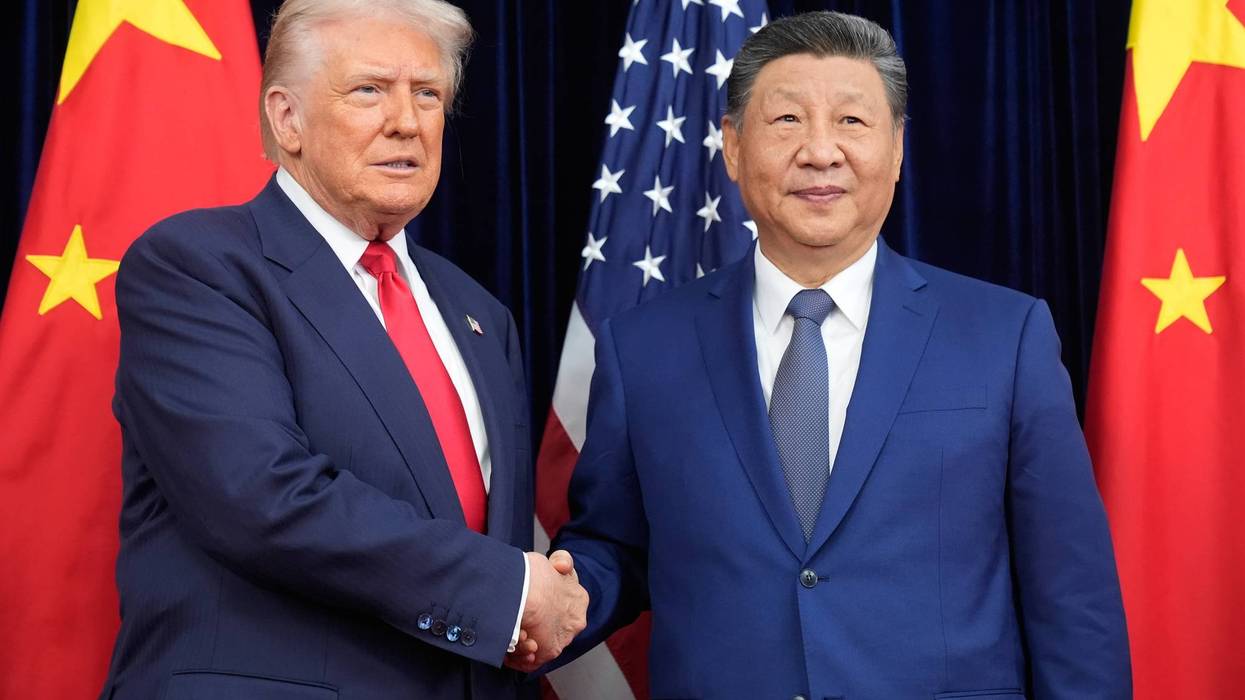

TAIPEI, Taiwan (AP) — Taiwan is likely to be overshadowed as presidents Xi Jinping and Donald Trump are expected to meet on the sidelines of the Asia Pacific Economic Forum this week, even as the threat from China evolves and grows stronger.
Leaders from China, the U.S. and some 21 other economies will gather at the APEC summit this week in Shenzhen, China. Recent events like the scandal that forced Nvidia's CEO to resign, export controls and the ongoing trade dispute have made the tech competition between Beijing and Washington all the more pressing.
Few expect major breakthroughs on Taiwan, a self-ruled island that is claimed by Beijing. While the U.S. does not formally recognize Taiwan, it is the island’s biggest informal ally and seller of arms.
“For the Trump administration, this isn’t a core issue between the U.S. and China,” said Arthur Zhin-Sheng Wang, an expert on cross-Straits relations at Taiwan’s Central Police University.
US-Taiwan ties remain strong behind the scenes
Experts largely say that cooperation with the U.S. remains strong below the level of rhetoric, despite Trump’s public ambivalence toward Taiwan.
One sign of this came from the summer, when the de facto United States embassy in Taiwan posted a photo showing joint patrols between the two coast guards, a rare occurrence, as the U.S. does not usually acknowledge it has direct cooperation with Taiwan in any defense capacity.
“This also is proof of the decades that Taiwan and U.S. have had of cooperation and training. I was also surprised,” said Kuo Yu-jen, a defense studies expert and director of the Institute for National Policy Research in Taiwan.
The U.S. is obligated by law to help Taiwan defend itself, which has manifested in the form of arms sales, while the government officially adopts a stance of ambiguity on whether it would intervene militarily in the case of a Chinese invasion.
The Taiwanese public is used to the continued uncertainties of the island’s relationship with the U.S. Research from the Institute of National Defense and Security Research in Taiwan, a government-funded think tank, showed that public attitudes toward the U.S. remain around the same. Polls conducted in the past five years show that about half of the public believes the U.S. will send soldiers to support Taiwan in the event of a Chinese invasion, and about half don’t.
“I do think they will take some actions, though it may not be sending soldiers,” said Allen Hsieh, a 28-year-old media professional in Taipei. “I think Taiwan’s importance to the U.S. is even more important than Ukraine.”
Stalled arms sales for now
Since starting his second term, Trump called for Taiwan to spend more on its own defense and Taiwan responded that it would commit to 5% of its GDP on defense.
Arms sales are ongoing. While much media attention has focused on a $14 billion package that remains stalled, an earlier package of $11 billion approved at the end of last year is in progress. Some of the stalled arms packages have been delayed since before Trump came into office, experts have also said.
Those include fighter jets. Taiwan received the first two of long-delayed F-16V fighter jets from the U.S. in October, and three more jets earlier this month. The aircraft are a part of a long list of backlogged U.S. orders worth almost $30 billion, according to the Taiwan Security Monitor research project which tracks defense-related developments on the island at George Mason University.
But the delays are not necessarily because of political considerations with China, a concern that was raised when Trump said he discussed arms sales with Xi earlier this year. Instead, it may be more of an issue with manufacturing capacity, particularly for future sales.
Congress approved the sale of long-range precision strike systems to Taiwan in December 2025, but Taiwan faces competition because of limited supplies. Kuo noted that among the missiles approved for sale are the same ones being used by the U.S. military in the ongoing Iran war, such as the HIMARS rockets and supplies were low.
“I don’t think this is a political issue. They just can’t produce so many of these missiles in a short period,” he said.
China expands coast guard role in pressure on Taiwan
Meanwhile, China has intensified its military and nonmilitary pressure on Taiwan. In 2025, the People’s Liberation Army flew about 5,448 fighter jet sorties toward the island during military exercises, according to Skyfaring, an open-source website that compiles public data from Taiwan’s Ministry of Defense. That marked a sharp increase from the years before 2023, when such flights were sporadic.
Beijing also recently held unannounced military drills in the Western Pacific, deploying more than 100 vessels in waters near Taiwan and Japan, Taiwan’s National Security Council chief Joseph Wu said in a Nov. 3 post on X.
The number of PLA flights recorded this year stood at 2,401 as of Nov. 12, below the full-year total for 2025.
“I think the threat is transforming ... for example, more of its exercises are now about blockading and sealing off” Taiwan, Wang said, rather than firing live missiles. He said Beijing was expanding its gray-zone tactics — aggressive actions that fall short of open warfare.
These include greater use of the coast guard to assert China’s claims, mirroring its approach elsewhere. In June, the Chinese coast guard began patrolling off Taiwan’s east coast, which faces the open Pacific, extending its activities beyond Taiwan’s outlying islands closer to China.
Wang compared the approach to Beijing’s tactics in the South China Sea, where Chinese coast guard vessels patrol waters disputed with the Philippines. China has also designated a shoal claimed by the Philippines as a nature reserve under Chinese protection.
“It’s telling the whole world it has sovereignty here.”
———
Wu reported from Bangkok.