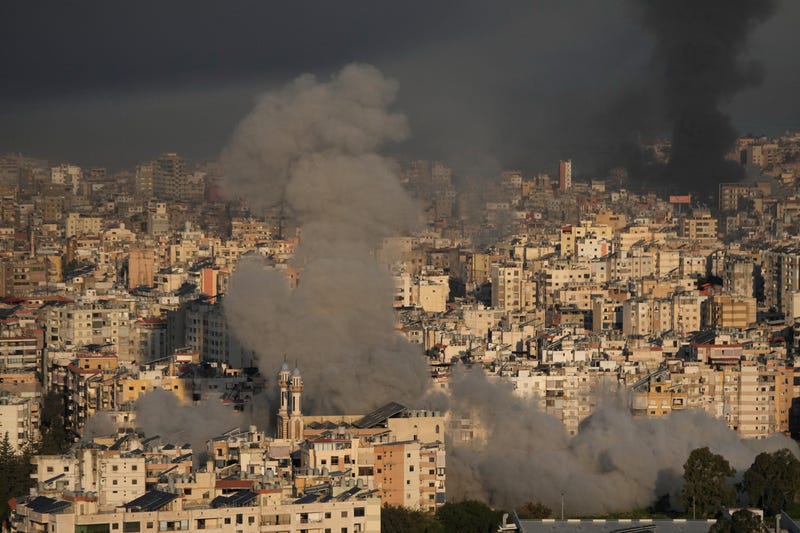
U.S. President Donald Trump said “someone from within” Iran’s government might be best suited to take power once the U.S.-Israeli war on the country ends.
His remarks came four days into a war that has killed hundreds, nearly all of them in Iran, as well as many of the country’s top leaders, including Supreme Leader Ayatollah Ali Khamenei.
Although Tehran has kept up its retaliatory missile and drone strikes against Israel and across the Gulf — disrupting travel and driving up oil prices — the pace of Iranian attacks appears to be slowing. However the conflict has also spread to Lebanon, where Iran-backed Hezbollah fired missiles at Israel, prompting Israeli strikes in Beirut and additional troop deployments to southern Lebanon.
The spiraling nature of the war has raised questions about when and how it would end, and the Trump administration has given various objectives.
Here is the latest:
Health officials say 50 killed, more than 300 wounded in Israeli strikes in Lebanon
The death toll over the past two days in Lebanon has risen to 50, with 335 wounded, Lebanon’s Health Ministry said Tuesday evening.
On Monday, Hezbollah launched missiles toward Israel for the first time in more than a year, and Israel responded by bombarding southern Lebanon and the southern suburbs of Beirut with strikes. No casualties have been reported from the Hezbollah attacks in Israel.
It is not clear how many of those killed in Lebanon were civilians, but the health ministry said earlier Tuesday that they included seven children. Officials with Hezbollah and the Palestinian Islamic Jihad militant group were also killed.
First government evacuation plane from Jordan lands in Prague
The first government evacuation plane landed in Prague late Tuesday. The airbus that belongs to the Czech military has a capacity for some 40 passengers and was flying from Jordan.
Another two government planes are expected to arrive during the night. One of them will fly from Egypt to take home Czech nationals who traveled there by buses from Israel. The other one will transport people from Oman.
“It was perfect. We saw everything we wanted to in Jordan,” said Zdenek Viktorin, who was traveling with his family of four. He said that he didn’t expect the war could start during their stay. “When the politicians say one day that the talks are fine and the other day (the war) begins, that’s hard to comprehend.”
In neighboring Slovakia, the first two evacuation planes sent by the Slovak government to Jordan landed in the Slovak capital Bratislava on Tuesday with 127 people on board. The government plans at least 10 such flights from the Middle East.
US and Israel have ‘superiority’ and control nearly all Iran's airspace, Israeli diplomat says
“I’m sure we will be able to show that superiority in the next few days,” Israeli ambassador Danny Danon told reporters at the United Nations.
He cautioned, however, that while U.S.-Israeli attacks have degraded Iranian capabilities and it’s harder for them to launch missiles, “they put missiles underground, in caves, in secret locations.”
He said Israel has told its own citizens and people in the region, “give us some more time” to further degrade the Iranian military and achieve its objectives: “no nuclear weapons, no missile threat, no terror infrastructure.”
“It will not continue forever,“ Danon said.
UAE says it has been attacked by 1,000 Iranian drones and missiles so far
The United Arab Emirates said Tuesday on X that it retains the right to self-defense, insisting that the Gulf monarchy is not part of the U.S.-Israel war against Iran and that it hasn’t authorized the use of its territories for attacks against Iran.
The UAE Defense Ministry also released a breakdown of its missile and drone interceptions. It said Iranian drones struck within its territory 57 times out of more than 800 detected, while only one of 186 ballistic missiles managed to hit. All eight Iranian cruise missiles were intercepted, the ministry said. It was not possible to independently very those figures.
Venezuelan government supporters hold a solidarity march for Iran
Dozens of Venezuelan government supporters on Tuesday marched in the capital in solidarity with Iran and mourning Supreme Leader Ayatollah Ali Khamenei, who was killed on the first day of the war.
Demonstrators wore T-shirts with the photo of former Venezuelan President Nicolás Maduro, whom the U.S. military captured from the capital Caracas in a stunning operation two months ago.
Two women at the head of the demonstration carried photos of Khamenei and of late Ayatollah Ruhollah Khomeini, who orchestrated Iran’s 1979 Islamic revolution and ruled as supreme leader for a decade.
“We are here to give our support to the Iranian diplomatic representation in Caracas,” Yoser Quijada, an engineer, said. “We are here with our presence telling them that the people of Venezuela, the heart of the Venezuelan people, is together with the heart of the Iranian people.”
Rubio pushes back in a testy exchange at the Capitol
The secretary of state insisted that Trump made the decision to attack Iran because this past weekend presented what he called a unique opportunity for the mission to be successful.
“The president is determined we were not going to get hit first. It’s that simple,” Rubio said ahead of a closed-door briefing for lawmakers.
Secretary of State Marco Rubio speaks to reporters as he arrives for an intelligence briefing with top lawmakers on Iran, at the Capitol in Washington, Monday, Mar. 2, 2026. (AP Photo/J. Scott Applewhite)
Secretary of State Marco Rubio speaks to reporters as he arrives for an intelligence briefing with top lawmakers on Iran, at the Capitol in Washington, Monday, Mar. 2, 2026. (AP Photo/J. Scott Applewhite)
Rubio was revisiting his remarks from a day earlier that have generated fierce blowback. At the time, he said Trump believed Israel was determined to act and wanted the U.S. to go first with a preemptive strike on Iran to prevent any retaliation on American bases and operations in the region.
“We are not going to put American troops in harm’s way,” he said.
Amid the administration’s shifting reasons for the war with Iran, Rubio also returned to Trump’s initial rationale. “There is no way in the world that this terroristic regime was going to get nuclear weapons, not under Donald Trump’s watch,” he said.
Iranian drone hits near US consulate in Dubai
An Iranian drone slammed into a parking lot outside the U.S. consulate in Dubai, sparking a small fire, according to U.S. Secretary of State Marco Rubio.
Although the pace of Iranian missile and drone strikes has slowed, Tuesday’s near-miss shows that Iran is still able to get munitions past American interceptors.
Rubio told reporters at the U.S. Capitol that all of the consulate personnel in Dubai had been accounted for.
“We began drawing down personnel from our diplomatic facilities in advance of this,” Rubio said.
Satellite imagery shows Iran’s presidential complex destroyed
Before-and-after images published by the Colorado-based satellite company Vantor on Tuesday showed the domed roof of Iran’s presidential complex destroyed, aligning with Israel’s earlier claims of an overnight strike.
Numerous munitions were dropped on what Israel’s military said was among the most heavily secured sites in Tehran. Iranian officials and state media have not yet acknowledged the damage or reported casualties from the strike.
UN official says humanitarian fallout in Middle East escalations is ‘increasingly daunting’
In a statement Tuesday, U.N. humanitarian chief Tom Fletcher warned about the impact the ongoing conflict in the Middle East is having on civilians in nearly a dozen countries in the region just days after U.S. and Israel began to attack Iran.
“First, civilians are paying the price across the region. Civilians must be protected - full stop. Yet strikes are hitting homes, hospitals, and schools,” Fletcher said. “Civilians and civilian infrastructure have been under attack in Iran, Lebanon, Syria, the Occupied Palestinian Territory, Israel, the United Arab Emirates, Bahrain, Qatar, Kuwait, Saudi Arabia and beyond.”
Fletcher added that while contingency plans across Iran and other nearby countries have been activated, the already limited presence by international organizations inside the Islamic Republic have made aid workers’ challenges much greater. Beyond the countries now involved in the wider regional conflict, Fletcher said the impacts on the civilians will worsen already dire humanitarian situations in places like Afghanistan and the occupied Palestinian territories.
Trump pitches a plan to protect oil and other trade moving through the Persian Gulf
Trump said on social media he ordered the United States’ development finance arm to provide political risk insurance for tankers carrying oil and other goods through the Persian Gulf “at a very reasonable price.”
Political risk insurance is a type of coverage intended to protect firms against financial losses caused by unstable political conditions, government actions, or violence.
He said that, if necessary, the U.S. Navy would escort oil tankers through the Strait of Hormuz. About a fifth of the world’s oil passes through the strait. The disruption to that traffic caused by the war has pushed oil prices higher.
The Navy has at least eight destroyers and three smaller littoral combat ships in the region. These ships have previously been used to escort merchant shipping in the region and in the Red Sea.
Israel says it destroyed Iran’s reconstituted secret nuclear headquarters
Israel’s military says it destroyed what it calls Iran’s secret nuclear headquarters, and claims Iran moved work into hidden bunkers, known as Minzadehei.
On Tuesday, an Israeli military spokesman said the site supported research tied to a key component for nuclear weapons. Israel does not say Iran enriched uranium there.
There was no immediate public comment from the U.S. or Iran about the site Israel named.
Israel says Iran tried to rebuild and hide parts of its program after last year’s strikes. The United States said as recently as last week that those strikes destroyed Iran’s nuclear program.
U.S. officials also accuse Iran of trying to restart parts of the program but do not say Iran was restarting enrichment.
Turkey’s top diplomat criticizes Iran’s ‘flawed strategy’ of attacking Gulf states
Turkish Foreign Minister Hakan Fidan on Tuesday accused Iran of attacking Gulf neighbors that had worked to prevent war, calling it a strategy of “If I go, I will take the region with me.”
He called Iran’s strikes on countries mediating between Tehran and Washington an “incredibly flawed strategy” and warned the conflict could widen if Gulf states retaliate.
In an interview with state broadcaster TRT, Fidan said Gulf states, including Qatar, had pushed for diplomacy until the last hour before the U.S.-Israeli war began Saturday.
“I believe that if the Iranians had better understood the pressure President Trump was facing and given him something in advance, the pressure from Israel might not have been so effective,” he said.
Fresh attacks target US diplomatic post in northern Iraq
Associated Press journalists heard explosions and saw smoke rising but no casualties were reported after a new wave of drone and missile attacks was intercepted over Irbil, the capital of northern Iraq’s semi-autonomous Kurdish region.
Multiple drones targeted areas around the U.S. consulate building Tuesday but did not hit it directly.
Debris from the intercepted drones caused fires and property damage.
Iran-linked Iraqi militias have claimed multiple attacks on the Kurdish region, which hosts bases with U.S. troops, since the U.S. and Israel launched the war on Iran.
France’s nuclear-powered aircraft carrier heads to the Mediterranean to help protect allied assets
French President Emmanuel Macron on Tuesday said he ordered the aircraft carrier Charles de Gaulle to move from the Baltic Sea to the Mediterranean. He said it will be escorted by its air wing and frigates.
In a pre-recorded speech on French TV, Macron added that Rafale fighter jets, air-defense systems, and airborne radar systems have been deployed over the past few hours in the Middle East.
Israel says it killed the Iranian Revolutionary Guard commander responsible for Lebanon
Daoud Alizadeh, the acting commander of the Lebanon Corps in Iran’s Islamic Revolutionary Guard Corps’ elite Quds Force, was killed on Tuesday in an airstrike in Tehran, the Israeli military said in a statement.
The Quds Force works with Iran’s allied militant groups in the region, including Hezbollah. The army said the Lebanon Corps “supports Hezbollah force-building and functions as the connection between senior IRGC personnel and Hezbollah leadership.” It said Alizadeh replaced the Lebanon Corps’ previous commander, Hassan Mahdavi, killed in an earlier Israeli strike.
UAE’s stock markets to resume trading
The United Arab Emirates’ Capital Markets Authority said Tuesday that the country’s stock markets will reopen Wednesday following a two-day halt.
Authorities in Dubai and Abu Dhabi say that the Dubai Financial Market, Nasdaq Dubai, and Abu Dhabi Securities Exchange were suspended due to Iran’s strikes on the Gulf nation.
UN says apparent strike on girls school in Iran may be a war crime
Iranian state media has reported that at least 165 people were killed and dozens of others were wounded Saturday by what Iran says was an airstrike on a girls school in the country’s south.
The Israeli military said it was not aware of strikes in the area, and the U.S. military said it was looking into the strikes.
Ravina Shamdasani, spokesperson for the Office of the United Nations High Commissioner for Human Rights, said Tuesday that the “devastating” airstrike may amount to war crimes if it is found to have targeted civilians or been carried out indiscriminately in violation of international law.
“Children, little girls, in the middle of the school day, at the beginning of the school day, being killed in this manner, backpacks with blood stains on them,” said Shamdasani.
The U.N. human rights chief called for an investigation into the airstrike.
Children among those killed by Israeli strikes in Lebanon
Seven children have been killed by Israeli strikes in Lebanon over the past two days, Lebanon’s health ministry said Tuesday.
In total, 40 people have been killed in Lebanon — including a Palestinian militant leader and a Hezbollah intelligence official — and 246 wounded in the new escalation between Israel and the Iran-backed militant group Hezbollah.
On Monday, Hezbollah launched missiles toward Israel for the first time in more than a year, and Israel responded by bombarding southern Lebanon and the southern suburbs of Beirut with strikes. No casualties have been reported from the Hezbollah attacks in Israel.
Crews tend to scorched cars and wreckage in the streets of central Israel
Israeli firefighters hosed down charred vehicles after Iranian missiles struck and, in some places, ignited fires on city streets Tuesday.
Missile and drone strikes — as well as the debris from projectiles intercepted by Israel’s Iron Dome — have crashed down in central Israel. They’ve hit residential buildings and street-level property, sending shockwaves booming, damaging shopfronts and reducing some structures to rubble.
Iranian missiles set off air raid sirens and sent Israelis into shelters across the country, although the pace of attacks appeared to be slowing on Tuesday. Israel says it has intercepted most of the incoming strikes, but some missiles have landed, killing 11 people.
No deaths or injuries have been reported so far Tuesday.
Israel will begin reopening airspace for repatriation on Thursday
As governments race to evacuate citizens from the Middle East, Israel is preparing to fly home its citizens who are stranded abroad.
Transportation Minister Miri Regev said Ben-Gurion Airport will reopen for limited incoming flights around the clock starting early Thursday.
Israel’s airspace has been closed since Saturday, when the joint U.S.-Israeli war on Iran began, although some land crossings remain open. Regev said thousands have returned that way.
Under the plan, one passenger flight per hour will be allowed in the first 24 hours, totaling about 5,000 people, with more later depending on security.
It is unclear whether only Israelis will be permitted on the flights, and no commercial departures leaving Israel have been approved.