DAVOS, Switzerland (AP) — President Donald Trump on Wednesday scrapped the tariffs that he threatened to impose on eight European nations to press for U.S. control over Greenland, pulling a dramatic reversal shortly after insisting he wanted to get the island "including right, title and ownership.”
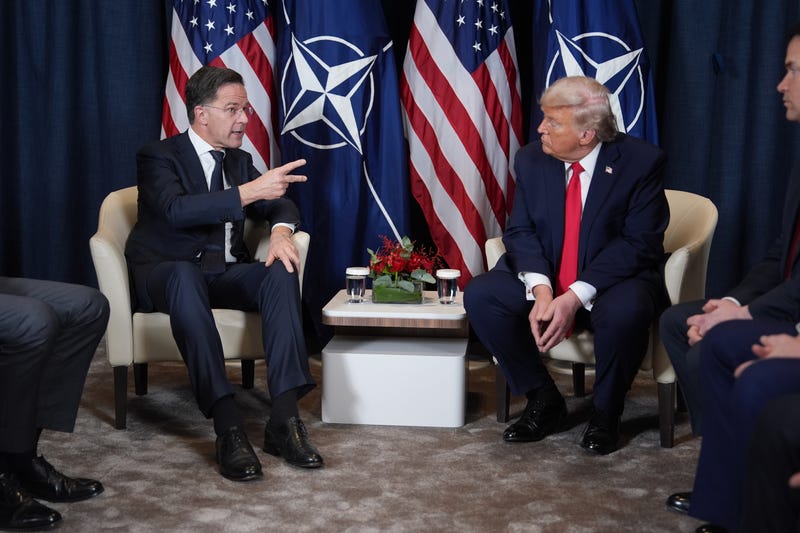
In a post on his social media site, Trump said he had agreed with the head of NATO on a “framework of a future deal” on Arctic security, potentially defusing tension that had far-reaching geopolitical implications.
He said “additional discussions" on Greenland were being held concerning the Golden Dome missile defense program, a multilayered, $175 billion system that for the first time will put U.S. weapons in space.
Trump offered few details, saying they were still being worked out. But one idea NATO members have discussed as part of a compromise with Trump was that Denmark and the alliance would work with the U.S. to build more U.S. military bases on Greenland.
That's according to a European official familiar with the matter but not authorized to comment publicly. The official, who spoke on condition of anonymity, said it was not immediately clear if that idea was included in the framework Trump announced.
Trump has backed off tariffs before
The president has threatened tariffs before only to back away. In April, after first saying he would slap massive import levies on nations from around the world, which prompted a sharp negative market reaction, Trump eased off.
But his change of heart this time came only after he used his speech at the World Economic Forum in the Swiss Alps to focus on Greenland and threatened to upend NATO, an alliance that has been among the globe's most unshakable since the early days of the Cold War.
In his address, Trump said he was asking for territory that was “cold and poorly located" and that the U.S. had effectively saved Europe during World War II while declaring of NATO: “It’s a very small ask compared to what we have given them for many, many decades.”
“We probably won’t get anything unless I decide to use excessive strength and force, where we would be frankly unstoppable. But I won’t do that, OK?” Trump said.
But Trump has also said repeatedly that, while the U.S. will defend NATO, he wasn't convinced the alliance will backup Washington, if needed, and suggested that was at least part of the reason for his aggressive stance toward Greenland. That prompted NATO Secretary General Mark Rutte, in a post-speech event with Trump, to say that the alliance would stand with the U.S. if it is attacked.
“You can be assured, absolutely,” Rutte said. A short time later came Trump's post canceling the tariffs.
Danish Foreign Minister Lars Løkke Rasmussen said he welcomed Trump ruling out taking “Greenland by force” and pausing ”the trade war with Europe.”
"Now, let’s sit down and find out how we can address the American security concerns in the Arctic while respecting the red lines of the Kingdom of Denmark,” he said in a statement.
President cites national security
Trump argues that the U.S. needs Greenland for national security and to counter threats from Russia and China in the Arctic region, despite America already having a large military base there. He threatened to impose steep U.S. import taxes on Denmark and seven other allies unless they negotiate a transfer of the semi-autonomous territory.
The tariffs were to have started at 10% next month and climb to 25% in June.
Trump often tries to increase pressure on the other side when he believes it can lead to a favorable agreement. His threats at Davos appeared on the verge of rupturing NATO, which was founded by leading European nations, the U.S. and Canada to counter the Soviet Union.
The alliance's other members were steadfast in saying Greenland is not for sale and cannot be wrested from Denmark, while angrily rejecting Trump's promised tariffs.
A Danish government official told The Associated Press after Trump's speech that Copenhagen was ready to discuss U.S. security concerns. But the official, who was not authorized to comment publicly and spoke on condition of anonymity, underscored the government’s position that “red lines”— namely Denmark’s sovereignty — must be respected.
It was not immediately clear how Trump's canceling of tariffs might change such calculations.
Greenland tells citizens to prepare
In the meantime, Greenland's government responded by telling its citizens to be prepared. It has published a handbook in English and Greenlandic on what to do in a crisis that urges residents to ensure they have sufficient food, water, fuel and supplies at home to survive for five days.
“We just went to the grocery store and bought the supplies,” said Tony Jakobsen in Greenland’s capital Nuuk said, showing off the contents of bags that included candles, snacks and toilet paper.
Jakobsen said he thought Trump’s rhetoric towards Greenland was “just threats... but it’s better to be ready than not ready.”
Before backing down, Trump had urged Denmark and the rest of NATO to stand aside, adding an ominous warning.
“We want a piece of ice for world protection, and they won’t give it,” Trump said. “You can say yes, and we will be very appreciative. Or you can say no, and we will remember.”
He also called for opening “immediate negotiations” for the U.S. to acquire Greenland. In subsequent comments to reporters, he declined to name a price that might be paid, saying only, “There’s a bigger price, and that’s the price of safety and security and national security and international security.”
His arrival in Davos was delayed after a minor electrical problem on Air Force One forced a return to Washington to switch aircraft. As Trump’s motorcade headed down a narrow road to the speech site, onlookers — including some skiers — lined the route, some making obscene gestures.
Financial markets that had fallen sharply on Trump’s threatened tariffs bounced back Wednesday. Also breathing a sigh of relief were a number of U.S. officials who had also been concerned that Trump’s hard-line stance and bellicose rhetoric toward Greenland, Denmark and other NATO allies could harm other foreign policy goals.
Trump's Davos speech was originally supposed to focus on how to lower U.S. housing prices — part of a larger effort to bring down the cost of living. Greenland instead carried the day, though Trump mistakenly referred to it as Iceland four times during his speech.
“This enormous unsecured island is actually part of North America,” Trump said. “That’s our territory.”
When he finally did mention housing, Trump suggested he did not support a measure to encourage affordability. He said bringing down rising home prices hurts property values and makes homeowners who once felt wealthy because of the equity in their houses feel poorer.
‘Now there’s another threat'
Before Trump announced that he was abandoning the tariffs and potentially easing international pressure, his speech left people in Nuuk preparing for the worst.
Resident Johnny Hedemann said it was “insulting” that Trump “talks about the Greenlandic people and the Greenlandic nation as just an ice cube.” He spoke while heading out to buy a camping stove and instant mashed potatoes.
“Living in this nature, you have to be prepared for almost anything. And now there’s another threat — and that’s Trump,” Hedemann said.
___
Weissert and Madhani reported from Washington. Associated Press writers Emma Burrows in Nuuk, Greenland, Jamey Keaten in Davos and Michelle L. Price in Washington contributed to this report.