LONDON (AP) — Travelers stranded by a widening war began departing the United Arab Emirates aboard a small number of evacuation flights Monday, as governments around the world worked to extract their citizens from the Middle East after the U.S. and Israel bombarded Iran, and Iran and its affiliates struck back at targets throughout the region.
Long-haul carriers Etihad Airways and Emirates, based in Abu Dhabi and Dubai, and budget carrier FlyDubai said they would operate limited flights from the country, where air defense systems were deployed to intercept Iranian missiles and drones. More than 90% of the scheduled flights from Dubai and more than half of those set to depart Abu Dhabi were still canceled Monday, according to flight-tracking site FlightAware.
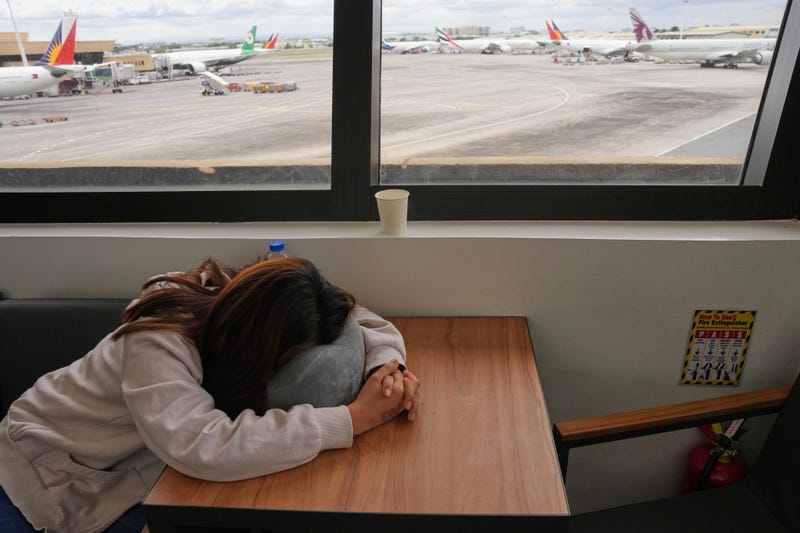
Days of sweeping airspace closures or heavily restricted air traffic at some of the world's busiest aviation hubs unexpectedly marooned tourists, business travelers, migrant workers and religious pilgrims in hotels, airports and on cruise ships once the conflict started Saturday. Global travel relies heavily on Gulf airports, and the conflict's disruptions for airlines and their passengers rippled across multiple continents.
Leela Rao, a 29-year-old law student at Georgetown University in Washington, made it onto one of Monday’s Etihad flights. She said she learned of the airstrikes while waiting to make a connection in Abu Dhabi on Saturday and spent hours at the airport following news updates, hearing explosions and receiving shelter-in-place alerts before the airline arranged a hotel stay in Dubai.
“I am feeling so, so, so grateful,” Rao said via text message after arriving in Delhi in time for a friend’s wedding. “Everyone clapped when we landed.”
The select departures from UAE brought relief to some but did not indicate a return to business as usual. Airspace closures remained in effect for Iran, Iraq and Israel, and Jordan instituted one for the afternoon through overnight starting Monday. Total or partial closures in Qatar, Bahrain, Kuwait, Saudi Arabia and Syria were set to expire Monday but could be expanded, according to flight-tracking service Flightradar24.
Even when the restrictions are lifted, commercial flights may not immediately resume, experts said. Airlines that operate evacuation flights are doing so with government backing, and the carriers’ home countries may be assuming part of the financial risk, said Henry Harteveldt, president of travel market research firm Atmosphere Research Group.
“If the countries reopen their airspace, that certainly is helpful," Harteveldt said. “But airlines aren’t going to resume operations until they are fully confident that there is a zero — or as close as possible to zero — risk that their aircraft will be attacked."
At least 11,000 flights into, out of and within the Middle East have been canceled since Saturday, impacting more than 1 million passengers, according to an analysis by aviation analytics firm Cirium. It said the major airlines operating in the region, including Emirates, Etihad, Qatar Aiways and Saudia, along with all of the carriers in the three main airline alliances, fly around 1,500 flights a day to the Middle East, totaling nearly 389,000 seats.
The Gulf’s shimmering and globalized cities depend on a steady flow of flights carrying foreigners – both tourists and resident workers – and cargo to keep their economies humming. Dubai International Airport handled a record 95.2 million passengers last year, cementing its status as the world’s busiest airport when measured by international travel. It’s second only to Hartsfield-Jackson Atlanta International Airport overall.
Abu Dhabi's Zayed International Airport and Hamad International Airport in Doha, Qatar, also are key hubs for travel between Europe, Africa and Asia. All three airports were all directly affected by Iranian strikes over the weekend. Along with people planning to head to or from the region, travelers who were passing through on multileg journeys also found themselves stuck.
Canadian traveler Raymond Grewal and his wife were returning from a honeymoon in the Maldives when the U.S.-Israeli strikes in Iran trapped them in Dubai on their way back to Vancouver.
“You don’t really have time to process it,” Grewal said. “In the moment, it’s scary. But you’re just trying to figure out the best thing to do, take shelter when they say to, monitor the news, try to get information.”
Dubai’s government urged passengers Monday to go to airports only if contacted directly, warning that operations remained limited.
At least 16 Etihad flights left Abu Dhabi during a three-hour window Monday, according to Flightradar24, heading to destinations including Islamabad, Paris, Amsterdam, Mumbai, Moscow and London. The airline’s website, however, said all its regularly scheduled commercial flights remained suspended until Wednesday afternoon.
Emirates said customers with earlier bookings would get priority for seats aboard the limited flights it planned to operate starting Monday evening. FlyDubai said it would operate four flights departing the city and another five arriving planes on Monday, adding that schedules could quickly change as the situation evolved.
The Association of Tennis Professionals said former U.S. Open tennis champion Daniil Medvedev was among “a small number of players and team members” it was trying to help leave Dubai. Governments urged stranded citizens to shelter in place as they scrambled to organize evacuations and alternative routes.
Israel’s flag carrier, El Al, said it was preparing a “recovery operation” to get stranded passengers to their destinations once Ben Gurion Airport near Tel Aviv reopens. The airline said customers with flights booked on El Al and its subsidiary, Sundor, would not be charged for seats on recovery flights, which would initially operate from New York, London, Paris, Rome, Los Angeles and more.
The Philippines upgraded its travel advisory on Monday for the United Arab Emirates, placing it — along with Bahrain, Kuwait, Qatar and Saudi Arabia — at a level that automatically triggers a deployment ban on newly hired Filipino workers, the country's foreign affairs department said.
Indonesia said more than 58,000 of its citizens were stranded in Saudi Arabia, where they were visiting Islam's holy sites in Mecca and Medina during Ramadan.
“It has become an urgent humanitarian and logistical issue,” said Ichsan Marsha, spokesperson for Indonesia’s Ministry of Hajj and Umrah, which was coordinating with Saudi authorities, airlines and Indonesian travel operators to arrange alternative routes or rescheduled flights. Thousands of travelers also were stranded on Indonesia’s tourist island of Bali because of international flight cancellations.
Germany's Foreign Ministry said about 30,000 German tourists were stranded on cruise ships, in hotels or at closed airports in the Middle East. The government said it plans to send aircraft to Oman and Saudi Arabia to evacuate ill travelers, children and pregnant people, while working with airlines to assist others.
The Czech Republic said it was sending several planes to Egypt, Jordan and Oman to bring home citizens from Israel and surrounding countries.
With more than 102,000 Britons having registered their presence in the region, the U.K. government was exploring various options, including a possible evacuation, Foreign Secretary Yvette Cooper told Sky News.
___
Schreck reported from Bangkok and Yamat reported from Las Vegas. Contributing to this report were AP writers Kirsten Grieshaber in Berlin; Karel Janicek in Prague; Sam Magdy in Cairo; Mustakim Hasnath in London; Niniek Karmini in Jakarta; Matt Sedensky in New York; Sam Metz in Ramallah, West Bank; and Josh Funk in Omaha, Nebraska.