


This past offseason when we ranked the nine greatest players in the history of the Montreal Expos/Washington Nationals franchise, Bryce Harper checked in at No. 9, but he did so with a couple caveats.
The first was that if the Nationals had re-signed Harper after the 2018 season -- rather than allowing him to leave to sign with the division-rival Philadelphia Phillies -- he may have ended up at No. 1 by the end of his career.
Disclaimer No. 2 was that as Juan Soto continued to accumulate production for the Nationals, there was a very real chance he would surpass Harper on the list.
Little did we know that the Nationals -- less than a month after he reportedly declined a 15-year/$440 million contract offer -- would trade Soto to the San Diego Padres ahead of the 2022 MLB trade deadline.
So now, that both Harper and Soto's tenures in D.C. are over, who will be remembered as the better National? We took a deep dive into that discussion.
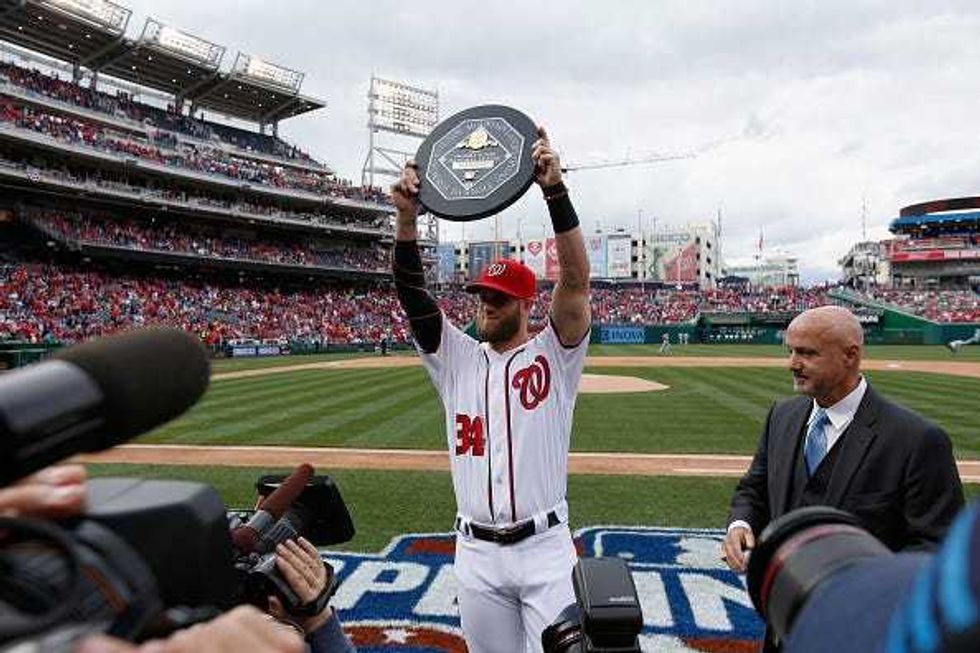 Bryce Harper won the 2015 NL MVP with the Nationals.(Rob Carr/Getty Images)
Who Had the Best Individual Season as a National?
Harper's finest individual season as a National came in 2015, when he became the first player in franchise history to win the National League MVP. Soto's best full year with the Nationals was in 2021, when he finished runner up in NL MVP voting, with Harper capturing the award for the second time.
These are how the two compared statistically during their best seasons rocking the curly W on their hat.
Harper in 2015: .330/.460/.649 with 42 home runs, 99 RBIs, 124 walks, 1.109 OPS, 198 OPS+, four defensive runs saved and a 9.3 fWAR
Soto in 2021: .313/.465/.534 with 29 home runs, 95 RBIs, 145 walks, .999 OPS, 177 OPS+, four defensive runs saved and a 7.0 fWAR
Verdict: While Soto gets credit for putting together staggering production without much in the way of support around him in 2021, Harper's 2015 season was one of the best offensive campaigns of the last 25 years. He wins this round.
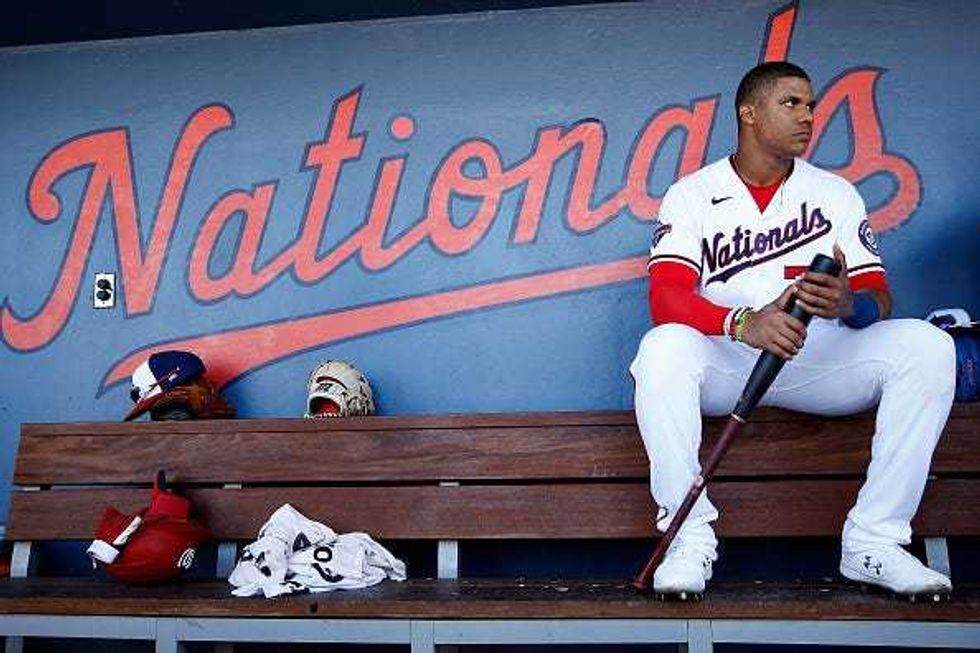 Juan Soto had his 2020 season cut short by the COVID-19 pandemic.(Michael Reaves/Getty Images)
Both Had Potential MVP Seasons Cut Short
Soto will, of course, not play a full season with the Nationals in 2022, but his 2020 season really sticks out when you talk about what could have been during his time with the franchise.
During the pandemic-shortened 2020 season, Soto missed the beginning of the season as he battled COVID-19. He would ultimately play in just 47 of the 60 games that season, and still managed to finish fifth in NL MVP voting.
Soto led the senior circuit with a .351 batting average in 2020, while leading all of baseball with a .490 on-base percentage, .695 slugging percentage, 1.185 OPS and 217 OPS+. If Soto had gotten the chance to play a full season in 2020, there's a very real chance he would have captured his first MVP and had a season that comes close to what Harper did five years earlier.
Meanwhile, Harper wasn't the first or last victim of a wet first base bag at Nationals Park when he hyperextended his left knee and suffered "a significant bone bruise on the inner portion" of that same knee in August of 2017.
The injury didn't prevent Harper from returning that season, but it did cost him six weeks and potentially a second NL MVP in three seasons. Prior to the injury, Harper was one of the favorites to win the award. He finished 2017 having slashed .319/.413/.595 with 29 home runs, 87 RBIs and a 4.3 fWAR in 111 games.
It may have been hard for anyone other than Giancarlo Stanton -- who homered 59 times in his final season with the Miami Marlins -- to win the 2017 NL MVP, but if Harper had played for a full season, he certainly would have had a strong case.
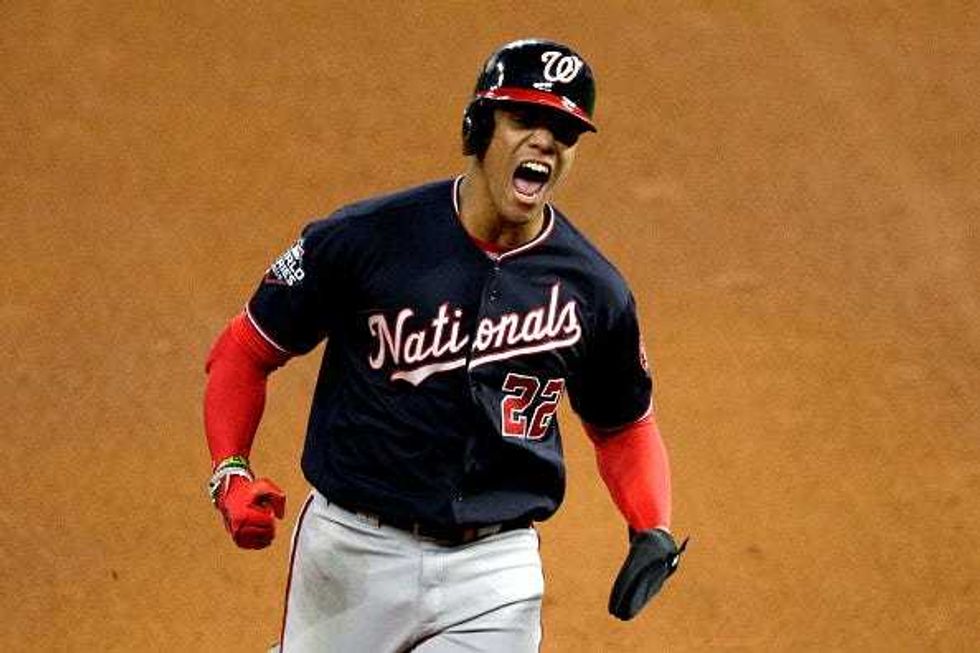 Juan Soto and the Nationals won the 2019 World Series.(Bob Levey/Getty Images)
Postseason Success
Harper was part of four Nationals teams that reached the playoffs, but infamously none of them advanced beyond the NLDS. Harper hit just .211 in 76 postseason at-bats with the Nationals, though he did homer five times and drive in 10 runs.
Soto, on the other hand, reached the postseason just one time as a National, but helped to deliver the franchise's first World Series title in his lone trip to the playoffs. During the 2019 postseason, Soto hit .277 with five home runs, 14 RBIs and a .927 OPS in 17 games.
Verdict: Sometimes in sports it's just about being in the right place at the right time. A year after Harper departed Washington, the Nationals finally got over the hump. Was that an example of addition by subtraction? Almost certainly not. But Soto gets the edge here.
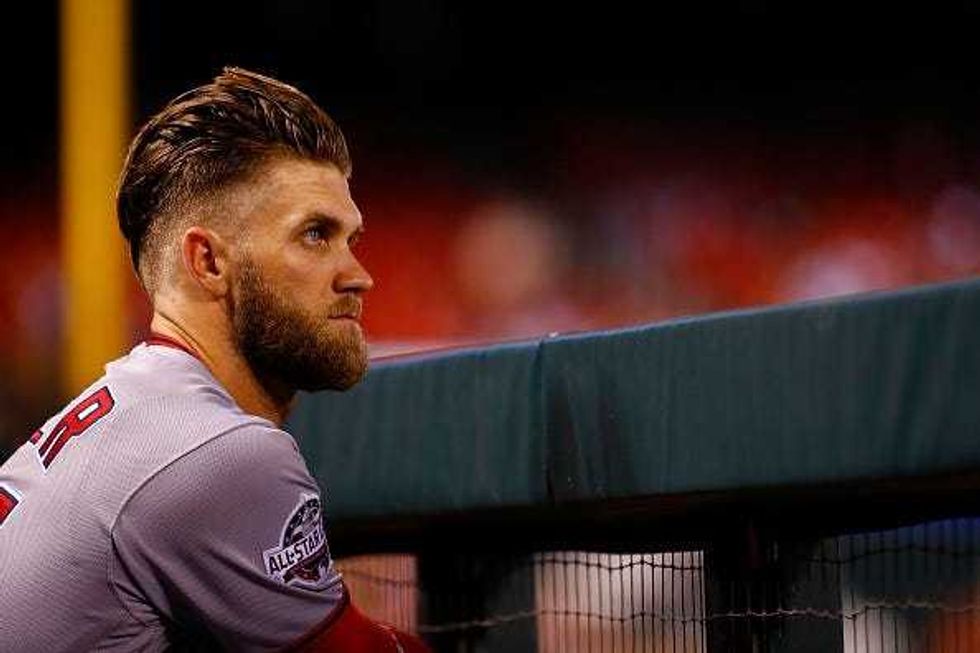 Bryce Harper didn't receive a competitive contract offer from the Nationals.(Dilip Vishwanat/Getty Images)
Neither Received a Serious Offer From The Nationals Before Leaving
While the Nationals did offer both Harper and Soto large contracts before moving on, it's hard to say that they put their best foot forward in trying to retain two stars that are likely going to be in the Hall of Fame one day.
Harper was offered a 10-year/$300 million deal from the Nationals before becoming a free agent, but Barry Svrluga of The Washington Post would later report that the deal included deferrals of up to $100 million that would have paid Harper until he was 60 years old.
He would ultimately end up signing a 13-year/$330 million deal with the Phillies, which included no deferred money and a full no-trade clause. From that sense, it's hard to say that the Nationals made a competitive offer to retain Harper.
In Soto's case, he declined a 15-year/$440 million deal from the Nationals just a couple weeks before the trade deadline, per Ken Rosenthal of The Athletic. But when you looked past the big number attached to the deal, Soto would have had an average annual value of less than $30 million, and Audacy MLB Insider Jon Heyman would go on to report that the deal included "heavy backloading."
Harper is booed mercilessly every time he returns to D.C., even though by all accounts he was interested in re-signing if the Nationals had made a competitive offer. The guess here is that Soto won't receive the same type of treatment when he comes back as a visitor.
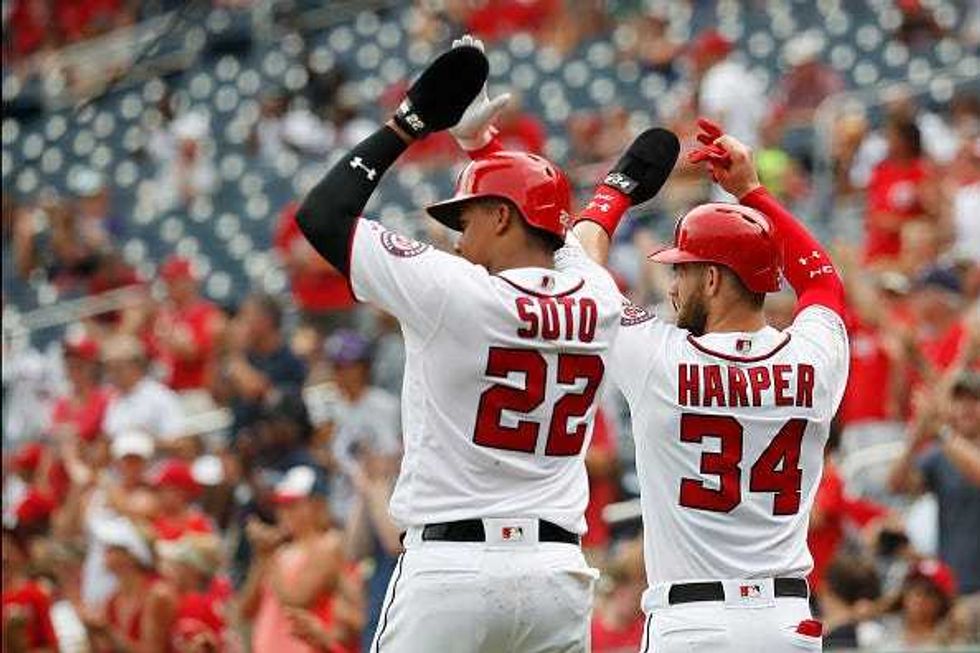 Juan Soto and Bryce Harper were teammates in 2018.(Patrick McDermott/Getty Images)
Whose Total Numbers With The Nationals Are Better?
These are the final numbers that Harper and Soto put up during their stints with the Nationals.
Harper (927 games): .279/.388/.512 with 184 home runs, 521 RBIs, 585 walks, .900 OPS, 139 OPS+, five defensive runs saved and 29.4 fWAR
Soto (565 games): .291/.427/.538 with 119 home runs, 358 RBIs, 464 walks, .966 OPS, 160 OPS+, -9 defensive runs saved and 21.4 fWAR
Verdict: Soto was clearly on pace to be an even better National than Harper was, but doesn't have him beat in counting statistics because he played quite a bit less time with the franchise. It will be hard not to wonder what a lineup with Harper and Soto both at their peaks could have looked like. Instead, there's a very real possibility that both of them will go into the Hall of Fame with a cap that doesn't feature the curly W.
LISTEN on the Audacy App
Sign Up and Follow Audacy Sports
Facebook | Twitter | Instagram