JACKSON, Miss. (AP) — A suspect in an arson fire at a synagogue that was bombed by the Ku Klux Klan decades ago admitted to targeting the historic institution because it’s a Jewish house of worship and confessed what he had done to his father, who turned him in to authorities after observing burn marks on his son’s ankles, hands and face, the FBI said Monday.
Stephen Pittman was charged with maliciously damaging or destroying a building by means of fire or an explosive. The 19-year-old suspect confessed to lighting a fire inside the building, which he referred to as “the synagogue of Satan,” according to an FBI affidavit filed in U.S. District Court in Mississippi on Monday.
At a first appearance hearing Monday in federal court, a public defender was appointed for Pittman, who attended via video conference call from a hospital bed. Both of his hands were visibly bandaged. He told the judge that he was a high school graduate and had three semesters of college.
Prosecutors said he could face five to 20 years in prison if convicted. When the judge read him his rights, Pittman said, “Jesus Christ is Lord.”
A crime captured on video
The fire ripped through the Beth Israel Congregation in Jackson shortly after 3 a.m. on Saturday. No congregants or firefighters were injured. Security camera video released Monday by the synagogue showed a masked and hooded man using a gas can to pour liquid on the floor and a couch in the building’s lobby.
The weekend fire badly damaged the 165-year-old synagogue’s library and administrative offices. Five Torahs — the sacred scrolls with the text of the first five books of the Hebrew Bible — located inside the sanctuary were being assessed for smoke damage. Two Torahs inside the library, where the most severe damage was done, were destroyed. One Torah that survived the Holocaust was behind glass and was not damaged in the fire, according to the congregation.
The suspect’s father contacted the FBI and said his son had confessed to setting the building on fire. Pittman had texted his father a photo of the rear of the synagogue before the fire, with the message, “There's a furnace in the back.” His father had pleaded with his son to return home, but “Pittman replied back by saying he was due for a homerun and ‘I did my research,’” the affidavit said.
During an interview with investigators, Pittman said he had stopped at a gas station on his way to the synagogue to purchase the gas used in the fire. He also took the license plate off his vehicle at the gas station. He used an ax to break out a window of the synagogue, poured gas inside and used a torch lighter to start the fire, the FBI affidavit said.
The FBI later recovered a burned cellphone believed to be Pittman’s and took possession of a hand torch that a congregant had found.
A congregation determined to rebuild
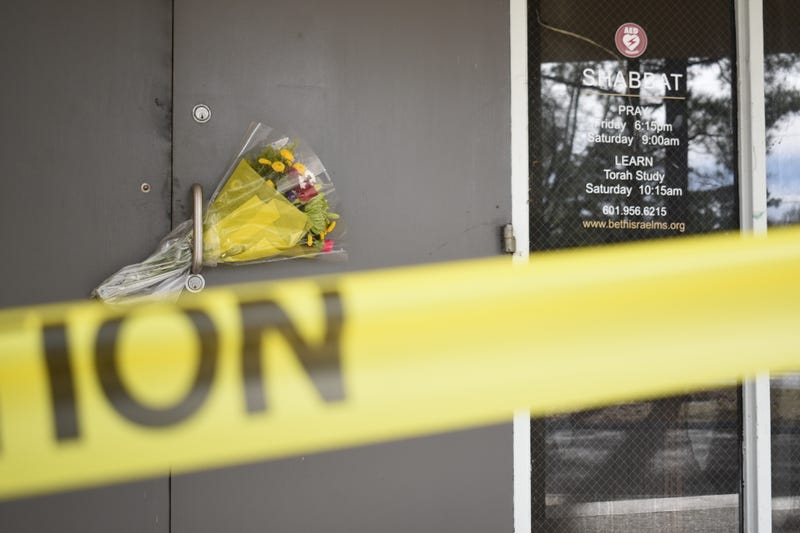
Yellow police tape on Monday blocked off the entrances to the synagogue building, which was surrounded by broken glass and soot. Bouquets of flowers were laid on the ground at the building's entrance — including one with a note that said, “I'm so very sorry.”
The congregation's president, Zach Shemper, has vowed to rebuild the synagogue and said several churches had offered their spaces for worship during the rebuilding process. Shemper attended Pittman's court appearance Monday but didn't comment afterward.
With just several hundred people in the community, it has never been particularly easy being Jewish in Mississippi’s capital city, but members of Beth Israel have taken special pride in keeping their traditions alive in the heart of the Deep South.
Nearly every aspect of Jewish life in Jackson could be found under Beth Israel's roof. The midcentury modern building not only housed the congregation but also the Jewish Federation, a nonprofit provider of social services and philanthropy that is the hub of Jewish society in most U.S. cities. The building also is home to the Institute of Southern Jewish Life, which provides resources to Jewish communities in 13 southern states. A Holocaust memorial was outdoors behind the synagogue building.
Because Jewish children throughout the South have attended summer camp for decades in Utica, Mississippi, about 30 miles (48 kilometers) southwest of Jackson, many retain a fond connection to the state and its Jewish community.
“Jackson is the capital city, and that synagogue is the capital synagogue in Mississippi,” said Rabbi Gary Zola, a historian of American Jewry who taught at Hebrew Union College in Cincinnati. “I would call it the flagship, though when we talk about places like New York and Los Angeles, it probably seems like Hicksville.”
A rabbi who stood up to the KKK
Beth Israel as a congregation was founded in 1860 and acquired its first property, where it built Mississippi's first synagogue, after the Civil War. In 1967, the synagogue moved to its current location.
It was bombed by local KKK members not long after relocating, and then two months after that, the home of the synagogue's leader, Rabbi Perry Nussbaum, was bombed because of his outspoken opposition to segregation and racism.
At a time when opposition to racial segregation could be dangerous in the Deep South, many Beth Israel congregants hoped the rabbi would just stay quiet, but Nussbaum was unshakable in believing he was doing the right thing by supporting civil rights, Zola said.
“He had this strong, strong sense of justice,” Zola said.
___
Martin contributed to this report from Atlanta. Schneider reported from Orlando, Florida. Follow him on the social platform Bluesky: @mikeysid.bsky.social