


FORT LAUDERDALE, Fla. (AP) — Hurricane Milton quickly intensified Sunday and is on track to become a major hurricane with the Tampa Bay area in its sights, putting Florida on edge and triggering evacuation orders along a coast still reeling from Helene’s devastation.
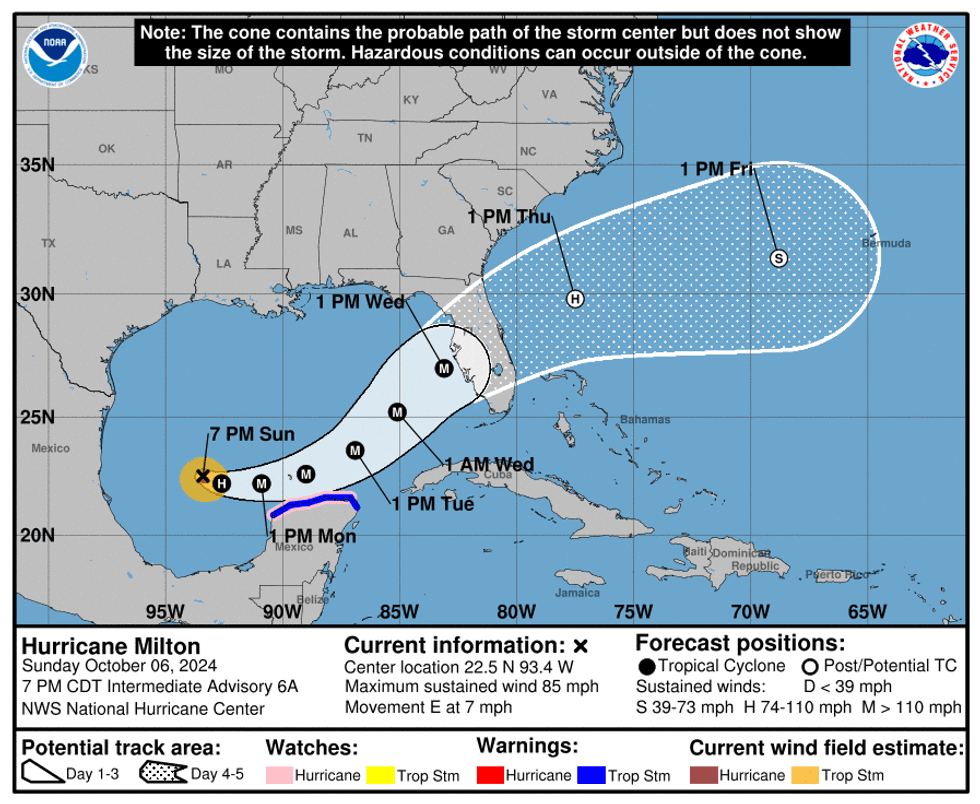
While forecast models vary, the most likely path suggests Milton could make landfall Wednesday in the Tampa Bay area and remain a hurricane as it moves across central Florida into the Atlantic Ocean, forecasters said. That would largely spare other southeastern states ravaged by Hurricane Helene, which caused catastrophic damage from Florida into the Appalachian Mountains and a death toll that rose Sunday to at least 230 people.
Florida Gov. Ron DeSantis said Sunday that it's clear that Florida is going to be hit hard by Milton — “I don't think there's any scenario where we don't have major impacts at this point.”
Hurricane Milton was centered about 780 miles west-southwest of Tampa on Sunday afternoon, with maximum sustained winds of 85 mph, the National Hurricane Center said.
 NHC
NHC
“You have time to prepare — all day today, all day Monday, probably all day Tuesday to be sure your hurricane preparedness plan is in place,” the governor said. “If you’re on that west coast of Florida, barrier islands, just assume you’ll be asked to leave.”
In Pinellas County, officials issued voluntary evacuation orders for people along the barrier island beaches and mobile home parks. Mandatory evacuations are likely to follow.
With Milton achieving hurricane status, this is the first time the Atlantic has had three simultaneous hurricanes after September, said Colorado State University hurricane scientist Phil Klotzbach. There have been four simultaneous hurricanes in August and September.
The St. Petersburg-Tampa Bay area is still cleaning up extensive damage from Helene. Twelve people perished as storm surge swamped the coast, with the worst damage along the narrow, 20-mile string of barrier islands that stretch from St. Petersburg to Clearwater.
DeSantis expanded his state of emergency declaration Sunday to 51 of the state's 67 counties — home to more than 90% of the state’s nearly 23 million residents. The state’s Panhandle, which continues to recover from other recent storms, is expected to be mostly spared.
Floridians should prepare for more power outages and disruption, making sure they have a week's worth of food and water and are ready to hit the road, DeSantis said. The Federal Emergency Management Agency, meanwhile, coordinated with the governor and briefed President Joe Biden Sunday on how it has staged lifesaving resources.
“We are preparing ... for the largest evacuation that we have seen, most likely since 2017, Hurricane Irma," said Kevin Guthrie, executive director of the Florida Division of Emergency Management.
The state has prepared emergency fuel sources and electric vehicle charging stations along evacuation routes, and “identified every possible location that can possibly house someone along those routes,” Guthrie said. People who live in homes built after Florida strengthened its codes in 2004, who don't depend on constant electricity and who aren't in evacuation zones, should probably avoid the roads, he said.
As many as 4,000 National Guard troops are helping state crews to remove the tons of debris left behind by Helene, DeSantis said, and he directed that Florida crews dispatched to North Carolina in Helene's aftermath return to the state to prepare for Milton. The Florida Department of Emergency Management is establishing a base camp at Tropicana Field in St. Petersburg, where the Tampa Bay Rays play baseball, to support the operations to remove debris ahead of Milton's arrival, the governor said.
“All available state assets ... are being marshaled to help remove debris,” DeSantis said. “We're going 24-7."
FEMA Administrator Deanne Criswell said the agency is already preparing for Milton.
“We’re working with the state there to understand what their requirements are going to be, so we can have those in place before it makes landfall,” she said.
The hurricane center said Mexico’s Yucatan Peninsula, the Florida Peninsula, the Florida Keys and the northwestern Bahamas should monitor Milton’s progress. Heavy rainfall was expected Sunday ahead of the storm itself and will likely then combine with Milton's rainfall to flood waterways and streets in Florida, where forecasters said up to a foot of rain could fall in places through Wednesday night.
Meanwhile in the open Atlantic, Hurricane Kirk diminished to a Category 2 hurricane on Sunday, with top winds of 105 mph, sending large swells and “life-threatening surf and rip current conditions” to Bermuda and northward along the U.S. and Canadian coasts, the center said. Hurricane Leslie was also moving over the Atlantic Ocean, well away from land, with top winds of 85 mph.