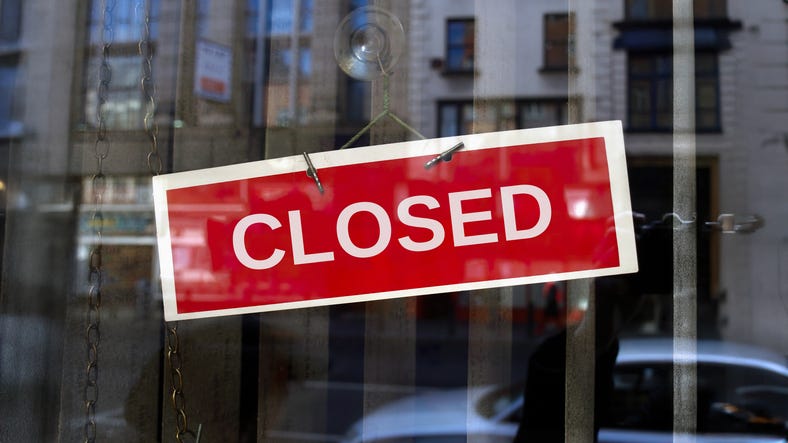

Online holiday sales broke records, which is both good for the economy, and functions as a double-edged sword ...because brick and mortar retailers are struggling as much as ever.
Macy’s announced last week that it was shutting down 14 “underproductive” stores, while Saks Global group filed for bankruptcy on Tuesday. GameStop is closing 500 stores; mall staples Francesca's and Torrid are shuttering hundreds of stores.
And that's just the tip of the iceberg because new data from Coresight Research shows 8,000 chain retail stores shuttered, including Rite Aid, Joann and Party City.
Neil Saunders, a retail expert, told Daily Mail he doesn't see this trend slowing down in 2026.
"Against the backdrop of rising costs, a lot of retailers are looking to become more efficient," Saunders told Daily Mail. "Part of this involves closing underperforming stores that are not producing sales growth or contributing to profits."
Deloitte did a forecast of what to expect from retail in 2026, and wrote this, "2026 could prove to be a watershed moment, forcing retailers to flex their “adaptability” muscles in new and challenging ways. The industry faces significant shifts in commerce, customer engagement, and operational discipline, with artificial intelligence at the core of these disruptions."
The forecast included a renewed focus on value, a drive to improve margins, and AI-driven pricing.
"Heading into 2026, there is great uncertainty, which could negatively influence business investment," Deloitte's chief economist Ira Kalish wrote. "Some companies have already postponed supply chain investments. The disruption of economic relations between countries also means uncertainty about the direction of currency values and borrowing costs. Overall, a modest slowdown in global economic growth is likely in 2026."
A Kiplinger forecast found much the same. "Consumer spending growth is likely to be weaker going into next year because there are too many economic headwinds," David Payne wrote in his forecast. "Consumer sentiment measures appear to be softening again. The hiring slowdown in the labor market is creating job anxiety, even among those who are employed. Households tend to cut spending and add to savings when the possibility of losing a job looms.
"If the unemployment rate or initial claims for unemployment rise, that fear will intensify. Also, price increases caused by tariffs are starting to show up among home furnishings and other imported goods in the Consumer Price Index."