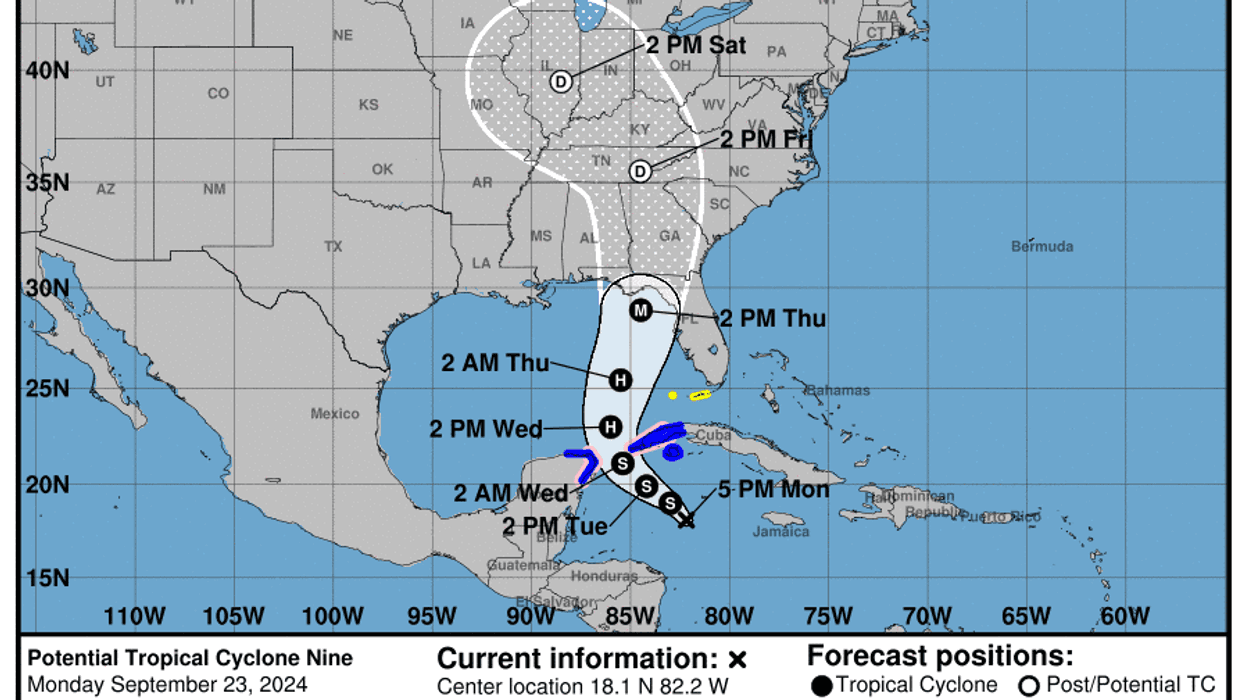

An evolving storm in the western Caribbean is expected to intensify into a hurricane before moving north and making landfall along the United States Gulf Coast on Thursday into Friday, AccuWeather expert meteorologists are forecasting.
A Tropical Storm Watch has been issued for the Dry Tortugas and the Lower Florida Keys south of the Seven Mile Bridge.
“Everyone along the Florida Panhandle and Big Bend region needs to be prepared for hurricane impacts,” said AccuWeather Lead Hurricane Expert Alex DaSilva, adding that the setup has the potential to become the strongest hurricane landfall in the U.S. so far this season.
"The region we are closely watching is more commonly a threat to tropical development in the late-spring or mid- to late-autumn seasons," said DaSilva. "There's even evidence of the Central America gyre now, which is also more common in the spring and later in the autumn."
The gyre is a circulation of air that is not only rotating, but also rising. When air rises in the atmosphere, it creates low pressure and moisture, which in turn generates clouds, showers and thunderstorms. In the right environment, and with continued rotation and organization, a tropical system can form, which is what AccuWeather is expecting this week.
Where will the storm go, and how strong will it get?
Once the storm tracks inland, two possible scenarios could arise. One such scenario could involve a track farther inland across the Southeast states, while another could result in the storm advancing eastward along the Atlantic Southeast coast.
Residents along the Gulf Coast from New Orleans to Key West, Florida, including the Tampa Bay metropolitan area, should closely monitor the progress of the potential storm.
This developing tropical threat is currently forecast to impact similar areas to those that were hit hard by Hurricane Idalia in August 2023. The next tropical storm name on the list for the 2024 Atlantic hurricane season is Helene.
“There are a lot of tall pine trees in Florida’s Big Bend and Nature Coast area. Those trees can be incredibly dangerous in hurricane-force winds. We saw a lot of trees fall onto houses and damage parked cars when Idalia hit the Big Bend region last August,” DaSilva warned.
Regardless of the exact track, because of the warm waters, there is the potential that this storm could further strengthen into a major hurricane, which is a Category 3 on the Saffir-Simpson Hurricane Wind Scale.
"In the past, major hurricanes, containing maximum sustained wind speeds of at least 111 mph, have developed in similar setups," said AccuWeather Meteorologist Alex Duffus.
It will not just be wind that will be present with landfall of a hurricane along the Gulf Coast. Intense tropical moisture can lead to widespread flooding from rain and significant storm surge flooding along the coast.
“The Tampa Bay region is extremely vulnerable to storm surge. If this storm tracks any farther west, we could end up dealing with a serious storm surge and flooding problems in Tampa,” DaSilva said.
On Thursday into Friday, there is also the risk of spin-up tornadoes across much of the Florida Peninsula and parts of the Panhandle, as well as southern Georgia and southeast Alabama. The tornado risk will shift northward late on Friday into eastern Alabama, much of Georgia, southwestern South Carolina and parts of far southeast Tennessee.
“Tornadoes embedded in tropical rainbands can be incredibly dangerous, especially after dark,” warned AccuWeather Chief Meteorologist Jon Porter.
“Make sure to have your cell phone fully charged and download the AccuWeather app to get tornado warnings and severe weather alerts. It’s a good idea to review safety plans with your family, too. If a tornado warning is issued in your area, make sure you take shelter in a sturdy interior room on the lowest level, away from exterior doors and windows. It’s also important to review evacuation zones and routes if you live near the coast.”
A risk of widespread power outages is also a concern where this storm makes landfall and across the Tallahassee area. Regional and localized power outages are expected across the Florida Panhandle and Big Bend region, as well as across much of Georgia, Alabama, southern Tennessee and pockets of far western South Carolina and North Carolina.
How can residents and businesses prepare now?
With so much up in the air and little set in stone, the prospects of preparation this far in advance of a potential hurricane strike may seem premature. However, AccuWeather experts say that now is the time to start thinking about it, and even putting some initial preparations in place, including the possibility of extensive power outages.
"AccuWeather is sounding the alarm, so people from Texas to Florida are frequently checking the forecast even more often than they typically do so they can be updated on if a storm develops and where it may bring impacts later [this] week," said Porter.
AccuWeather was the first known source to highlight areas of both medium and then high risk for tropical development in the region.
Currently, a high risk for development is forecast for between Tuesday and Thursday of the new week in a zone from the northwestern Caribbean Sea to the southern Gulf of Mexico.
Elsewhere in the tropics
AccuWeather meteorologists are also watching one other area of potential tropical development. This area lies over the open Atlantic Ocean, where a tropical feature will have a high risk of development later this week.
AccuWeather hurricane experts are still calling for an above-average hurricane season, with 16-20 named storms expected. So far, there have been seven named storms, three of which have had direct impacts on the United States. An additional two to four storms with direct U.S. impacts are forecast this season.
Nature Coast and Big Bend could be hit again, need to complete preparations by Wednesday night before hazardous conditions begin arriving on Thursday