



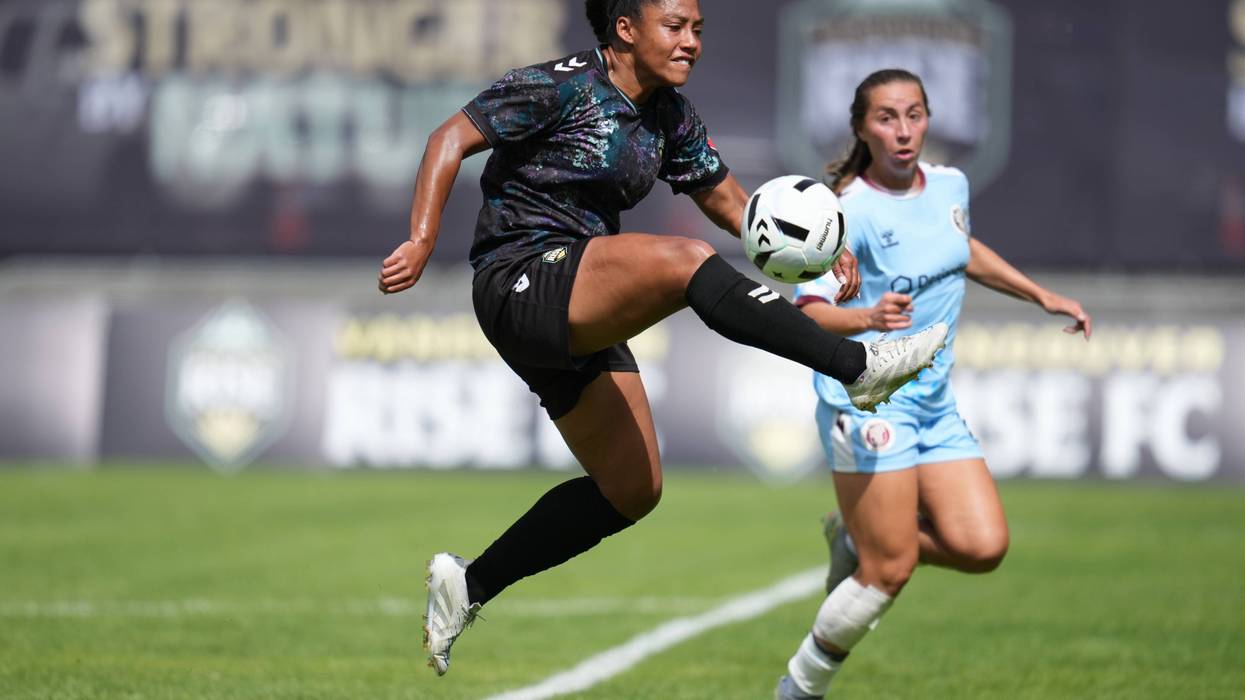

The fledgling Northern Super League has been boosted in its second year by investment and expansion plans as the women's game in Canada grows.
The six-team NSL, co-founded by former Canada national team player Diana Matheson, announced this summer that it will add a team in Winnipeg in 2027.
The league also announced that London-based sports investment firm APEX will invest up to $30 million in the women's league. And that's in addition to the $5.45 million that the Canadian government pledged on the day of the league's first championship last year.
“I know my first season in the NWSL was nothing compared to where the NSL is now,” said midfielder Quinn, who was an early signing for the Vancouver Rise after playing for the Seattle Reign in the United States. “I think it’s just set a really amazing standard at the very beginning, and I think the crowds that we have, the resources that every team has, it’s really set a great bar for what it can look like."
The league's growth reflects a global trend in the women's game. The National Women's Soccer League expanded this season with two teams, the Boston Legacy and the Denver Summit, with two additional teams in Atlanta and Columbus, Ohio, coming on board in 2028.
The English Women's Super League added two teams — Birmingham City and Crystal Palace — this coming season, pulling them both from the second-tier league to bring the WSL to 14 teams.
Canada was one of only two countries that played in the 2023 Women’s World Cup without a domestic professional league. The other was Haiti.
Players for the Canadian national team had long lamented the lack of a professional league in their home country. It became a reality last year, when the league kicked off with six teams: the Halifax Tides, Montreal Roses, Calgary Wild, Ottawa Rapid, AFC Toronto and the Vancouver Rise. Sponsors of the startup league included Coca-Cola, Toyota and DoorDash.
Quinn, who won a gold medal with Canada at the Tokyo Olympics in 2021, scored the league’s first goal, converting a penalty for a 1-0 Vancouver victory over Calgary in front of more than 14,000 fans at BC Place.
The Rise would go on to win the championship, defeating AFC Toronto 2-1 before 12,429 fans at Toronto’s BMO Field. On the same day as the title match, the Canadian government pledged up to $5.45 million to help grow the league.
“We set ourselves some pretty high ambitions, and by the end of the season had hit all the the metrics that we were looking for in terms of attendance and corporate support, our broadcast deals, ratings and those other kind of metrics,” NSL president Christina Litz said. “So I would say the theme of Year 2 has been the long-term growth and stability of this league and making sure that we’re moving from startup to being able to scale in the way we need to continue on those ambitions.”
Canada Soccer this summer announced the W Canadian Championship, which gives teams a pathway to the 2027 CONCACAF W Champions Cup and the 2028 Women’s Club World Cup. The quarterfinals conclude in October with the semifinals and final set for next year.
Next year Winnipeg will join in.
Former Canada national team player Desiree Scott, who was on the gold-medal winning Canadian team in Japan, is co-founder of the new Winnipeg team and will serve as the club's vice president of community and player experience. Former Portland Thorns coach Rob Gale is the team's chief sporting officer.
Currently, the Ottawa Rapid lead the NSL standings by two points over the Montreal Roses. The two-legged semifinals start on Oct. 31 and the final is set for Nov. 14.
Rise midfielder Nikki Stanton has played in both the NWSL and the NSL.
“Last year blew all my expectations out of the water. ... This entire country was ready for a women's sports team. Everyone I meet and I say a play for the Rise they're like, Oh, you guys won the championship,” Stanton said. "I can only see it growing up from here and I'm already loving it and it's one of the best things to be involved in this league."
___