


LONDON (AP) — Grass in much of London turned brown last week amid a record heat wave that made Britain and the rest of Europe sizzle. Water demand skyrocketed and suppliers urged people to drastically reduce outdoor usage.
The perfectly manicured lawns of Wimbledon’s famous tennis courts are as green as ever, though, as play at the grass-court Grand Slam got underway this week.
The lush green courts are a standard that players, spectators and broadcasters have come to expect — or take for granted.
“I have not once ever considered the watering of the grass,” American player Madison Keys said Thursday after a second-round win. “They always are (green), so that’s probably why I have never thought about it.”
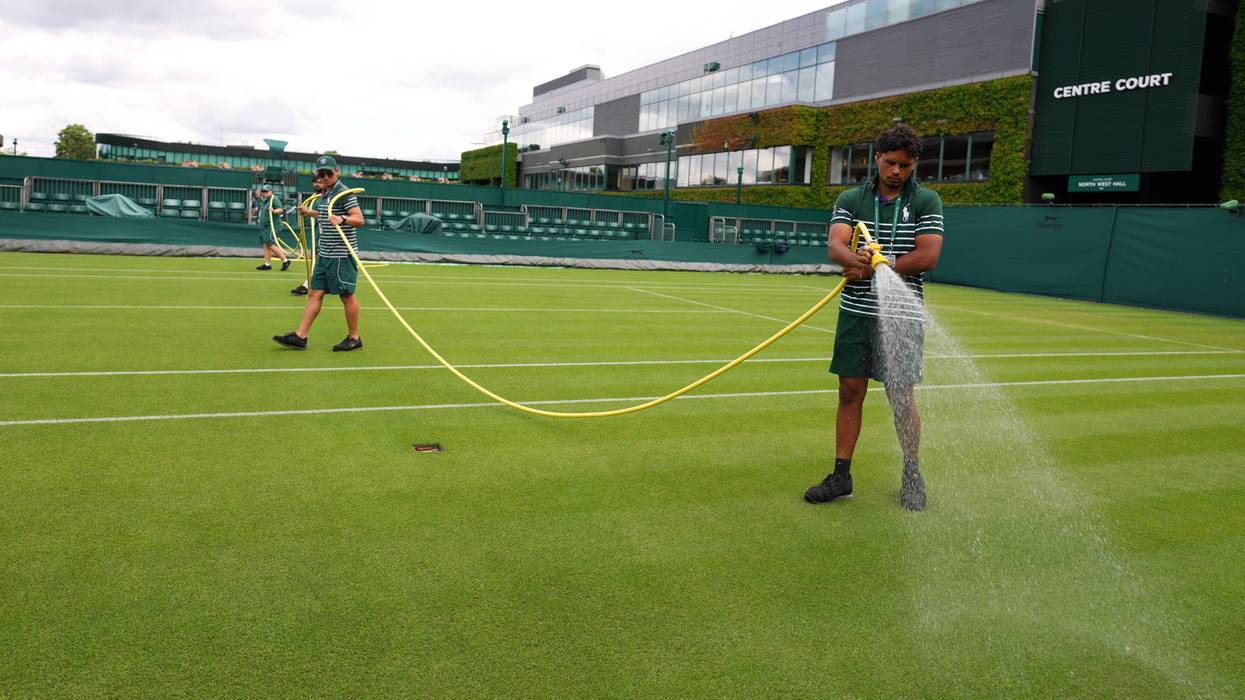
The players don't need to worry about it because Neil Stubley, the All England Club’s head of courts and horticulture, and his team of 31 groundskeepers make sure that Wimbledon is always a picture-perfect spectacle thanks to constant maintenance.
Stubley said he's “probably got about 25 weather apps that I look at probably every seven minutes” to make sure he keeps up with the changing climate. He attributes the perfectly green courts to years of research into grasses that can withstand extreme heat.
“It’s inevitable and it is happening,” Stubley said of the increasing number of heat waves in Britain. “We have a grass species trial that’s been running for nearly 40 years looking at what are the best grasses for tennis, the more drought tolerant, the more hard-wearing grasses.”
The 18 tournament courts and 20 practice courts for Wimbledon have been sown with perennial ryegrass since 2001. Also, tubes are installed on Centre Court and four other courts in which a probe can be inserted to measure soil moisture.
Soil moisture levels have a direct bearing on surface hardness, live grass cover and ball rebound. The probes came in handy last week when temperature records for June in Britain were smashed on three consecutive days.
It was England’s warmest June on record, according to the Met Office, Britain’s national weather service.
What made the heat wave even worse was overnight temperatures were also well-above average.
That hasn't been an issue this week, though.
“At the moment, in London, in the UK, you may have a 33-degree (Celsius) day (91 Fahrenheit) but you’re then getting a 17-degree (62 F) overnight," Stubley added. "That allows the temperature to come down, it allows the dew point to come in. It’s almost like us going into an air conditioned room in the evening — we can all chill out.”
The heat wave in Britain ended last weekend and temperatures at Wimbledon this week have not risen above 26 C (79 F). But it's forecast to get hotter over the middle weekend and into next week.
What's more is that it hasn't rained once during this year's tournament and there is no rain in the forecast.
Spring in London this year was also drier than usual with April having had only 20% of the average expected rain, according to Thames Water, which is responsible for the water supply in Greater London.
Water supply
There are 54 million grass plants on Centre Court alone at the start of the championships and 200 metric tons of soil are used each year to level the courts.
Each court at Wimbledon has its own unique irrigation program but the club does not have its own water supply system.
Still, organizers strive for conservation.
“Every time we do a project, part of the remit is how can we conserve things, whether that be energy, whether that be water, the construction of the core, we’re constantly looking at the drainage layers, whether we can start using systems where we can recapture water and reuse it, whether it’s just potable or can we have boreholes, whether we can use the lakes across the road,” Stubley said.
“It’s always a very fast-moving kind of dynamic because the laws always change. One minute you can have a borehole, the next year you can’t, depending on legislation,” Stubley added.
Counting grass blades
Hot temperatures have become an issue at all four Grand Slams in recent years, whether it’s consistently extreme temperatures at the Australian Open, an unexpected heat wave during this year’s French Open, or the humidity at the U.S. Open.
But Wimbledon is the only major played on a live surface; since the Australian Open and U.S. Open are contested on hard courts and the French Open is played on red clay.
Preparation of the Wimbledon courts is independently verified by the Sports Turf Research Institute (STRI) in Yorkshire.
The research institute performs moisture and hardness readings and even counts blades of grass on the baselines to see how quickly the plants are wearing out.
“And then every day we get that data,” Stubley said. “Each court will have its own microclimate. … So we’re constantly number crunching. … When we’re getting those hardness readings and it’s saying that Court 14 is firmer than Centre Court, we can then add a little bit more water to 14 and a little less to Centre Court so we keep those numbers the same.”
‘Cheese grater’ sliding damage
Heat isn’t the only menace to Wimbledon’s courts. Defending champion Jannik Sinner and seven-time winner Novak Djokovic act as unintended lawn mowers when they slide across the baseline to reach shots.
“If you look at the pimple of a grass-court tennis shoe, it’s almost like a cheese grater,” Stubley said. “As it cuts through the plant, it will shred leaves.”
Unlike the spots where most players stand to serve — which typically turn brown later in the tournament because of heavy usage — the sliding damage has a different impact on the courts.
“It’s more spread out when you’ve got the likes of Novak and Sinner doing that,” Stubley said. “Year on year you will have people that just have different styles and we just have to accept that.”
___
AP tennis: https://apnews.com/hub/tennis