


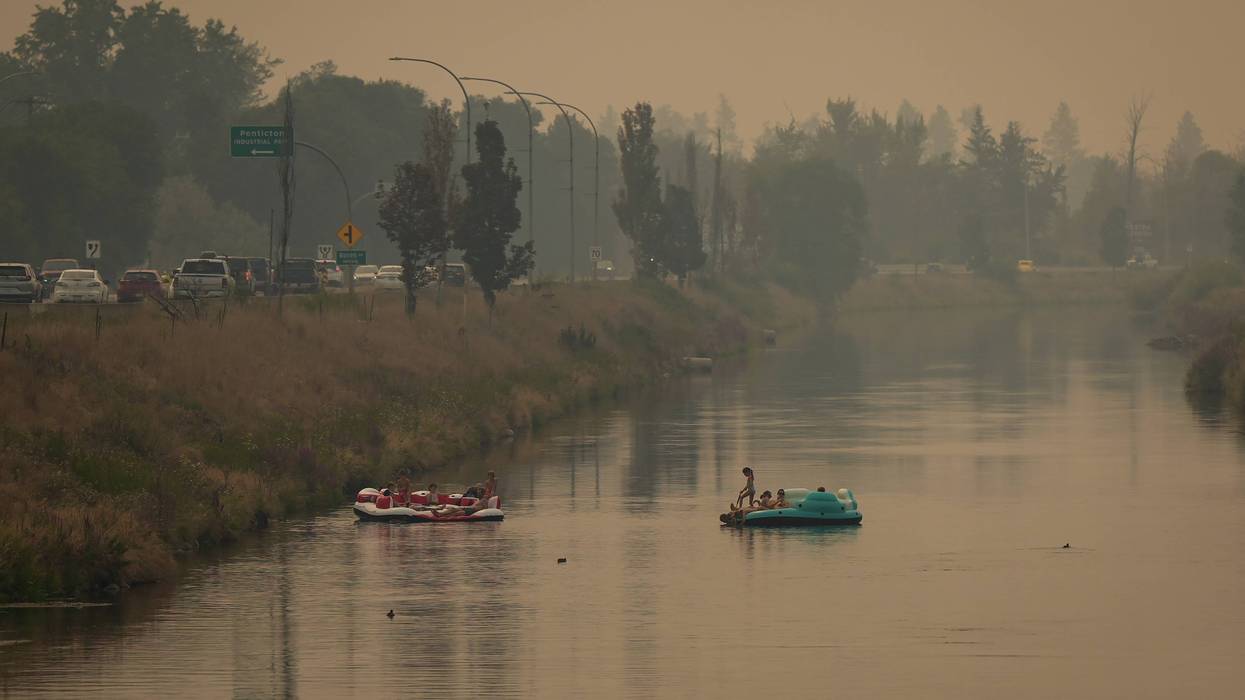

TORONTO (AP) — Canada put its military on standby Monday to help battle deadly wildfires in British Columbia as a local mayor warned that one of the blazes had wreaked destruction on his community. A woman has died and some 20,000 people have fled their homes.
For days, scores of wildfires have burned across the province, nearly half of them out of control in hot, windy weather and prolonged drought. Thousands have fled on jammed roads as officials said even more communities could be threatened.
The mayor of Summerland — home to about 12,000 people, which was ordered evacuated on Saturday night along with about 8,000 people in and around nearby Peachland — warned that the affected areas remained too dangerous to enter and that it was impossible to determine the scope of the destruction.
The blaze, known as the Bald Range wildfire, remained out of control after racing toward Summerland and other communities along Okanagan Lake over the weekend.
“We need to brace ourselves for that bad news when it’s time to go back. Everybody will know somebody who has lost a home," Summerland Mayor Doug Holmes said.
Canada's defense minister says the military is ready to respond
Defense Minister David McGuinty said the Canadian Armed Forces were in constant contact with provincial and federal officials and were ready to respond if British Columbia formally requested assistance. The federal government has already approved provincial requests for help with shelter and accommodations.
The Royal Canadian Mounted Police said an 80-year-old woman died while trying to escape the fire near Summerland. Canadian Prime Minister Mark Carney said the death was heartbreaking and that the federal government would continue supporting British Columbia.
The Royal Canadian Mounted Police said the cause of the wildfire is under investigation.
The British Columbia Wildfire Service said the fire had grown to about 60 square miles (156 square kilometers). Officials warned clearer skies and direct sunlight could increase fire activity.
Hugh Murdoch, an incident commander on the fire, said about 99 wildland firefighters and 120 structure protection personnel were working the blaze, along with heavy equipment and helicopters. He said 100 firefighters from Mexico were expected to join crews Tuesday morning.
Ravi Parmer, British Columbia forestry minister, said 19 helicopters were assigned to the Bald Range wildfire but that its intensity made it impossible to halt the blaze.
“We could have put a thousand more helicopters and a thousand more people on the ground, and it wouldn’t have made a difference,” he said.
British Columbia Wildfire Service spokesperson Nicole Bonnett said the smoke lingering over the fire has reduced visibility, limiting the use of air tankers and water-skimming aircraft.
Bonnett said the blaze has been fueled primarily by extremely dry conditions rather than wind, and grew explosively Friday, reaching 19 square miles (50 square kilometers) within three hours.
Evacuated residents face uncertain prospects for return
Graham Statt, chief administrative officer of Summerland, said residents will be allowed to return to their neighborhoods in phases but he did not say when.
Holmes, the mayor, was more blunt, saying residents would not be going home “anytime soon” and that the process could not begin until the fire was brought under control.
Kyla Gaudiuso, a resident of the tiny community of Faulder, said her home was likely destroyed as she had received a photo showing the ridge where it stood engulfed in flames
She described the community's evacuation as “pandemonium” and said she was now staying with a friend in the town of Penticton.
“It doesn’t really seem real,” she said. “I have to see it to believe it.”
Canada has endured increasingly destructive wildfire seasons in recent years, forcing mass evacuations and repeatedly sending smoke across large parts of the country and neighboring United States.
Summerland — a farming community that grows cherries, peaches and apples, and also boasts some vineyards — is in a mountainous area where past wildfires have occurred.
Holmes said the blaze started around 5:30 p.m. Friday and was within the city limits in just a couple of hours. By midnight, it was so out of control that people were unable to flee on the highway north, so they began evacuating to the south, he said.
“People said they’ve never seen a fire move so fast," he said.
Firefighters still battling blazes across the US West
In California, evacuations have been ordered for areas along the famous Big Sur coast as a wildfire burns in the nearby steep, rugged mountains. The Timber Fire in Monterey County started Sunday and had grown to about 2 square miles (5 square kilometers) by midday Monday, according to Cal Fire.
By Monday, a quick-moving blaze just north of Reno, Nevada, had forced about 5,500 people to evacuate, according to the U.S. Wildland Fire Service. Fueled by hot, dry and windy conditions, the Bug Fire grew to nearly 27 square miles (69 square kilometers) after igniting Saturday in California.
Firefighters in Spokane, Washington, have strengthened containment lines around three destructive blazes in recent days, allowing some evacuated residents to return home.
Washington Gov. Bob Ferguson said he visited some of the burned neighborhoods and met a couple who lost everything. They told him that losing their home was terrible, but losing the community was worse, he said.
“It’s our job to rebuild that community,” Ferguson said.
Oregon, meanwhile, is experiencing its worst year on record for land burned by large wildfires, with 3,671 square miles (9,508 square kilometers) scorched, said Northwest Interagency Coordination Center spokesperson Jean Nelson-Dean. That beats the state’s previous record set in 2024.
___
Stengle reported from Dallas. Associated Press reporters Martha Bellisle and Hallie Golden in Seattle and Claire Rush in Portland, Oregon, contributed to this report.