


DUBAI, United Arab Emirates (AP) — The United Arab Emirates said that it intercepted an Iranian drone over its waters Monday, an attack that comes after the United States and Iran exchanged fire over the weekend for the first time in a month.
Iranian officials said two people were killed and several others wounded in the U.S. attack Sunday night on Larak Island in the Strait of Hormuz. Iran responded by launching missiles at U.S. sites in Jordan, which were intercepted.
During the lull in fighting, the U.S. has been ratcheting up economic pressure on Iran with the hope of forcing concessions out of Tehran, including reopening the Strait of Hormuz to shipping.
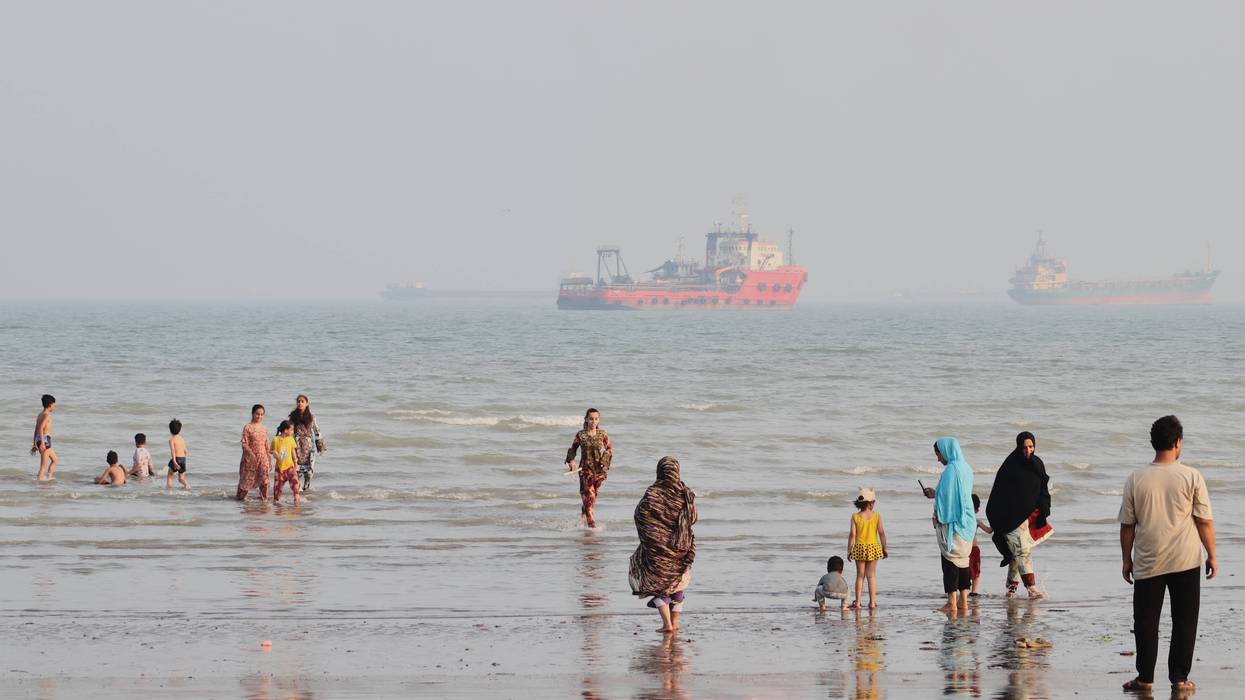
After the U.S. and Israel attacked Iran on Feb. 28, Iran established a chokehold on the vital strait, through which a fifth of the world's traded oil passed in peacetime, slowing ship traffic to a trickle. That has roiled the global economy, raising prices worldwide for energy and other goods.
As the fighting resumed, the price of Brent crude oil, the international standard, climbed above $90, up about 25% from the start of the war, presenting a growing problem for U.S. President Donald Trump before the midterm elections.
A return to open conflict would be dangerous for the region, where Iran has targeted U.S. military bases and infrastructure in Gulf countries since the war began.
In the wake of the renewed violence, Anwar Gargash, a diplomatic adviser to the UAE’s president, said on social media that “the state of neither war nor peace cannot be a sustainable solution.”
He called for a political solution that would return normal navigation to the Strait of Hormuz, but also a “more realistic approach” than the June memo of understanding between Iran and the U.S., which, he said, “failed to outline a practical and acceptable” road map.
UAE says Iranian attack is a ‘dangerous escalation’
In a short statement earlier, the UAE Defense Ministry said it “dealt with” an Iranian drone that was detected over its waters approaching from Iran. There were no reports of damage.
“This dangerous escalation constitutes a blatant violation of the UAE’s sovereignty, security, and stability, and a direct threat to the safety of its citizens and residents,” the Foreign Ministry said.
The Defense Ministry later issued a second statement denying a claim by the Iranian army that the Al Minhad Air Base in Dubai had been targeted, saying it was false.
In the wake of the U.S. attack on Sunday, Iran's military warned that any further U.S. attacks would draw a far heavier response, including strikes on bases or other points from which attacks against Iran are launched, state-run IRNA reported.
“The U.S. military has no choice but to leave the region,” the statement from Iran’s Armed Forces General Staff and the Khatam al-Anbiya Central Headquarters said.
Trump on Monday didn’t rule out the possibility of further strikes on Iran. “We’ll see what happens,” he told reporters.
Iran says it has right to defend itself and will ‘respond decisively’
Speaking after the first day of the Shanghai Cooperation Organization's summit in Kyrgyzstan, Iranian Foreign Minister Abbas Araghchi said the U.S. must abide by the June memo, state television reported.
Araghchi said Iran would continue defending its rights and that the solution to ending the conflict remained “completely clear.”
The summit brings together a group billed as a counterweight to U.S. global influence, and includes Chinese President Xi Jinping, Russian President Vladimir Putin and Indian Prime Minister Narendra Modi. Iranian President Masoud Pezeshkia was scheduled to meet with Putin on the sidelines Tuesday.
US weekend attack comes after weeks of rising economic pressure
Meantime, U.S. Treasury Secretary Scott Bessent opened meetings of the Group of 20 finance ministers in North Carolina on Monday, as Washington pressures other countries to help the U.S. economically isolate Iran.
The shifting strategy centers on threats to punish any country or entity that conducts business with Tehran.
Two weeks ago, the UAE suspended all trade with Iran after saying it had come under renewed fire from Iran with two missiles splashing down harmlessly in the Persian Gulf. Iran denied the attack.
Bessent later suggested it was pressure from Washington that led to the UAE decision.
Trump stressed last week that he is “not in a hurry” to get Iran back to the negotiating table, and he continues making the case that the Islamic Republic’s leadership is on the ropes.
Appointments to Iran’s senior security leadership in the past month, however, have signaled Tehran’s defiance after weathering decades of sanctions.
US military says strike on Iranian rocket launchers 'precise’
On Sunday, U.S. Central Command said it struck Iranian launchers after observing forces with Iran’s Revolutionary Guard Corps preparing to launch rockets with sea mines into the Strait of Hormuz. The U.S. military said last week that it had completed clearing sea mines from the waterway’s international shipping routes.
U.S. military officials disputed Iran’s claim that the latest American strikes were an act of aggression, calling them a “limited, precise action” against what they said were minelaying forces.
Iranian state television later showed what it said were ballistic missiles being fired at American bases in Jordan, and Jordan’s military said it intercepted eight that had entered its airspace.
The last time the U.S. military confirmed targeting Iran was July 29, when it announced a “heavy wave of strikes” on dozens of Revolutionary Guard targets.