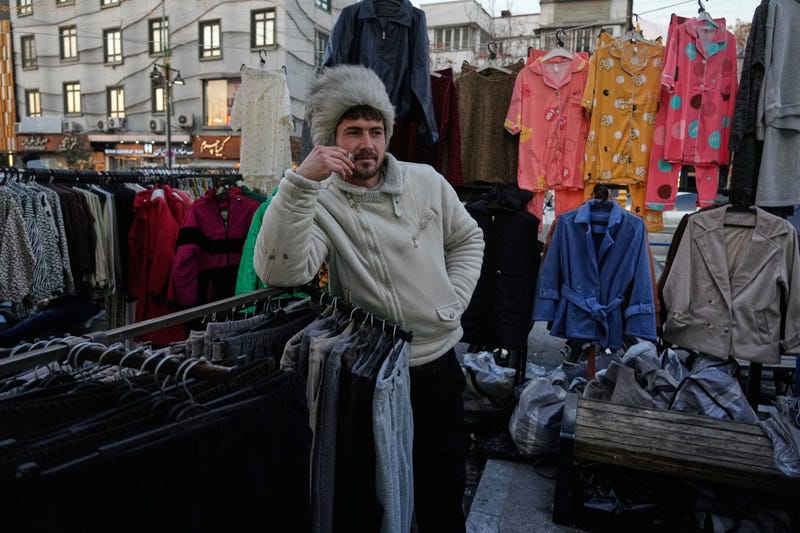
DUBAI, United Arab Emirates (AP) — Iranian officials reached out to the wider Middle East on Wednesday over the threat of a possible U.S. military strike on the country, while the value of Iran's currency reached a new low a month since the start of protests that spread nationwide and sparked a bloody crackdown.
Two nations, Saudi Arabia and the United Arab Emirates, have signaled they won't allow their airspace to be used for any attack. But America has moved the USS Abraham Lincoln and several guided missile destroyers into the region, which can be used to launch attacks from the sea.
Iran’s currency, the rial, fell to a record low of 1.6 million to $1, according to local currency traders. Its value has been plunging since late last year, and is down from about 32,000 to $1 a decade ago. Economic woes had sparked the protests that broadened into challenging the theocracy.
It remains unclear what U.S. President Donald Trump will decide about using force, though he has threatened to use it in response to the killing of peaceful demonstrators. At least 6,221 people have been killed in the protests, activists said.
Trump also indicated Wednesday that he wants movement toward a deal that his administration has been seeking with Tehran that would prohibit Iran from developing nuclear weapons in return for a lifting of economic sanctions.
“Hopefully Iran will quickly ‘Come to the Table’ and negotiate a fair and equitable deal - NO NUCLEAR WEAPONS - one that is good for all parties,” Trump wrote on his Truth Social platform. “Time is running out, it is truly of the essence!”
Mentioning the June strikes on Iran as the U.S. inserted itself in Israel's 12-day war on the Islamic Republic, Trump wrote: “The next attack will be far worse!”
Iran's mission to the United Nations was quick to respond to Trump, posting on X that “Iran stands ready for dialogue based on mutual respect and interests—BUT IF PUSHED, IT WILL DEFEND ITSELF AND RESPOND LIKE NEVER BEFORE!”
Rubio comments on Iran
U.S. Secretary of State Marco Rubio said the increasing military presence in the Middle East has been put in place “to defend against what could be an Iranian threat against our personnel” -- a message that stands in contrast to Trump’s continuing threats to strike Iran if it does not yield to his demands.
“I think it’s wise and prudent to have a force posture within the region that could respond and ... if necessary, preemptively prevent the attack against thousands of American servicemen and other facilities in the region and our allies,” Rubio told Congress.
He was cautious regarding the prospect of a change in government. “You’re talking about a regime that’s been in place for a very long time,” he said in response to a question. “So that’s going to require a lot of careful thinking, if that eventuality ever presents itself.”
Iran's state-run media, which now only refers to protesters as “terrorists,” remains the sole source of news for many as Tehran cut off access to the global internet some three weeks ago. But Iranians have become angry and anxious, seeing footage of protesters shot and killed while worrying about what may happen next as the economy sinks further.
“I feel that my generation failed to give a better lesson to younger ones," said Mohammad Heidari, a 59-year-old teacher in Tehran. “The result of decades of teaching by my colleagues and me led to death of thousands, and maybe more injured and prisoners.”
Rapid diplomacy between Iran, Arab nations
Egypt's Foreign Ministry said its top diplomat, Badr Abdelatty, separately spoke with Iranian Foreign Minister Abbas Araghchi and U.S. Mideast envoy Steve Witkoff to “work toward achieving calm, in order to avoid the region slipping into new cycles of instability.”
Witkoff, a billionaire real estate developer and Trump's friend, had earlier negotiated over Iran's nuclear program. There was no immediate acknowledgment from the White House of the call.
The Turkish foreign minister also spoke by phone with Araghchi about reducing regional tensions. Turkish officials have expressed concern that intervention in Iran could spark instability or trigger a refugee influx.
Meanwhile, Saudi Arabia's Crown Prince Mohammed bin Salman held a call with Iranian President Masoud Pezeshkian, saying the kingdom would “not allow its airspace or territory to be used for any military actions against Iran or for any attacks from any party, regardless of their origin.” That follows a similar pledge by the UAE.
Both Saudi Arabia and the UAE host U.S. air assets and troops.
Saudi officials continue to be in “constant contact” with Trump administration officials about developments in the region, including on Iran, a senior Saudi embassy official in Washington said Wednesday, speaking on condition of anonymity because they were not authorized to comment publicly.
“Our position is exactly this: Applying diplomacy through military threats cannot be effective or constructive,” Araghchi told journalists Wednesday outside of a Cabinet meeting. “If they want negotiations to take shape, they must abandon threats, excessive demands and the raising of illogical issues. Negotiations have their own principles: They must be conducted on an equal footing, based on mutual respect, and for mutual benefit.”
Activists offer new death toll
While the protests have been halted for weeks after the crackdown, information trickling out of Iran via Starlink satellite dishes is reaching activists, who have been trying to tally the carnage.
On Wednesday, the U.S.-based Human Rights Activists News Agency, which has been accurate in multiple rounds of unrest in Iran, said the at least 6,301 dead it counted included at least 5,925 protesters, 214 government-affiliated forces, 112 children under 18 and 50 civilians who weren’t demonstrating. More than 42,450 have been arrested, it added.
The group verifies each death and arrest with a network of activists on the ground in Iran. The Associated Press has been unable to independently assess the death toll given that authorities cut off the internet and disrupted calls into the Islamic Republic.
Iran’s government has put the death toll at a far lower 3,117, saying 2,427 were civilians and security forces, and labeled the rest “terrorists.” In the past, Iran’s theocracy has undercounted or not reported fatalities from unrest.
That death toll exceeds that of any other round of protest or unrest in Iran in decades, and recalls the chaos surrounding the 1979 Islamic Revolution.
The protests began on Dec. 28, sparked by the fall of the Iranian currency, the rial, and quickly spread. The country has faced more than two weeks of internet blackout — the most comprehensive in its history.
___
Associated Press writers Fay Abuelgasim in Cairo, Suzan Fraser in Ankara, Turkey, and Meg Kinnard, Stephen Groves, Aamer Madhani and Konstantin Toropin in Washington D.C. contributed to this report.