NEW YORK (AP) — Cryptocurrency mogul Do Kwon weaponized investors’ trust, convincing them that his company’s artificially propped up crypto ecosystem was safe before a $40 billion crash wiped out nest eggs and money for charities, college tuition, rent and other bills, victims said at his sentencing hearing Thursday.
Kwon, known by some as “the cryptocurrency king,” listened as victims — one in court and others by telephone — described the scam’s personal toll. He pleaded guilty in Manhattan federal court in August to fraud charges stemming from Terraform Labs’ $40 billion crash.
The loss was greater than the combined losses caused by FTX fraudster Sam Bankman-Fried and OneCoin co-founder Karl Sebastian Greenwood’s multi-level-marketing scheme, prosecutors said.
Sentencing guidelines recommend about 25 years in prison, but federal prosecutors have asked for 12 years. They cited his guilty plea, pending prosecution in Korea and time behind bars in Montenegro while awaiting extradition. Kwon’s lawyers asked for five years, arguing that his conduct stemmed not from greed, but hubris and desperation.
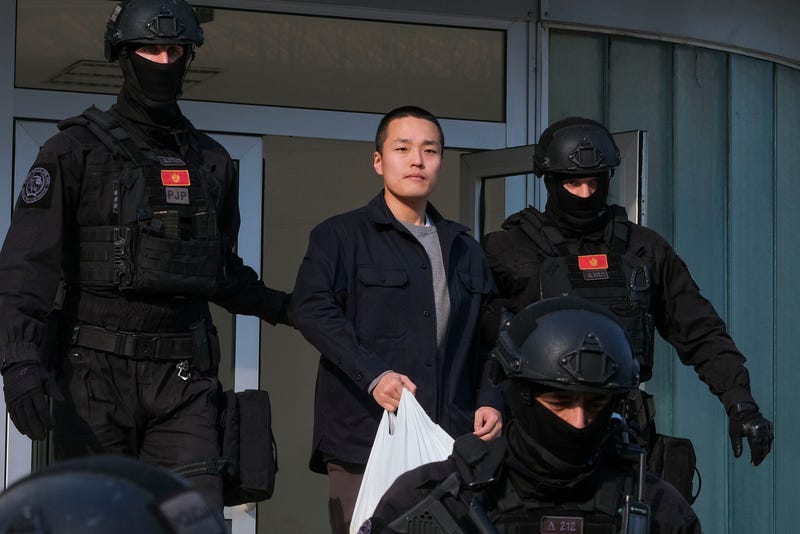
Kwon fled from Singapore, where his tried to rebuild Terraform Labs, to Serbia and then Montenegro after his assets were frozen. He was extradited to the U.S. after his March 23, 2023, arrest while traveling on a false passport.
Judge Paul A. Engelmayer will issue Kwon’s sentence later Thursday after giving him and his lawyers a chance to address the court.
Kwon’s Terraform Labs had touted its TerraUSD as a reliable “stablecoin” — a kind of currency typically pegged to stable assets to prevent drastic fluctuations in prices. But prosecutors say it was an illusion backed by outside cash infusions that came crumbling down, devastating investors and triggering “a cascade of crises that swept through cryptocurrency markets.”
Kwon, who hails from South Korea, has agreed to forfeit over $19 million as part of the plea deal.
One victim, speaking by telephone, said his wife divorced him, his sons had to skip college and he had to move back to Croatia to live with his parents after his family’s life savings evaporated. Another said he has to “live with the guilt” of persuading his in-laws and hundreds of nonprofit organizations to invest.
Stanislav Trofimchuk said his family’s investment plummeted from $190,000 to $13,000 — “17 years of our life, gone” during what he described as “two weeks of sheer terror.”
Chauncey St. John, speaking in court, said some nonprofits he worked with lost more than $2 million and a church group lost about $900,000. He and his wife are saddled with debt and his in-laws have been forced to work well past their planned retirement, he said.
Nevertheless, St. John said, he forgives Kwon and “I pray to God to have mercy on his soul.”
A prosecutor read excerpts from some of more than 300 letters submitted by victims in recent days, including a person she identified only by initials who lost nearly $11,400 while juggling bills and trying to complete college. Kwon had presented himself as trustworthy and made Terra seem like a safe place to stash savings, the person said.
“To some that is just a number on a page, but to me it was years of effort,” the person wrote. “Watching it evaporate, literally overnight, was one of the most terrifying experiences of my life.”
“What happened was not an accident. It was not a market event. It was deception,” the person added, imploring the judge to “consider the human cost of this tragedy.”
Authorities said investors worldwide lost money in the downfall of the Singapore crypto firm, which Kwon co-founded in 2018. Around $40 billion in market value was erased for the holders of TerraUSD and its floating sister currency, Luna, after the stablecoin plunged far below its $1 peg.
Kwon created an “illusion of resilience while covering up systemic failure,” Assistant U.S. Attorney Sarah Mortazavi told Engelmayer. “This was fraud executed with arrogance, manipulation and total disregard for people.”
In a letter to the judge, Kwon wrote, “I alone am responsible for everyone’s pain. The community looked to me to know the path, and I in my hubris led them astray,” while adding, “I made misrepresentations that came from a brashness that is now a source of deep regret.”
___
Associated Press reporter Anthony Izaguirre contributed to this report.