



Article Summary
- A University of Illinois Report shows that transparency and utility bills are among the top concerns of residents in DeKalb, Aurora and Elk Grove Village when it comes to data centers.
- The Illinois General Assembly began its two-week veto session on Nov. 17, during which lawmakers are considering data center regulations.
- A Senate committee met for two hours on Wednesday to discuss a potential regulatory proposal but did not vote on it.
This story was written by the reporters and editors who worked on this story.
Data centers have dominated public discourse over the last year, but much analysis of their effects has relied on limited information, because of a lack of public sources, according to a new report from the University of Illinois.
The state keeps no master list, no single agency oversees them, zoning is handled by local municipalities, environmental and utility connection oversight is split, and few companies report water and energy use on a voluntary basis. That means that, when residents have concerns, few resources are available to answer their questions.
The report came just weeks before the first week of the legislative veto session, during which lawmakers are discussing the POWER Act. That bill is aimed, among other things, at requiring standardized, public reporting, banning nondisclosure agreements, and increasing information accessibility.
The report focused on three case studies: DeKalb, Aurora and Elk Grove Village. DeKalb is home to the state’s largest single data center investment, operated by Meta. Aurora enacted a moratorium and the most detailed data center rules in the state in March 2026 after years of resident complaints about noise. Elk Grove Village is the state’s oldest and most concentrated data center market.
The three communities account for half of the 34 data centers that have benefited from Illinois' data center incentive program, but their approaches to data centers have varied, as have their resulting experiences.
Of these data centers, only Meta reports its water and electricity use, and only Aurora requires data centers to report this information.
Utility bill and resource use concerns
The Union of Concerned Scientists estimated that centers will drive 64-72% of the state’s growth in electricity demand from 2025 to 2030. The report also found that ComEd bills rose on June 1, 2026, because of new electricity prices set by the regional grid operator, PJM Interconnection, as well as higher demand from data centers and summer weather.
Meta drew roughly 76,000 gallons of water a day, about 2.5% of DeKalb's average daily use, though that disclosure was voluntary. The report also outlined that newer facilities tend to use closed-loop or waterless systems, which use less water than older facilities.
Brad Tietz, the Data Center Coalition director of government affairs for the Midwest, said utility bill increases and water usage are the two biggest misconceptions about data centers and suggested that more transparency would combat misinformation.
“There is a lot of responsibility on the industry to do a much better job of getting the facts out and speaking to what these projects are and what they're not,” Tietz told Capitol News Illinois.
The POWER Act will require water resource and scarcity plans, monthly and annual water reporting, and a Water Impact Permit managed by the Illinois Environmental Protection Agency.
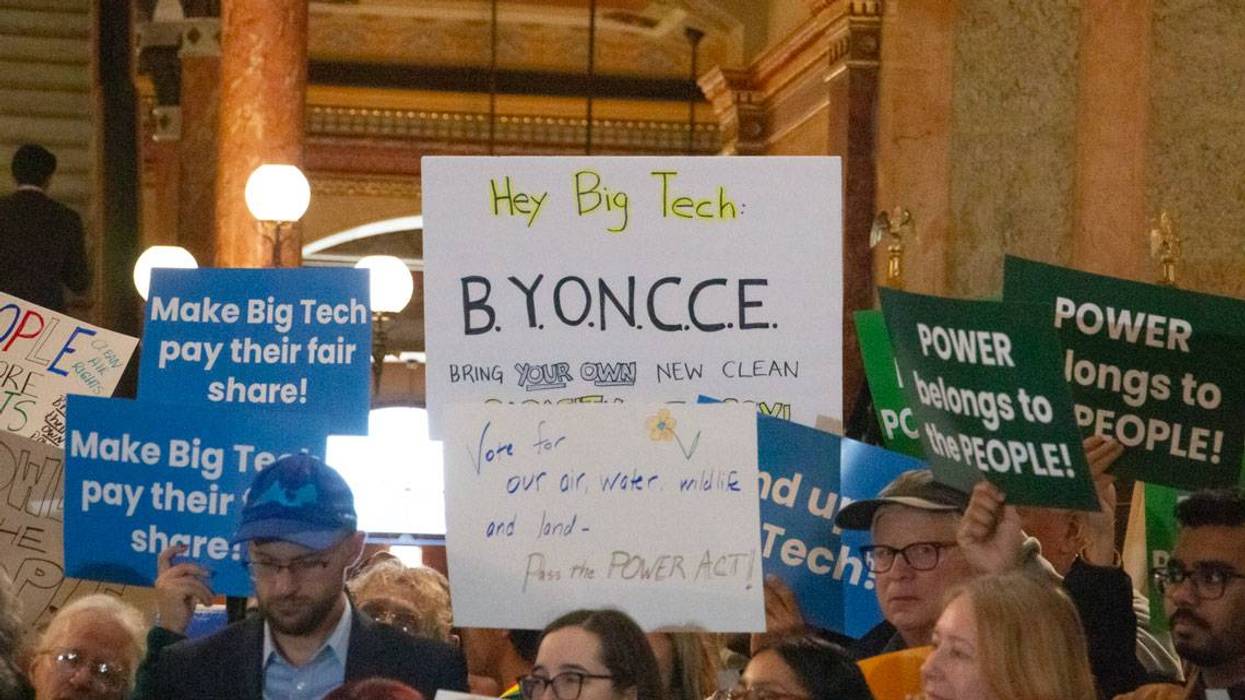
To address electricity costs, the act suggests that data centers bring new clean energy built in Illinois and clarify who pays for electricity and grid updates.
POWER Act, property taxes and procurement
This week, advocates rallied at the state Capitol, hoping to see the POWER Act passed in the veto session — something Gov. JB Pritzker has also supported. Later that day, the Senate Energy and Public Utilities Committee convened to discuss the act, focusing mostly on data centers bringing their own clean energy to the state.
While environmental advocates say regulation is needed for the data center industry to be able to grow in Illinois, industry backers say if the policies get too stringent, new data centers can find other states to break ground.
In response to the clean energy provision, Tietz cited S&P Global, saying that in the first half of 2025, the technology and web services sector accounted for over 84% of U.S. carbon-free energy procurement. That means the industry is paying for energy “credits” from carbon-free sources including nuclear power, although data centers often still run on fossil fuels.
“If there is one industry powering our clean energy economy, it's this one,” Tietz said.
Investing in data centers also grows the local economy, Frank Manzo of the union-tied Illinois Economic Policy Institute told Capitol News Illinois.
The report said that from 2022 to 2024, data centers paid $46.6 million in DeKalb, $5.6 million in Aurora and $88.7 million in Elk Grove Village.
“There are entire counties in Illinois that don't collect that much in tax and property tax revenue,” Manzo said.
In DeKalb, these property taxes helped pay for a new elementary school. In Elk Grove Village in October, each residential neighborhood received a $200 gift card from unanticipated revenue from the real estate transfer taxes on the sale of two data center properties.
However, Manzo warned communities about local tax credits and abatements for data centers, even if they think they will drive new development to their area.
“If you do that, you're removing the number one positive to your community from that data center. You're removing the chance to fully fund your public school or to rebuild a whole new high school,” Manzo said.
These tax breaks shift the burden to local homeowners.
Data centers also create thousands of construction jobs and a few well-paying permanent jobs. The permanent jobs average about $120,500 a year, 50% more than the average-paying job in Illinois.
Tale of two communities
After adopting a 180-day moratorium, Aurora enacted the state’s most detailed data center rules in March 2026. The four adopted ordinances require data centers to make annual energy, water, and noise reports public.
These ordinances also require public hearings and city council approval, which is important to make residents feel heard, Alison Lindburg, Aurora’s sustainability director, said.
“A lot of residents are feeling like they don't have agency in these decision-making processes — that these data centers come out of nowhere, and people are not being heard about whether or not they want them in their communities,” Lindburg told Capitol News Illinois.
Aurora Mayor John Laesch said members of the General Assembly contacted the city and he has testified in Springfield to make suggestions for future regulations.
Those include provisions measuring noise in decibels, creating a commission that studies the long-term health impact of low-volume noise on residents and animals and making data centers pay more in utility tax than residents.
In Elk Grove Village, the first data center was built in 2000, and Mayor Craig B. Johnson said that 26 years of experience has led the village to develop requirements for data centers over time.
“There's ways to locate their equipment, screen their equipment to minimize the impact on noise,” Johnson told Capitol News Illinois. “How they lay out their floor plans, all that can be done in such a way to help minimize their impact.”
But Elk Grove Village Business Park is the nation’s largest business park, with over 5,600 businesses and over 400 manufacturers. It’s an industrial strip tucked away from the village’s population of roughly 32,000.
“Probably 90% of my residents still don't know that they're a data center. They drive by it every day. They have no clue. They think it might be a factory, might be a manufacturer,” Johnson said.
The data centers are in zoned industrial areas and have been there so long that few have protested them, Johnson said.
The village also does not enter into nondisclosure agreements with data centers and uses closed-loop systems to conserve water, which reduces waste in the city, Johnson said. However, he agreed that Elk Grove needs lower electricity costs.
“We fully support data centers paying upfront the cost to run the lines out to them, to set up the power source,” Johnson said. “We fully support data centers paying their share in electric costs.”
What’s ahead for Illinois with the POWER Act?
Data center demand is a factor in rising electricity prices, Manzo said, but so are rising fuel costs and extreme weather events, along with a supply shortage as new energy comes online and grid operators have not added enough new energy.
The POWER Act could address the supply issue by requiring data centers to bring new clean energy into the state, advocates say.
Some advocates have suggested creating provisions giving those who provide their own clean energy easier access to connecting to the grid or tax exemptions for doing so.
Hannah Flath, climate communications manager at the Illinois Environmental Council, said the IEC wants to ensure that the bring-your-own energy provision doesn’t allow for fossil fuels.
“We want to see them build new clean energy, bring that with them, and that can be utility-scale solar, wind, battery storage, but it can also include things like distributed energy resources,” Flath told Capitol News Illinois. “Those are the types of tools that put money back in Illinois families' pockets.”
James Gignac, the Midwest policy director at the Union of Concerned Scientists, said state policy should prioritize data centers that prioritize renewable energy.
“If they want to receive the firm service and not have their usage reduced when the grid is stressed, they need to provide more clean energy sooner,” Gignac told Capitol News Illinois.
However, this issue goes beyond Illinois because the power grid is interconnected over a large area, Gignac said. PJM Interconnection, for example, covers northern Illinois, 12 other states and the District of Columbia.
“What data centers may be doing in other states can also affect ratepayer bills in Illinois, and so the POWER Act is important and needs to be adopted,” said Gignac. “We also need our state officials, our utilities, and other stakeholders to continue advocacy with the grid operators and federal entities.”
Capitol News Illinois is a nonprofit, nonpartisan news service that distributes state government coverage to hundreds of news outlets statewide. It is funded primarily by the Illinois Press Foundation and the Robert R. McCormick Foundation.
As the POWER Act enters veto session discussion, report says main issues in Aurora, DeKalb and Elk Grove Village are transparency, utility bills
As the POWER Act enters veto session discussion, report says main issues in Aurora, DeKalb and Elk Grove Village are transparency, utility bills