


As the Colorado River and its once massive reservoirs shrink from overuse and climate change, officials are faced with a decision that pits conservation against ratepayer costs for electricity.
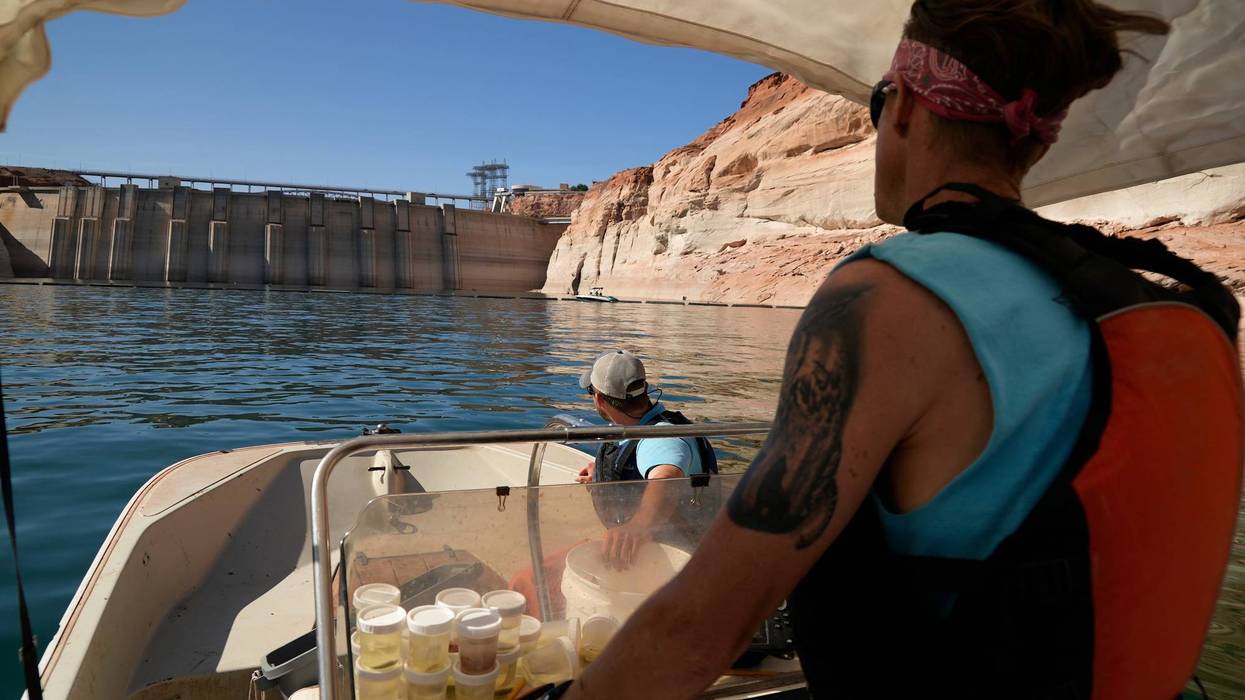
To fight off predators of the humpback chub, a threatened fish native to the river, Glen Canyon Dam in northern Arizona would need to do what is known as a “cool mix flow,” where cold water is released from deep in its reservoir to cool the river below. But there are no hydropower turbines in the cool, deep section, so significant power generation would be lost.
The proposal comes after the worst snowpack on record for the Colorado River Basin, relied upon by farmers, industries, wildlife and more than 40 million people in seven U.S. states, tribal nations and Mexico. It also comes as those states fail to reach a long-term agreement on how to share the river's dwindling resources beyond this year, when the guidelines expire.
“There is a limited water supply. It’s getting even lower. And with that, a lot of hard decisions need to be made,” said John Berggren, regional policy manager for the environmental nonprofit Western Resource Advocates.
Utilities that buy this hydropower say the cool water releases would be costly because they would have to spend millions to buy alternative energy and would increase financial hardship for customers. But supporters say that without cool releases, the warm waters projected downstream this summer would allow non-native predatory fish to spawn, further threatening the humpback chub, and would destroy a world-famous trout fishery nearby.
The Bureau of Reclamation, which is expected to announce a decision in the next couple of weeks, said in a statement that it is weighing several factors including the ecological health of the river and the hydropower production of the dam. The Interior Department, which oversees the bureau, declined to comment. If the cool water release is approved, it would likely happen from June to October through jet tubes, bypassing the turbines near the warmer surface.
How mixing cool water protects fish
Lake Powell, one of two massive reservoirs on the Colorado River, is just 23% full after decades of overuse and evaporation of water as average temperatures rise because of climate change. A record low inflow is expected this summer. With such a low reservoir, warm water near the surface gets sucked through the generators and sent downstream.
Smallmouth bass, introduced in Lake Powell in the 1980s for sport fishing, live at that warm surface, and also get sucked through the hydropower generators and into the river below. That's a problem for the humpback chub and other federally protected fish in the Grand Canyon, a 278-mile (447-kilometer) stretch farther south on the river that's world-famous for its geologic formations. A recent study shows that roughly half the bass survive the generators. If the river below is warm enough, they spawn.
Smallmouth bass already feast on humpback chub in the river’s upper section, where agencies spend millions of dollars annually to keep the intruders in check. Native fish have been safer below Glen Canyon Dam because it blocks the path to the Grand Canyon — but that may not be true for long.
Water temperatures just downstream of the dam are expected to shatter records set in 2022, when smallmouth bass were first found there. Officials project that water will consistently exceed 60 degrees Fahrenheit (15.5 Celsius) by mid-June due to the warm water being pulled in from Lake Powell. Any higher than that, and non-native predatory fish that pass through the dam could reproduce.
Officials say cool water releases from Lake Powell in 2024 and 2025 successfully prevented spawning.
It’s critical to consider the cost of not doing the cool mix, Heather Whitlaw, field supervisor with the U.S. Fish and Wildlife Service, said during a recent meeting on managing the issue. “We are certainly just giving up on the future for any kind of recovery for humpback chub and all of the other pieces of the system that rely on those cooler water temperatures.”
With no long-term solution to keep the predators from passing through the dam, withholding cool water would force officials to rely solely on manually removing them downstream.
More hydropower loss could further impact utilities
Utilities reliant on hydropower from federal generators are worried.
If the cool water releases are approved, it could mean bypassing about half the generation at Glen Canyon Dam, forcing utilities to buy power elsewhere that would likely be more expensive, according to the Utah utility group Heber Light & Power.
“We keep hearing comments that we must continue Cool Mix because the cost of not doing it will be even greater,” the Colorado River Energy Distributors Association, which represents about 155 customers who buy federal hydropower generated from the river and opposes the releases, said this month in a letter to Interior Secretary Doug Burgum. “We would like to understand what remediation would consistently cost more than $20 to $30 (million) per year.”
The association said the releases are not a sustainable solution to prevent smallmouth bass from reproducing and threaten a critical fund used to operate, maintain and invest in hydropower and transmission facilities.
During the cool water releases in 2024, nearly 900,000 acre-feet of water bypassed the generators, costing $19 million in replacement energy costs, according to the Bureau of Reclamation. It’s unclear how much water would bypass the generators this year, although the cost to replace it is anticipated to be around $25 million — roughly the total cost to hydropower users from the prior two years.
The ongoing loss of hydropower due to Lake Powell's decline has brought challenges to Heber Light & Power as the population grows, said Emily Brandt, the utility’s energy resource manager. The overall decline has led to rate hikes the past five years.
Ann Moulton, who lives in Heber City, has seen her residential electricity bill from Heber Light & Power steadily rise. Her bill this April was $125.98, up from $103.24 and $86.14 for the same month in the previous two years. That's impacting her budget, she said.
Other customers are struggling to pay. So far this year, the utility has seen a jump in late payments over the past two years, from 10% to 12%.
Brandt said the utility supports caring for fish, “but this particular experiment seems unnecessary.”
“We’re already seeing reduced generation from drought, and now we’re seeing even further reduced generation because of this environmental experiment,” Brandt said.
Fisheries downstream are also in limbo
Dave Foster still remembers the 2022 trout die-off in Glen Canyon, a remote stretch of river between the dam and the start of the Grand Canyon. Warm water killed nearly half the rainbow trout the world-renowned fishery relies on, said Foster, who has been working on or around that stretch of river since age 13.
He and other guides are still recovering from the die-off, he said, as “the population has simply not rebounded.” But cool water releases in recent years have offset more negative impacts, and more this year would get them through the fall and winter.
Foster has warned customers booking trips after mid-June that he might cancel if the water gets too warm, which can stress fish. Without cool water releases this year, “that's it for the trout fishery,” he said. “There's no ambiguity about it. It will destroy it.”
___
The Associated Press receives support from the Walton Family Foundation for coverage of water and environmental policy. The AP is solely responsible for all content. For all of AP’s environmental coverage, visit https://apnews.com/hub/climate-and-environment
___
In the third to last paragraph, corrects the name of a stretch of the river to Glen Canyon instead of Marble Canyon.