


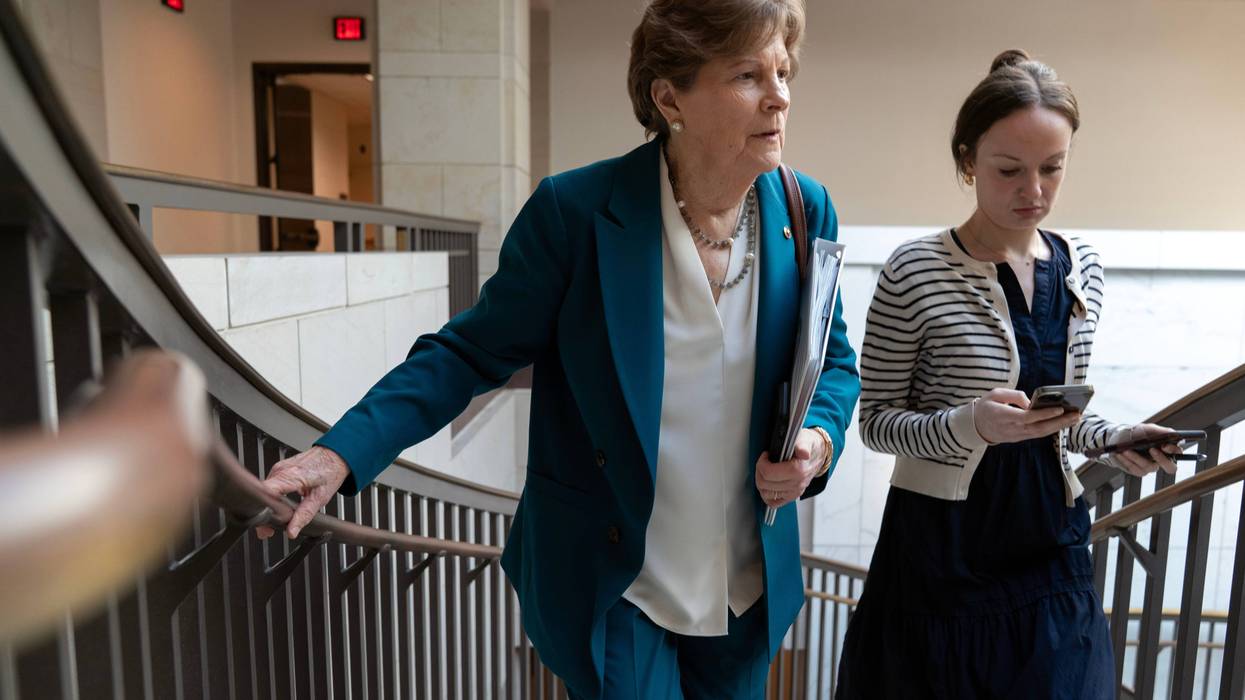

WASHINGTON (AP) — A bipartisan group of four senators has plans to visit Taiwan, Japan and South Korea in the coming days on a trip meant to bolster U.S. alliances seen as important to countering China's dominance in Asia.
Sen. Jeanne Shaheen of New Hampshire, the top Democrat on the Senate Foreign Relations Committee, announced the trip Saturday. She will be joined by Sens. John Curtis, R-Utah, Thom Tillis, R-N.C., and Jacky Rosen, D-Nev. Their visits to Taipei, Tokyo and Seoul are coming before President Donald Trump's trip to Beijing in May for a rescheduled summit with Chinese President Xi Jinping.
The lawmakers' stop in Taiwan could draw scrutiny from China, which opposes such relations and sees them as a challenge to its claim of sovereignty over the self-governing island. Taiwan relies on American backing for its democracy, but recent moves by Trump, such as discussing a potential weapons sales to Taiwan with Xi, have raised questions about the future direction of U.S. policy.
Analysts in both China and the United States believe Xi, through the leader-level summit, will try to influence Trump to soften the U.S. stance on Taiwan.
“This bipartisan delegation demonstrates Congress’ commitment to these alliances and partnerships is unwavering and will endure well beyond any one administration,” Shaheen said in a statement.
In a show of reassurance to the Asian allies, the lawmakers plan to meet with political leaders and defense officials on their trip.
“Our alliance with Taiwan is one of the most strategically and morally significant partnerships America has in the Indo-Pacific,” Curtis said.
It remains to be seen how Trump's intervention in Venezuela, Iran and elsewhere could influence other powers such as China and Russia. But there is some concern among lawmakers that the Republican president's actions could be seen as giving those countries an opening for their own foreign moves.
The economic relationship with Taiwan has also come under scrutiny from the Trump administration. The U.S. is reliant on Taiwan for its production of computer chips, which contributed to a trade imbalance of nearly $127 billion during the first 11 months of 2025.
The Trump administration reached a deal with Taiwan in February that removed 99% of its trade barriers.
During another visit by a bipartisan group of U.S. lawmakers last year, they emphasized that the U.S. would continue to partner closely with Taiwan.
___
Associated Press writer Didi Tang contributed to this report.


