


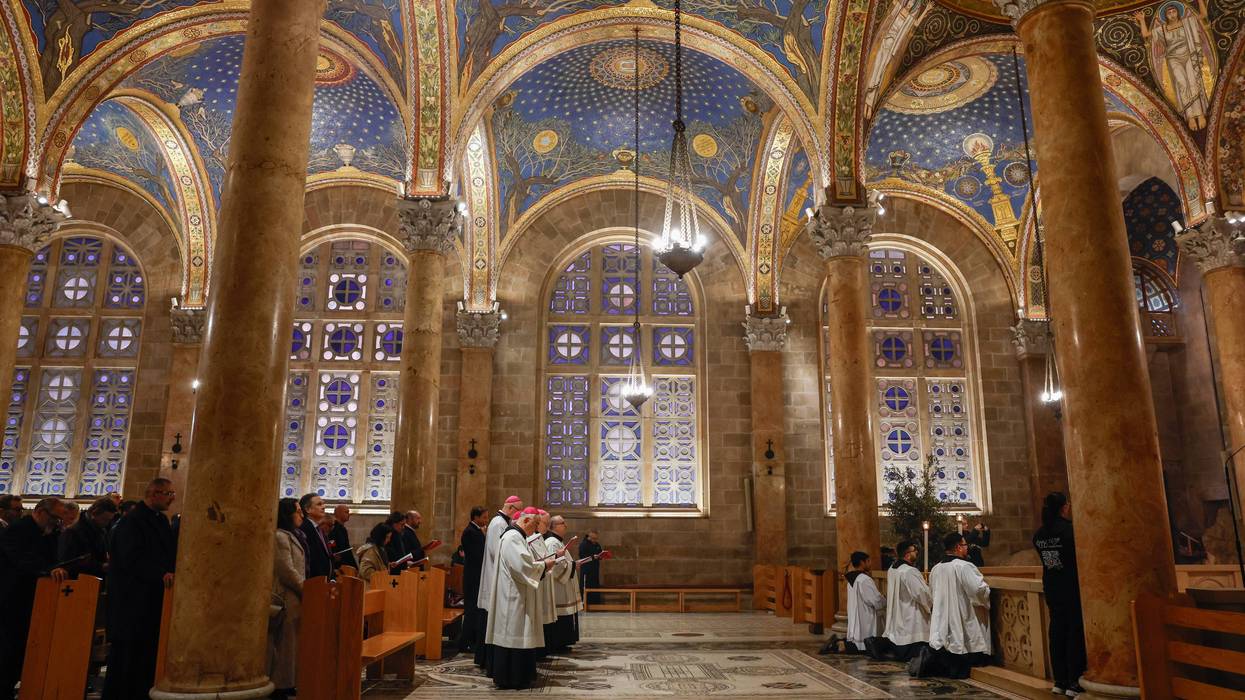

TEL AVIV, Israel (AP) — Israeli police prevented Catholic leaders from entering the Church of the Holy Sepulchre to celebrate a private Mass on the Christian holiday of Palm Sunday for the first time in centuries, setting off a wave of criticism from the United States and others.
Jerusalem's major holy sites, including the church, are closed because of the ongoing Iran war, as the city has come under frequent fire from Iranian missiles.
Early Monday morning, Israel's police said it had approved a “limited prayer framework” for the church, in consultation with the Latin Patriarchate of Jerusalem.
On Sunday, the Patriarchate had called the police decision to bar entry “a manifestly unreasonable and grossly disproportionate measure.” It prevented two of the church’s top religious leaders, including the Latin Patriarch, Cardinal Pierbattista Pizzaballa, and the Custos of the Holy Land, from celebrating Palm Sunday at the place where Christians believe Jesus was crucified.
Palm Sunday commemorates Jesus’ triumphant entry into Jerusalem and launches the Holy Week commemorations for Christians which culminates in Easter.
Israeli police said they had notified church authorities on Saturday that no Mass could take place on Palm Sunday because of safety considerations, the lack of access for emergency vehicles in narrow alleys of the Old City and lack of adequate shelter.
In the Monday statement, police said the new framework would aim to “enable freedom of worship.” It highlighted that restrictions at holy sites without standard protected spaces — like the cavernous church deep in a maze of tiny alleyways — are meant to “safeguard worshippers” from Iranian attacks.
Earlier this month, shrapnel from the interception of an Iranian missile fell on a rooftop just steps from the church.
However, the Latin Patriarchate said the Church of the Holy Sepulchre had been hosting Masses that aren't open to the public since the Iran war began on Feb. 28, and it was unclear why Sunday’s Mass and access by the two priests was any different.
“It’s a very, very sacred day for Christians and in our opinion there was no justification for such a decision or such an action,” said Farid Jubran, the spokesperson for the Latin Patriarchate of Jerusalem.
Jubran said that the church had requested permission from police for a few religious leaders to enter the church for a private celebration on Sunday — not one that was open to the public. The Patriarchate said that the decision impeded freedom of worship and the status quo in Jerusalem.
The traditional Palm Sunday procession normally sees tens of thousands of Christians from around the world walk from the Mount of Olives down the narrow, hilly streets toward the Old City, waving palm fronds and singing.
The Patriarchate canceled the traditional processional last week because of safety concerns, and has held Masses limited to fewer than 50 worshippers in compliance with the Israeli military’s guidelines for civilians.
Pizzaballa instead celebrated Mass in the nearby St. Savior’s Monastery, a soaring marble church which is located next to an underground music school that the Israeli military has deemed a safe shelter space. Later on Sunday, Pizzaballa held a prayer for peace at the Dominus Flevit Shrine on the Mount of Olives, but kept his homily concentrated on Jesus and didn't mention the morning’s incident.
Pope Leo XIV, at the end of Palm Sunday Mass in St. Peter’s Square, prayed for all Christians in the Middle East who he said were living through an “atrocious” conflict. He said that “in many cases, they cannot live fully the rites of these holy days,” though he didn’t elaborate.
The Vatican spokesman didn’t immediately respond when asked to comment on the Jerusalem incident.
US, France and Italy criticize decision
The closure sparked a wave of criticism that Israeli authorities had gone too far in restricting worship, including from Israel’s top ally, the United States.
U.S. Ambassador Mike Huckabee, a devout evangelical Christian, said that the incident was “an unfortunate overreach."
He said in a statement that the proposed prayer with Pizzaballa and the others was well below the 50-person limit for gatherings. “For the Patriarch to be barred from entry to the Church on Palm Sunday for a private ceremony is difficult to understand or justify,” he wrote.
French President Emmanuel Macron condemned the incident, which he said had added to the “concerning increase in violations of the status of the Holy Sites in Jerusalem.” In a post on X, Macron wrote: “The free exercise of worship in Jerusalem must be guaranteed for all religions.”
Italian authorities across the political spectrum condemned the move to restrict Pizzaballa, an Italian cardinal considered a leading papal contender in the 2025 conclave, to access the church.
The Italian government formally protested the incident to Israeli authorities and summoned Israel's ambassador to Rome for clarification.
Premier Giorgia Meloni said that the police action “constitutes an offense not only against believers but against every community that recognizes religious freedom.”
Meloni’s conservative government tried to keep a balanced position with Israel during the war in Gaza, supporting Israel’s right to defense but condemning the toll on Palestinians. The Italian leader has also said that Italy won't participate in the Iran war, while affirming that the Islamic Republic can't be allowed to possess nuclear weapons.
Israel working to allow partial access
Israeli Prime Minister Benjamin Netanyahu said there was no “malicious intent” and that the cardinal was prevented from accessing the church because of safety concerns, but that Israel would try to partially open the Church of the Holy Sepulchre in the coming days.
“Given the holiness of the week leading up to Easter for the world’s Christians, Israel’s security arms are putting together a plan to enable church leaders to worship at the holy site in the coming days,” Netanyahu wrote on X.
In an interview with Italian Catholic broadcaster TG2000, Pizzaballa said there was difference of opinions with Israeli authorities over accessing the church, but that the dispute remained polite.
"We want to use this situation to try to clarify better what will be done in the coming days, respecting the security of all naturally but also in respect of the right to prayer,” he said.
The Western Wall, the holiest site where Jews can pray, is also mostly closed because of safety issues, but authorities are letting up to 50 people at a time pray in an enclosed area adjacent to the plaza.
Smaller churches, synagogues, and mosques are open in Jerusalem’s Old City if they are located within a certain distance of a bomb shelter deemed acceptable by Israel’s military and, if gatherings are kept under 50 people.
The same limitations apply to most of Israel, where schools have also been closed since the beginning of the Iran war and workplaces can function only where a shelter can be reached in the short time available after an alert.
___ Nicole Winfield reported from Rome.


