


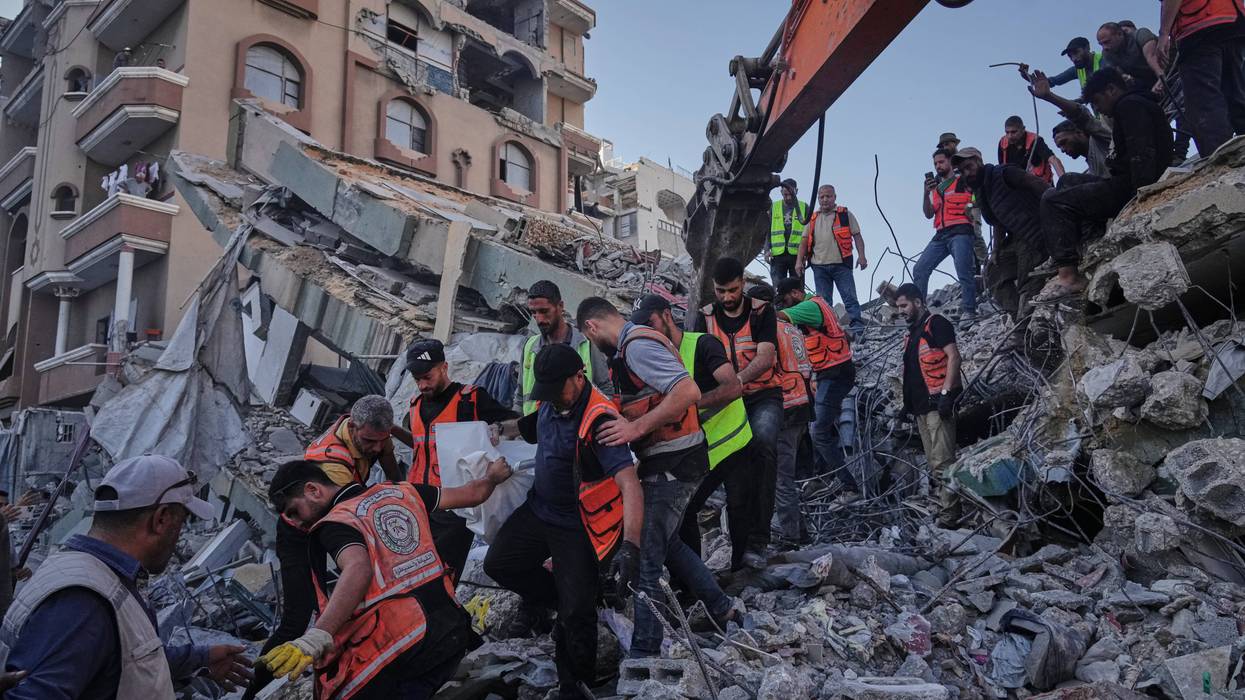

GAZA CITY, Gaza Strip (AP) — A building damaged by Israeli strikes collapsed suddenly in Gaza City early Wednesday, killing at least 21 people in their sleep, including 11 children, in a disaster that forced rescuers to dig through the rubble with bare hands.
The collapse of the building, which was known to be unstable from strikes earlier in the war, underscored how perilous living conditions have become for most of the Palestinian enclave’s population as a ceasefire deal between Israel and Hamas stalls.
No reconstruction work has happened since the ceasefire was agreed to almost a year ago. Israel has said that it will not permit any rebuilding until Hamas disarms, and only a handful of excavators have been allowed into Gaza.
Asked if it would allow in machinery to help with the collapse, COGAT, the Israeli military body charged with coordinating aid to the Gaza Strip, said the Israeli government's policy is that heavy machinery is allowed into Gaza.
Six Palestinian families lived in the building
As of Wednesday afternoon, the death toll included 11 children and five women, according to Zaher al-Wahidi, a spokesperson for the Gaza Health Ministry. He said at least 14 people were injured, and rescuers had finished digging.
Around six displaced Palestinian families had sheltered there, despite knowing the structure was on the brink of collapse, according to Gaza’s civil defense.
“The lack of options and alternatives left them with no other choice,” said Aboud Majdalawi, a civil defense rescuer.
Gaza’s roughly 2 million people now live in a stretch of land that makes up less than half the territory. They are dependent on aid and are surrounded by Israeli troops who carry out strikes or attacks on a near-daily basis.
Rescuers mount a bare-hands search for bodies
In the aftermath of the collapse, people searched desperately for loved ones.
A group of men were seen carrying the headless body of a child. Others sat atop a pile of rubble, pulling desperately at flashes of color they believed could be clothing worn by a survivor. All they found were dust-caked blankets wedged in the debris.
The collapse comes as rescuers in the Gaza Strip are trying to unearth hundreds of bodies from buildings that collapsed in Israeli strikes earlier in the war. They have just a few working excavators, and their fuel supply is dwindling.
On Wednesday, the U.N. human rights chief said he worried that the bodies recovered so far are just the “tip of the iceberg.”
“It is heartbreaking that the loved ones of those missing for so long are only now having their worst fears confirmed,” he said. “Much of Gaza has been flattened by Israeli bombing or demolition and clearing by heavy machinery and explosives.”
Many Palestinians live in buildings that are not structurally sound
Over one-fifth of buildings in Gaza City assessed by the Norwegian Refugee Council in March were not structurally sound, but residents inhabiting them said they had nowhere else to go.
The council leads a coalition of shelter providers in Gaza. In August, the coalition released an assessment of shelter conditions in the strip that said two-thirds of Palestinian households were living in tent camps.
Among those living in buildings, 72% of the households were in structures with minor or moderate damage.
The war was sparked after the Hamas-led attack on Oct. 7, 2023, in which militants stormed into southern Israel and killed about 1,200 people and took 251 people hostage. Many hostages recounted long-term starvation, physical and psychological abuse and, in some cases, sexual abuse.
Despite an October ceasefire that has reduced fighting in Gaza, Israel has continued to carry out strikes, killing at least 1,375 people since the agreement went into effect, according to local health officials.
The nearly three-year Israel-Hamas war has killed more than 73,789 Palestinians, according to Gaza’s Health Ministry. The ministry, part of the Hamas-run government, maintains detailed records viewed as generally reliable by U.N. agencies and international organizations. It does not distinguish between civilians and militants, but says women and children make up around half the toll.
___
Shurafa reported from Deir al-Balah, Gaza Strip, and Frankel reported from Jerusalem. Associated Press reporter Toqa Ezzidin in Cairo contributed to this report.