


SEOUL, South Korea (AP) — In shutting down a month-old Swiss diplomatic office in Pyongyang and expelling its head, North Korea has signaled it will set its own terms as it pursues a more assertive foreign policy. But experts say the move could potentially risk the loss of many European nations as alternative diplomatic partners.
The Swiss drew the anger of North Korean leader Kim Jong Un after they imposed sanctions on a youth camp over its alleged role in the transfer of children from Russian-occupied areas of Ukraine.
Just a few days earlier, in a more upbeat diplomatic moment, Kim received credentials from 10 newly appointed ambassadors, including envoys from ally Russia and longtime diplomatic partner Sweden, in the first such event of his 15-year rule.
Kim used the meeting with ambassadors to defend his nuclear arms buildup and call for the world to respect North Korea’s sovereignty, a standard Pyongyang later accused Switzerland of failing to meet by sanctioning the camp.
Here's a look at the closure of the Swiss office in Pyongyang and what it says about North Korea’s foreign policy.
Feud stems from sanctions on North Korean youth camp
North Korea’s Foreign Ministry on Wednesday summoned Sylvain Astier, head of the Swiss diplomatic office that opened in Pyongyang last month, declared him persona non grata and handed him a notice demanding the office’s closure and his departure from the country within 48 hours.
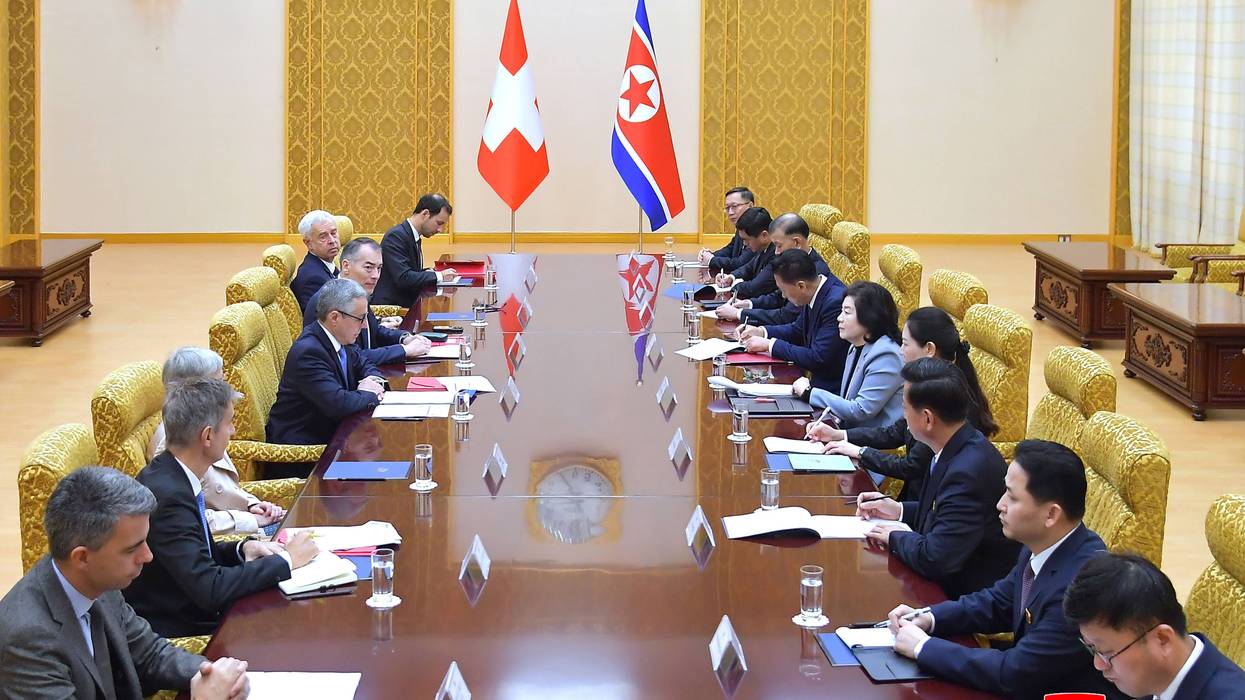
In a statement provided to The Associated Press on Thursday, Switzerland’s Federal Department of Foreign Affairs said it regrets the North Korean decision and was arranging for Astier to return to the Swiss embassy in Beijing. It said diplomatic relations will be maintained through the Swiss embassy in Beijing and the North Korean embassy in Bern and that Switzerland will continue to pursue dialogue through these channels.
Kim Jong Un’s powerful sister, Kim Yo Jong, earlier condemned Switzerland for imposing sanctions on the Songdowon International Children’s Camp in the North’s eastern coastal city of Wonsan. She called the Swiss steps an “open hostile act” that violated the North’s sovereignty, but didn’t directly address Western accusations that some Ukrainian children abducted by Russian forces were sent there to be reeducated with pro-Russian propaganda.
North Korea is one of Russia’s allies and has sent thousands of troops to fight in Russian President Vladimir Putin’s invasion of Ukraine.
Switzerland earlier this month added the Songdowon camp to its sanctions over Russia’s invasion of Ukraine. The United Kingdom in May and the European Union in September imposed similar sanctions on the camp, freezing its assets and banning financial transactions with it. The measures were seen as largely symbolic, given North Korea’s limited financial ties with Europe.
North Korea said in August it downgraded the level of diplomatic relations with the U.K. to that of chargé d’affaires in response to its sanctioning of the Songdowon camp.
North Korea may want to send a warning to other Western nations
Switzerland, which established diplomatic relations with North Korea in 1974, has been one of the few Western countries to maintain talks with Pyongyang. Switzerland previously operated a humanitarian-focused cooperation office in Pyongyang, which closed when North Korea sealed its borders during the COVID-19 pandemic. It was among the few countries allowed to open a new diplomatic office after North Korea reopened.
Kim Jong Un and his sister spent several of their teenage years at Swiss schools in the 1990s, and that may have deepened the sense of betrayal when Switzerland sanctioned the Songdowon camp, said Koh Yu-hwan, former president of South Korea’s Institute of National Unification.
But more importantly, North Korea is sending a broader warning that it could cut off diplomatic access to any country that expands sanctions or pursues policies it considers hostile, effectively putting pressure on the North's remaining Western contacts like Sweden, Koh said.
While Russia and China have blocked recent efforts to tighten U.N. sanctions over North Korea’s nuclear and missile programs, the United States and its European and Asian allies have imposed their own sanctions over illicit activities Pyongyang uses to fund its weapons programs, including information-technology worker fraud and cryptocurrency theft.
Kim Jong Un's diplomatic clout on the global stage has been bolstered in recent years as he's aligned with Russia and has taken steps to strengthen cooperation with China, North Korea's economic lifeline.
Leif-Eric Easley, a professor at Seoul’s Ewha University, said North Korea is benefiting enough from its ties with Moscow that it’s willing to make an example of Switzerland.
“By ordering the Swiss office closed just weeks after it opened, the Kim regime wants to show other states it intends to reengage only from a position of strength and on its own terms,” he said.
Closure of Swiss office removes rare Western contact point with Pyongyang
However, the strategy carries some risk, warned Moon Seong Mook, an analyst at the Seoul-based Korea Research Institute for National Strategy.
“Kim Jong Un may win Russia’s favor, but I think this could further deepen North Korea’s isolation from the international community,” he said.
Park Won Gon, a professor at Ewha University, said the North’s move could have long-term consequences, risking the loss of Europe as an alternative partner while further increasing its dependence on China. About 98% of North Korea’s external trade was with China in 2025.
“For European countries, this move will only reinforce the perception that North Korea cannot be trusted,” Park said.
Kim's advancing nuclear arsenal and deepened cooperation with Russia have bolstered his international standing, and he has steadfastly insisted that he will not engage in talks with the United States unless Washington drops its demand for denuclearization.
As Pyongyang increasingly believes it has the leverage to deal directly with Washington, rather than through intermediaries, European countries such as Switzerland or Asian U.S. allies such as South Korea — which Kim in recent years declared as his most hostile enemy — have likely significantly less value to the North.
“They think they no longer need to make compromises with individual countries ... as they portray their status as a nuclear-armed state on an equal footing with the United States," Koh said.