


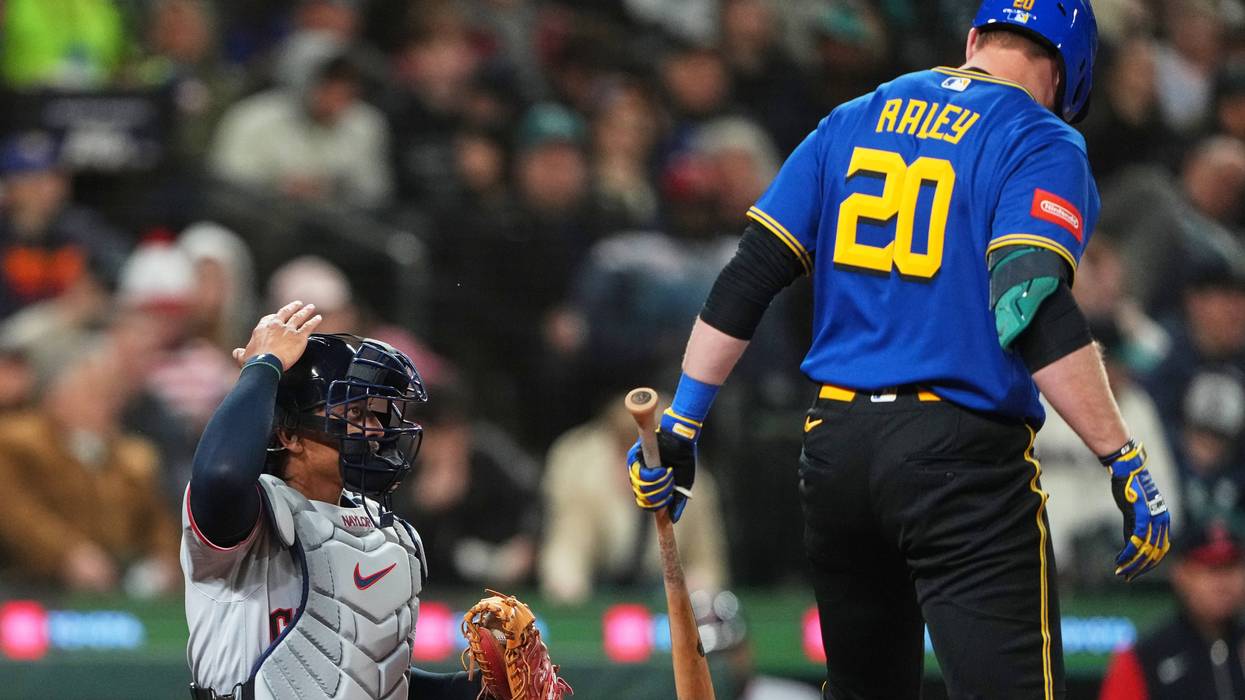

Every moment of pretty much any major sporting event can be dissected in high-definition these days, and officials and umpires are spending more and more time staring at a TV screen to review close calls.
It's also led to a type of sign language unique to the sports world.
There's the twirling motion with a finger that's ubiquitous during NBA games when anyone believes their team has been wronged. In the NFL, it's a red challenge flag thrown by coaches that's often mimicked by fans.
It's not just a U.S. phenomenon, either: There’s the rectangular box drawn in the air that’s everywhere in international soccer for VAR (Video assistant referee). In cricket, certain players can make a “T” sign with their hands, signaling they would like a replay from the DRS (Decision review system). Then the umpire draws a rectangular box in the air, similar to soccer.
Now Major League Baseball has a new entry to the lexicon: A couple pats on the head.
The Automated Ball-Strike Challenge System is now officially part of MLB games, with cameras that track each pitch and judge whether it crossed home plate within the strike zone. Human umps still call every pitch, but each team has the ability to challenge two calls per game.
When a batter, pitcher or catcher believes a ball-strike call has been missed, they can pat their head a few times and also verbally confirm they want a challenge. It hasn't taken long for fans to get in on the lingo, patting their heads when they think there's a bad call.
“Everybody now knows what touching the top of their hat means,” D-backs manager Torey Lovullo said, laughing. “It's definitely caught on fast. I think it's a great thing — everyone wants to get the calls right.”
Sometimes, the hand signals can be seen as a sign of disrespect.
Tampa Bay Rays infielder Taylor Walls was ejected from a regular season game last season after disagreeing with a call, patting his helmet a few times while arguing with the umpire. ABS was used in spring training in 2025 on an experimental basis, but wasn't allowed during regular season games.
Walls maintained it was an innocent gesture. Plate umpire Nic Lentz disagreed and sent Walls to the clubhouse early.
Lovullo said he doesn't expect many misunderstandings in the future.
“There's the verbal command, too, so that should help,” he said.
In many sports, the expanding video review procedures have created new strategies to get challenges right. Many times it's quick non-verbal cues that make the process work.
Many NBA teams have an assistant coach or staff member on the bench who has a tablet and can view the broadcast, reviewing plays quickly. Players sometimes make emotional decisions in the heat of the game — twirling their finger in the air when they believe their team should challenge. (Spoiler alert: Players always think they're right.)
But the final say comes from the bench.
For the New York Knicks, assistant coach Jordan Brink is the man who advises head coach Mike Brown.
“If he does this (nodding his head up and down), then you do this (twirls his finger). If he does this (shaking his head side to side), then you just go ‘Hmm...’ and got to tell your players sorry," Brown said.
Cleveland Cavaliers coach Kenny Atkinson said “you really got to control yourself” because replay reviews are usually emotional situations. Los Angeles Clippers coach Ty Lue had no clue how the finger twirl became the NBA's go-to symbol for a review, but in his typical deadpan manner, said its prevalence could occasionally be annoying.
“I’m sick of looking at it. Let’s take a look at that,” Lue said, drawing laughs from reporters. "Now they’re doing it in college, too, everybody’s doing it.”
MLB now has a pair of replay review signals. Managers can call for reviews of out-safe calls and some other rulings by tapping their hands over their ears, mimicking umpires putting on headsets to discuss plays with MLB's replay center. That and the ABS head-pat have taken over at a time when some of the longtime hand signals of baseball are disappearing. For more than a century, catchers called pitches with their fingers, sometimes relying on an elaborate sequence of signs to keep the opposing team from figuring out the next pitch.
That all started to change following the 2017 Houston Astros cheating scandal, which was uncovered in 2020. Now there's a system called PitchCom that can relay pitch calls and infield positioning decisions without hand signals.
“You used to have signals from the dugout to watch for a bunt, or watch for a delayed steal, but now all you have to do is hit a few buttons,” Lovullo said.
But the low-tech system of hand signals in sports is still very much a thing. In a strange juxtaposition, the high-tech world of video replay is one of the main reasons.
___
AP Pro Basketball Writer Brian Mahoney, AP Sports Writer Joe Reedy and AP freelance writer Dan Greenspan contributed to this story.
___
AP MLB: https://apnews.com/hub/MLB


