


DUNEDIN, Fla. (AP) — Kevin Gausman got 709 called strikes over the past decade on pitches out of the strike zone, tied for the third highest total in the major leagues.
"I would have thought maybe I was top 20 maybe but top five is kind of kind of crazy," the Toronto Blue Jays right-hander said. "I guess the book is kind of still out. We'll see what happens and how we have to adjust."
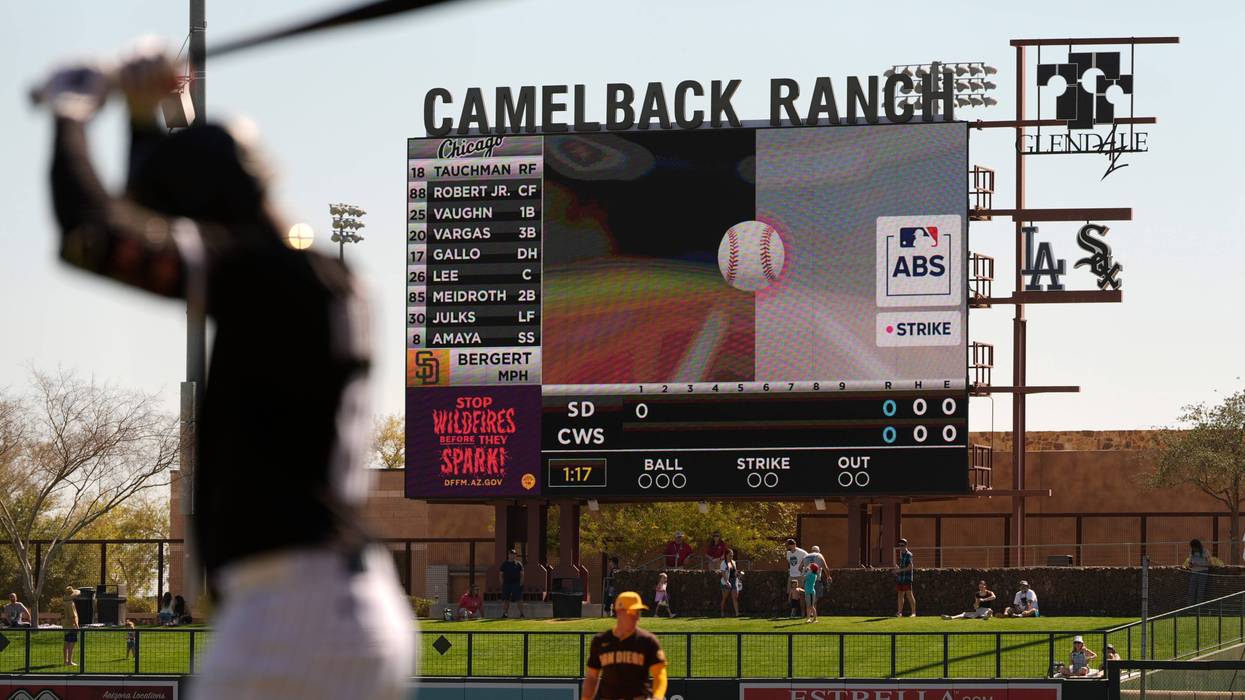
There will be winners and losers under the Automated Ball-Strike System, which makes its regular-season debut Wednesday night when the New York Yankees play at the San Francisco Giants. Using Hawk-Eye technology, 12 cameras measure whether a pitch crosses the strike zone with accuracy of about one-sixth of an inch.
Kyle Hendricks led the majors with 777 called strikes over the past decade on pitches that should have been balls, according to MLB Statcast. He was followed by Aaron Nola (747), Gausman and Zach Davies (709 each), Kyle Gibson (697), Patrick Corbin (694), Marcus Stroman (671), Zack Greinke (667), Martín Pérez (647) and Kyle Freeland (631).
"I guess that's a good thing because you make balls look like strikes," Nola said. "There's going to be some maybe good and bad to it, but I think the good parts and the big situations and big games, I that's going to help out a lot. We've seen over the years our side lose games on a bad call."
Conversely, Corbin topped the major leagues on balls that should have been called strikes with 470. He was followed by Chris Sale (461), Nola (460), Carlos Rodón (450), Yu Darvish (442), Sonny Gray (439), José Berríos (438), Steven Matz (436), and Jon Gray and Justin Verlander (435 apiece).
"All umpires always had like — they give a little bit here, they're a little tight there. You know this as a hitter and a pitcher," said Verlander, a three-time Cy Young Award winner back with Detroit for the start of his 21st big league season. "But it's all because of the way they set up and they see certain areas better than others. And now I think they're put in a situation where they have to call this like theoretical zone, instead of creating their own strike zone that they're probably much more consistent at."
Mookie Betts led batters on called strikes that should have been balls at 714.
"He knows the strike zone as well as anyone and it does seem that he gets the short end of a lot of calls," Dodgers manager Dave Roberts said. "He's a guy I certainly would trust to challenge a call."
Betts was followed by Eugenio Suárez (684), José Ramírez (657), Paul Goldschmidt (656), Aaron Judge (653), Marcus Semien (631), Xander Bogaerts (625), Alex Bregman (603) and Christian Yelich (594).
"When we didn't have a challenge system, you just try to do the best you could and understand that there's stuff that's out of your control," Goldschmidt said. "Definitely the guys that are a little bit more patient are always going to have that. We just understand that's kind of the nature of it."
Giancarlo Stanton had 440 called strikes on pitches out of the strike zone and 351 balls on pitches that should have been strikes.
"The challenge, you could change the whole game right there," the New York Yankees designated hitter said. "If you overturn one call, it could grow 15, 20 more pitches on a pitcher."
Carlos Santana received the most balls that should have been called strikes with 636. He was followed by Mike Trout (612), Suárez (558), Ramírez (554), George Springer (539), Andrew McCutchen (513), Cody Bellinger (487), Freddie Freeman (471), and Ryan McMahon (466).
Statcast has been calculating based on the rule book strike zone at the front of home plate and using a batter's stance. Starting this year, it will compute with the ABS strike zone measured at the middle of the plate and based on a batter's height.
Teams tried to prepare players by using ABS for batting practice and having the scoreboard signal ball/strike decisions.
A 1-1 pitch often can swing a plate appearance. Nola saw ABS in use last August when he made three injury rehabilitation starts at Triple-A Lehigh Valley.
"We're just going to have to see what the umpires do," he said, "if they're really going to be that tight as they were down there."
Statcast showed 1.6% of pitches out of the zone were called strikes last year, down from 2.1% in 2024 and the most accurate since 4.2% when tracking started in 2008.
Only 2.1% of pitches in the zone were ruled balls, up slightly from 1.7% in 2024 but well below 4.3% in 2008.
Pitchers who thrived on getting calls just beyond the black can lose those strikes, and memorable blown calls can be reversed — like Mark Langston's 2-2 fastball to Tino Martinez in the 1998 World Series opener that was over the plate and above the knees but ruled a ball by since-retired umpire Richie Garcia. One pitch later, Martinez hit a tiebreaking grand slam, sparking the Yankees to a 9-6 win and four-game sweep.
Garcia doesn't wish that there had been ABS back then.
"I'd rather take the grief," he said.
___
AP Baseball Writer Janie McCauley contributed to this report.


