



Buffalo, N.Y. (WBEN) - Gary Shoffstall remembers it vivid details 40 years later.
So does Ed Gawarecki.
Shoffstall and Gawarecki, both retired from the Buffalo Division of the U.S. Army Corps of Engineers, were working on Aug. 7, 1986 and saw "Barge 45", a 174-foot, 3,000-pound empty barge, crash into the Peace Bridge.
"I just knew it was not going to end in a good way," said Shoffstall, an Army Corps construction inspector.
The Peace Bridge suffered only minor damage to the pier that was hit.
"I think everyone learned something from a big mistake," said Adam Hamm, Army Corp. Buffalo District Chief of Operations.
But, the barge and the tug boat driving it had different outcomes.
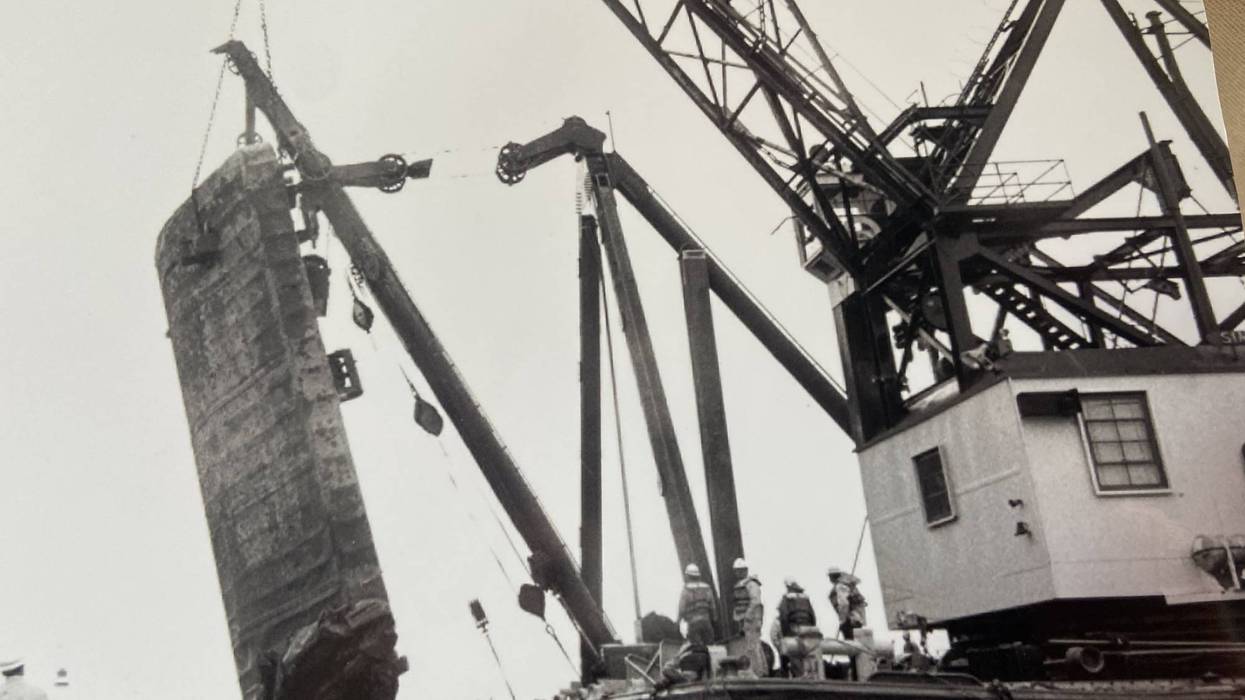
It took four months and a joint military and private sector teams to dislodge the barge from the Peace Bridge pier.
The barge was scrapped after it was removed from Lake Erie and the barge, Ruth B, sunk almost immediately after it and the barge collided with the Peace Bridge.
Ruth B sits at the bottom of the Niagara River near Strawberry Island and Riverside Park, some 22 feet below the surface.
One other casualty: a Dodge Ram Charger that was on the barge but fell into the water and has not been found.
Barge 45 and the Ruth B were en route from Detroit to Buffalo when the accident happened. Both were in what is called the "Emerald Channel" or Emerald Isle" instead of traveling down the Black Rock Channel where the current is slower makes for a safe route.
Gawarecki thinks because the tug boat pilot and barge owners were not familiar with the Lake Erie/Niagara River/Peace Bridge axis and its difficult to judge swirling currents it led to some confusion and ultimately crashing into the Peace Bridge pier.
"It was a factor," Gawarecki said.
The actual accident took about 10 minutes from when the barge was first spotted and when it crashed.
There were concerns about dislodging the barge chief among them: it block about 10% of the normal water flow patterns around the Peace Bridge. The water flows in that area at 5,000 cubic feet per second.
"The current is a huge difference," Gawarcki said.
The empty barge weighed 300 tons and with all the water it took on, its weight doubled to more than 600 tons, Shoffstall said.
By the time, the first attempt to remove the barge came, it was weighing closer to 1,000 pounds because of the water it was taking on.
That's why it took crews from the Army Corps, the U.S. Navy, private contractors and both the U.S. and Canadian Coast Guard four tries to remove the barge, which finally happened on Dec. 19, 1986.
And, it was expensive - to the tune of $5.5 million in 1986 dollars ($16.76 million in present dollars) - and only $20,000 in fines collected.
"The big picture to me is that no one was hurt, no one died and we learned a lot in those four months,"Shoffstall said.
The barge crashed into a Peace Bridge pier, and stayed there for four months
The barge crashed into a Peace Bridge pier, and stayed there for four months