


Buffalo, N.Y. (WBEN) - A Buffalo mother is seeking answers from city officials after her teenage son was involved in an altercation with police officers back on July 19 during the Puerto Rican Grease Pole Festival.
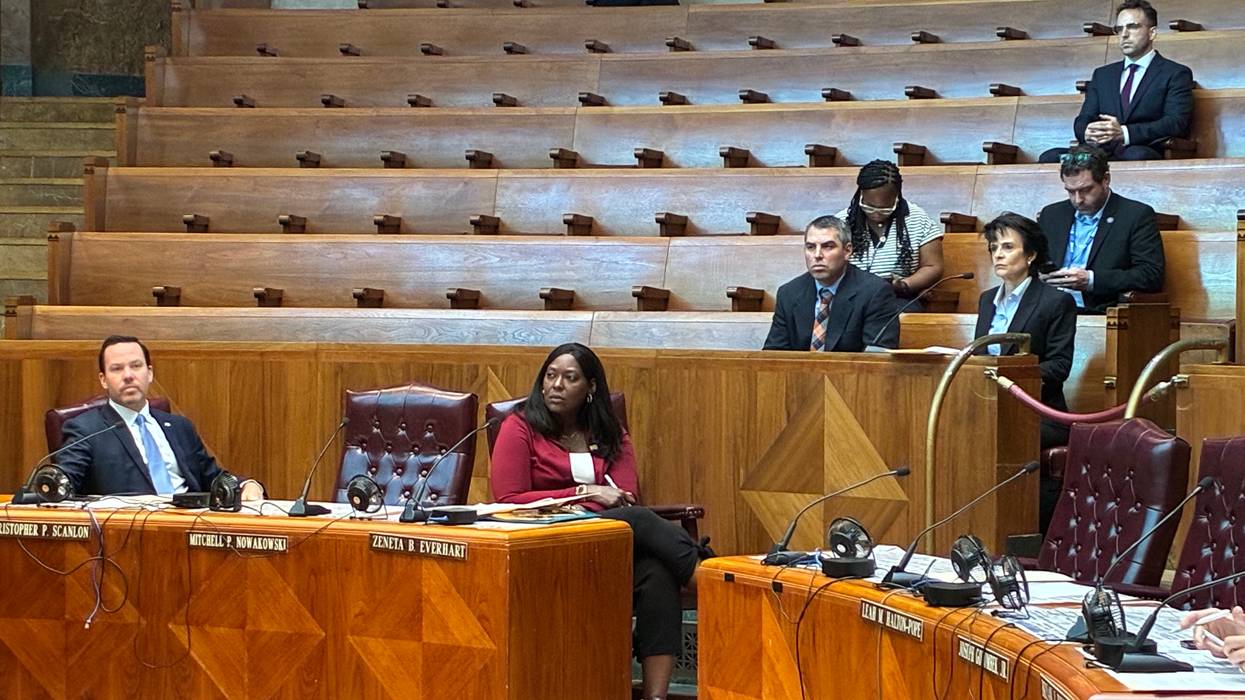
During Wednesday's Police Oversight Committee meeting at Buffalo City Hall, Tiffany Febres spoke directly to city lawmakers, as well as Buffalo police commissioner Erika Shields and asked why her 16-year-old son was jumped on by police officers, and then proceeded to get punched, kicked, and even felt knees on his chest during the incident.
"There were numerous officers that didn't have their cameras on, which it didn't show what was done to my son. My son was assaulted," said Febres during Wednesday's session.
"He went with his friends, he was going to leave, and his family asked him to stay. So he came through a gate that was already open, and when he was coming through the gate, his shoe fell off. And you can see in the camera that he was trying to retrieve his shoe, and an officer jumped on him. ... They didn't tell him why they did what they did. They didn't stop him and speak to him. They just jumped on him, and he didn't do anything. I can understand that maybe he wasn't supposed to be coming through the gate, but that's still no reason to jump on him."
Febres says she later went down to the festival after the incident and spoke with the police lieutenant on site.
"He would not give me any names. First, he told me my son got into a fight, and he didn't. Then he told me my son kicked the gate down, and I have that recording. My son didn't kick the gate down. It shows in the body camera footage that he just came through the gate. So I'm so confused why this happened," she said.
The fact that there is a lack of body camera footage from the officers directly involved in the altercation with her son is extremely concerning for her.
"Body cameras are not simply pieces of equipment; they are supposed to provide transparency, accountability and an objective record of interactions between police officers and members of the public," Febres said. "When officers are involved in a serious incident with a civilian, particularly a young person, and those officers do not have body camera footage, the public is left asking what happened, what was said, and what did the officers do, and why isn't there a recording? I understand there may be circumstances in which a camera may malfunction, or circumstances where an officer cannot activate it. But when internal affairs tells a mother that numerous officers involved in her son's incident did not have body camera footage, I believe that deserves serious scrutiny."
Febres acknowledged the fact that the Buffalo community has heard concerns about police body camera compliance before, with current and former Common Council members and community advocates raising some red flags about police accountability and body camera compliance.
"What happens when the officers don't follow the policy? Is there meaningful accountability? Is there documentation explaining why the cameras weren't activated? Are officers disciplined when they fail to follow the requirement? And most important, how is the department ensuring that this does not continue? Because policies mean very little if there are no consequences when those policies aren't followed," Febres said.
Commissioner Shields says an internal affairs complaint was opened shortly after the incident, and the file is still active at this time.
"What they'll be looking at is whether the force was aligned with our policy, whether de-escalation efforts were attempted, and whether or not the officers complied with the body-worn camera policy," said Shields to the Council and Febres.
Shields says there is body-worn camera footage of the incident at hand, but admits she does not know whether every officer involved had their camera on or not.
"If an officer does not have their camera on, they are out of policy. That is documented in the internal affairs file, and they will receive discipline," she said.
Internal affairs has committed to Shields to have this file closed by the end of October.
When officers start their tour of duty, Shields says their body cameras are in a "buffering" mode, meaning they're holding a 30-second snapshot throughout the day. She says the departmental policy is the minute an officer engages in any level of force or anything could potentially lead to force or a confrontation, they are to hit their camera so it holds the last 30 seconds before immediately recording not just visuals, but also audio.
" There is technology that, for certain recording devices, if you turn the lights or siren on your car, it'll trigger it. There is technology on the holsters so if one employee pulls their gun out of the holster, it activates all the cameras that are in the area. In terms of a standalone officer, they would have to take the initiative to activate the recording, and also that would retain that 30 seconds of buffer time," Shields explained.
She does express some concerns, though, about whether or not some officers are following departmental policy with body cameras.
"I think the policy is well-written. The issue, I don't think so much, is the policy, but officers complying with the policy. That's why if they do not comply with the policy, they are disciplined," Shields said. "And it's a progressive scale of discipline - if they had a second infraction, the discipline will continue to go up."
The police commissioner and the city's Police Oversight Committee says they are taking the allegations seriously, and will see the matter to its conclusion.
"My son was assaulted" - Tiffany Febres
"My son was assaulted" - Tiffany Febres