


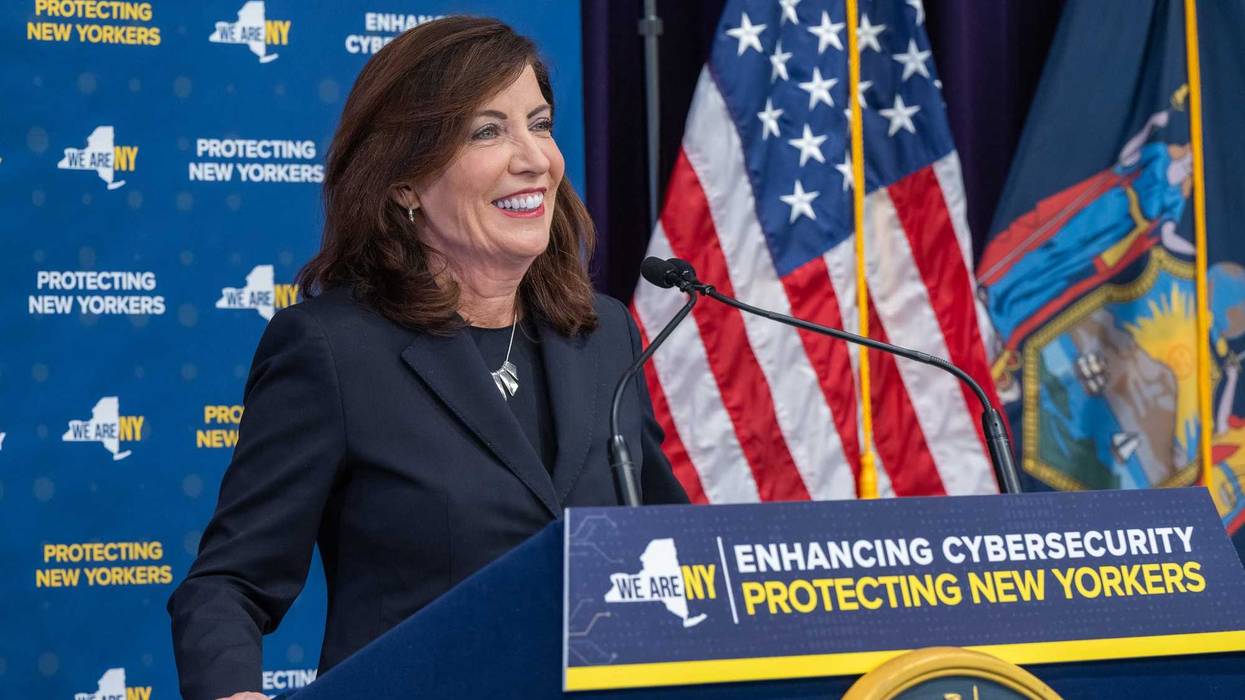

Buffalo, N.Y. (WBEN) - New York Gov. Kathy Hochul has announced a first of its kind cybersecurity strategy for the state, saying it will focus on three areas: unification, resilience and preparedness.
"Our interconnected world demands an interconnected defense leveraging every resource available," says Hochul. "This strategy sets forth a nation-leading blueprint to ensure New York State stands ready and resilient in the face of cyber threats."
Hochul says the strategy unifies New York's cybersecurity services in order to safeguard critical infrastructure, personal information and digital assets from malicious actors. It also provides a framework to align the actions and resources of both private and public stakeholders, including county and other local governments.
Hochul adds New York's cybersecurity strategy is not just about protecting digital assets. "It is about ensuring the safety and security of all New Yorkers and maintaining our ability to function and thrive in the digital age. From the State employees who deliver digital services to the residents who access and rely on them, the strength of the State's cyber defense impacts all New Yorkers. This strategy highlights the Governor's commitment to cybersecurity, not just for State Government systems but for New Yorkers everywhere, as a core responsibility of the State," notes Hochul.
Hochul says the state's comprehensive cybersecurity strategy is defined by three central principles: Unification, Resilience and Preparedness. "When taken together, New York State can lean on these tenets to present a unified and more resilient defense against new and more sophisticated cyber threats; preventing the vast majority of attacks but also isolating, controlling and mitigating potential threats; and preparing, adapting and always being ready for the cyber challenges of the future," says Hochul. "This strategy offers a blueprint for cybersecurity stakeholders across New York, from State agencies to local governments, to understand how they fit into a larger plan. The blueprint provides objectives, lines of effort, and a commitment from the Governor that they can use when doing future planning and program design."
Hochul announced during her State of the State address a $90 million investment for cybersecurity included in the Fiscal Year 2024 Budget which made $30 million in shared services funding available to assist local governments in strengthening their own defenses against cyber threats. This initiative signaled a new and stronger collaboration between the state and its local governments on this critical and evolving issue. A part of this strategy includes providing $500 million to enhance New York State's healthcare information technology, primarily cybersecurity infrastructure, as well as $7.4 million to expand the New York State Police's Cyber Analysis Unit, Computer Crimes Unit and Internet Crimes Against Children Center.
Local cybersecurity expert Michael McCartney is supportive of Hochul's move, considering his time with the New York Attorney General's office. "I know how antiquated systems for almost half of my time there we were using GroupWise in the mail system," recalls McCartney. He says computers, servers, and network infrastructure defense is lacking everywhere.
McCartney recalls working with local government agencies whose cybersecurity was breached. "A lot of those county systems, clerk's offices, and DMVs, are all interconnected. And speaking from experience, once an emissary can breach a network, then they do everything they can to escalate permissions, get more and more permissions on the system, moving laterally across the system, to gain access to other systems, bigger systems," notes McCartney. "We tell companies to upgrade your infrastructure, we call it an infrastructure refresh. Update, you make sure your systems are running all the latest operating systems, software, all the software that runs on those systems is all up to date and patched. Use an EDR, which stands for endpoint detection and response," notes McCartney.
McCartney has one concern, however. Money. "Where are we getting all this money as a state that dole out all these counties and municipalities and buy all this stuff. That's my big question, because the state's kind of broke," says McCartney.
Hochul also signed legislation to expand New York's technology talent pool and provide funding to help ensure that New York-based employers are able to hire and retain necessary cybersecurity personnel.