

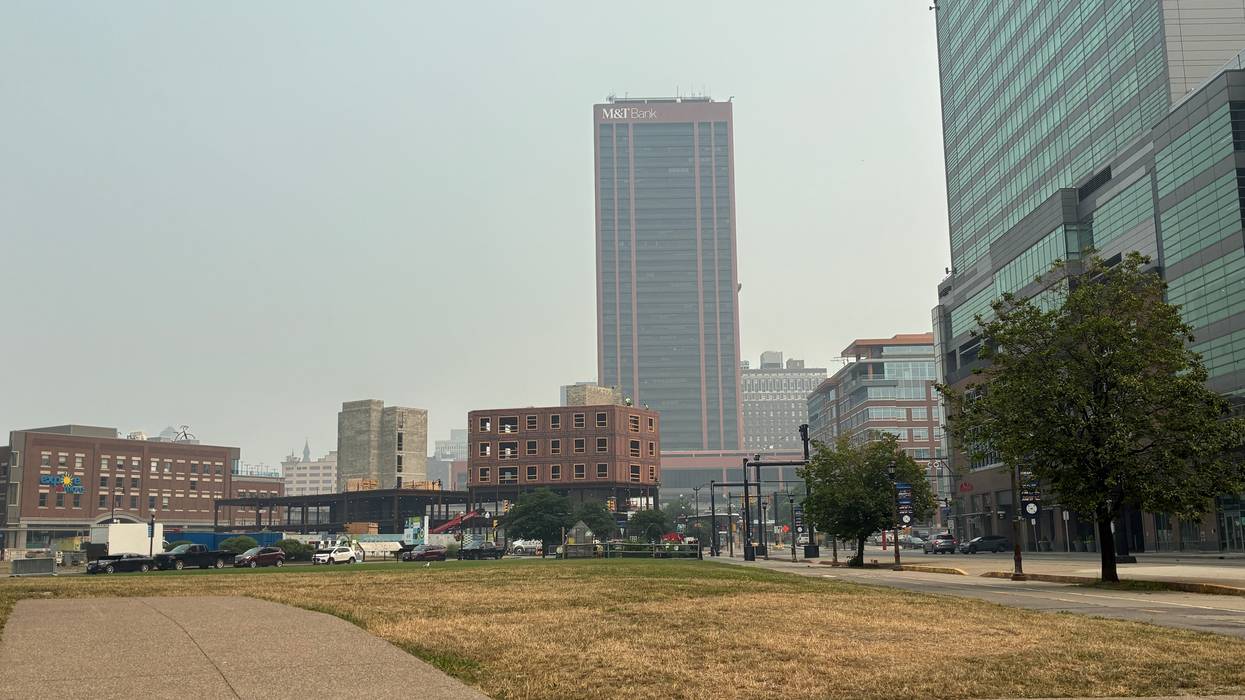

Buffalo, N.Y. (WBEN) - Despite the smoke from Canadian wildfires creating poor air quality values and keeping many Western New Yorkers inside over the last couple of days, there were still a number of workers and others that needed to brave the elements as part of their jobs.
For some, though, the smoke and air quality concerns are nothing as bad as dealing with the Western New York winters and dealing with the cold and snow.
"That's a whole different story," said Geoff Bray, owner of Arbor Lawn in Orchard Park. "I know two years in-a-row, we had five or six feet of snow, and to be honest with you, that's a nightmare. I guess we'll take the heat and the smoke over six feet of snow in a day-and-a-half any day."
For his landscaping crews, Bray feels the smoke and air quality level didn't get to them as much as the heat would.
"For us, it's a little uncomfortable, but it's not anything we can't get through," Bray said with WBEN. "To be honest with you, the cloud cover is blocking the sun, which at the end of the day when it's 85-90, degrees out, that sun will will get the best of you. So we're doing fine, and we're just working through it. But it hasn't, at least for myself and my crew, been a change.
"The heat is definitely what's going to get you. The heat and humidity, I think a week-and-a-half ago, when it was 90 degrees out and the humidity was 180%, that's what gets you. But the smoke, has not been a huge factor for what we're doing."
Bray adds he's advised his crew to continue to drink plenty of water and monitor how they're feeling in the smoky conditions.

Meanwhile, the air quality concerns with wildfire smoke make it a challenging couple of days for positions like postal carriers in the region.
"We've obviously dealt with these types of things before, so some of the carriers, the employer provides PPE - personal protection stuff - and we're asking for masks while we're out there, if we're working in the conditions," said Dave Grosskopf, president of the National Association of Letter Carriers in Buffalo. "Today was a lot worse than yesterday, they actually curtailed the delivery operation in the City of Buffalo and the surrounding AOs [areas of operation] due to the the smoke conditions from the Canadian wildfire."
Grosskopf acknowledges that postal carriers dealing with underlying health conditions - asthma, COPD, etc. - are definitely feeling the effects more than others on the job.
"I know we've had some carriers that have those conditions have to call off work yesterday and today until that air quality can clean up to the point where they can get out there and safely operate without the extra stress and strain on their body," Grosskopf said with WBEN.
While wildfire smoke making its way to Western New York is nothing really new over the years, Grosskopf feels the past couple of days have been the worst he's every seen the air quality locally.
"We're watching the air quality measuring tool there, and it's in the extremely unhealthy range right before the hazardous range. I'm watching some other stuff around the country, for example, Buffalo is at 290-something, and I saw a reading out of you know Milwaukee and it was, like, 694. But definitely the worst air quality conditions I've seen here in Western New York, as far as delivery conditions go for United States Postal Service letter carriers," he said.
Grosskopf wants to make sure his carriers are taking it as easy as possible when going about their shifts in hazardous conditions such as this. He says safety has to be the No. 1 priority.
"We're telling carriers check that air quality on a continual basis, as the union's doing also. We're asking them wear the protective equipment, for example, like an N95 mask if you're out there to filter any of that stuff out. Making sure you're taking breaks if you have to, get yourself out of those conditions inside, where the air quality is good and it's air conditioned. Keep yourself hydrated, know the signs of what to look for - the coughing, the wheezing, the chest tightness, shortness of breath, dizziness. Protect yourself at all times, and speak up," Grosskopf said. "If you're having an episode, let management know. Call us here at the union hall, we can call management and let them know because we don't want this to affect anybody's health. We want them going home the exact same way they came into work."
Smoky conditions due to the Canadian wildfires are expected to continue for Western New York, to varying degrees, through Friday and into the weekend.


