

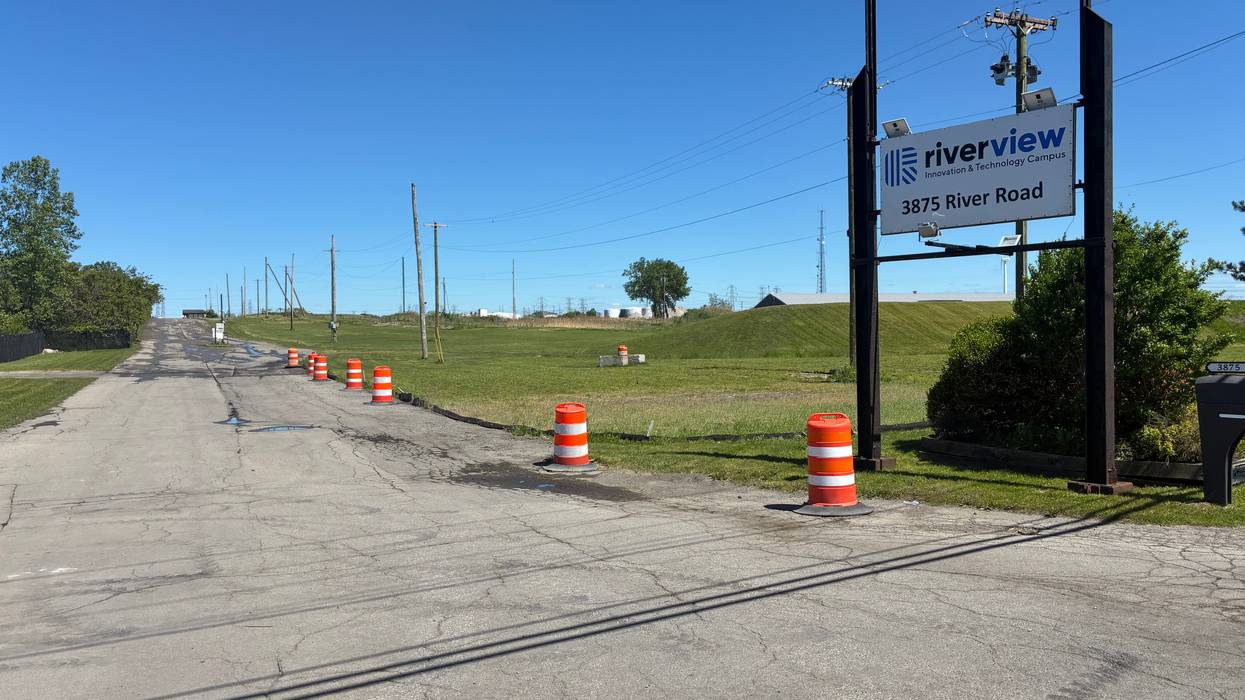

Tonawanda, N.Y. (WBEN) - It was back in April when developers proposed a plan in the Town of Tonawanda to build a new data center on the site of the former Tonawanda Coke Corp. plant. It was set to see a 500,000-square-foot, 300-megawatt AI data center built on the site along River Road, with total construction costs expected to be around $2 billion.
In the weeks since the proposed plan was announced, residents in-and-around the town have already voiced opposition to the project, which includes an online petition with more than 5,700 signatures already.
Jim Jones, board chair of the Clean Air Coalition of Western New York and resident of Tonawanda, is among the many that have reservations about the project at the former Tonawanda Coke site.
"We see the reuse [of the site] as a bit of a step back," said Jones in an interview with WBEN. "They are requiring 300 megawatts of power from the New York Power Authority to power this plant, and that's going to be a constant draw on the system. And there's a huge mad dash to build data centers around the country. There are dozens proposed in the permitting process right now, just in New York, and there are massive data centers being built around the country, and they're all in competition to build artificial intelligence facilities. We think the reuse of the site is a little short-sighted."
Jones and others in the community believe there is very little beneficial purposes when it comes to data centers not just in Western New York, but across the state and the country.
"There's really no long-term jobs that are provided by data centers. There are extreme energy demands on the data center, the building of the data centers," Jones stated. "And technology changes so quickly that the efforts put in by the time they're built, a lot of the equipment and servers that are put in are already beyond their service life. So it's a constant renewal of electronics that have to go into these data centers. There's a lot of mining of precious metals around the world that are really harmful to countries and people who work in this environment.
"There's federal tax incentives to build these, and there are state tax incentives to build these, and it's unclear how that benefits the public. Those tax incentives benefit the developer, they benefit the billionaire, but it is not communicated how those investments or those tax subsidies are benefiting the public, who are paying that. We have no say in that. And there's a lot of pushback from the developers, saying that the people who are adverse to data centers are ill-informed or uninformed, and no one is working hard to inform the public on the public benefits of an AI data center."
Jones is also skeptical over the developer's plans for a closed loop cooling system for the data center at the Tonawanda Coke site.
"The closed loop cooling systems need cooling in and of themselves, and they are also high energy demand. So the infrastructure, the transmission lines of National Grid and around the country, around the state are very old, and these data centers are really pushing the envelope on the capacity of the data grid that we have in our area," Jones explained.
Jones also points to a lack of government regulations that are set up to incorporate data centers into people's land use zoning definitions, as well as a lack of understanding of who and what controls these data centers, what AI tools can do.
"These chat bots are being used for illegal gain right now, and there's no regulatory oversight on that. So we're just trying to call it out, let's take a pause here," Jones said. "Maine has recently passed a moratorium to stop data center development until they can get a handle on the environmental impacts, and to develop a framework, 'Let's all sit down at the table and understand how are we going to work together to make AI the best it can be for the public, as opposed to extractive and harmful to the public.'"
With the backlash surrounding data centers locally and nationally, Congressman Tim Kennedy (D, NY-26) feels these proposed sites should really come down to the community's needs with these types of projects.
"What does the community want? I think the community needs to be front-and-center, giving input," Kennedy said with WBEN. "The government leaders that are working closely with the community members have to have those conversations, bring the community in, and make sure that whatever is done at that site is reflective of the desire and the need for the community.
"Whether it's Tonawanda, North Tonawanda, Alabama or anywhere else in the community here in Western New York, the state or the nation - to be front-and-center on the decisions that are being made for them in the municipalities that they live in."
For new Tonawanda Town Supervisor John Flynn, he knows the needs of the community have to come first with a project like this.
"The needs of the residents and the impact this will have on the residents are, quite frankly, first-and-foremost in my mind," said Flynn in an interview with WBEN. "I don't have any stock in any AI companies, so I'm not looking at this from a personal standpoint. I'm looking at this totally from the standpoint of what's best for our residents."
In the couple of weeks Flynn has been on the job as Town Supervisor in Tonawanda, he's not surprised much by the backlash that has come about from residence on the proposed data center.
"You look at the two areas locally here [North Tonawanda and Alabama], but you expand that out nationwide, you can Google 'data centers' and you'll get 1,000 stories on your phone about problems with data centers all across the country," Flynn said. "From electricity cost to the residents in the surrounding areas, to water problems, noise problems. Those issues are kind of on the micro area of this analysis."
Flynn also points to a "30,000-foot discussion" over the project, being, "Do we here, in Tonawanda, want to support a data center that is going to be used for AI purposes? And is AI in the next 10 years going to take away every job in this country?"
"I've got a daughter graduating college next week, so is AI going to have a significant impact on recent college graduates and their ability to find a job? That question is still up in the air, and no one really knows the answer to that question. A lot of smart people are speculating on those issues and those questions, but no one really knows," Flynn acknowledged.
"So the question becomes, 'As the leader of this municipality, how do I feel about the future of AI? And how do I feel about a pretty big entity now being built in the Town of Tonawanda that may have tangential repercussions to the economy of our country going forward?' I haven't made my mind up yet. I'm just throwing that out there, and I want the residents to know that I'm thinking about that, along with everything else too."
Flynn is in the process of evaluating the pros and cons of a data center for the Town of Tonawanda, and does point out a few notable ones: Jobs to build such a large facility, the potential of a community benefit agreement, and putting it back in a tax roll.
"When you're an elected official and you're making a decision on something like this, you gotta weigh the pros and cons here," Flynn said. "And you've gotta figure out at the end of the day, what is the greater benefit to our community? And when you tip the pros and cons and weigh them, wherever the scale tips, as far as what's best for our residents, that's probably the way I'm going to go."
If it's not a data center at the former Tonawanda Coke site when all is said and done, then what could, or should be put in place at the remediated site?
For Jones, given the money and effort the town has already spent on the site with studies, to go along with feedback from thousands of people locally, he wants to see a less extractive and environmentally harmful type business there, so people can enjoy and benefit from the beauty of the Niagara River.
"What we would like to see there is instead of energy consumption - Tonawanda has been has a long history of energy generation with the Huntley Plant across the street and down the road, which is also a formidable legacy structure there, and we still have to deal with that," Jones said. "What we would like to see is those transmission lines and those substations and the electrical infrastructure are better suited for electrical generation versus electrical extraction. So we would like to see alternative energy sources there, however, not nuclear."
As for Flynn, he knows whatever goes on that site has to be industrial, and can't be residential.
"It's going to have to be some type of industry. I do not have any preconceived notions about what should be there at all," he said. "Some people do, some people want to see 'X' there or 'Y' there, which is fine. I want to see something there to put on the tax rolls, that's my concern, but I'm not going to have that be the end-all and be-all. [But] just because something is put on the tax rolls doesn't mean that it is the best use for our community. If there's going to be skyrocketing electricity costs that our residents are going to have now, because of this data center, that's going to be a problem."
Flynn adds it likely will be quite some time before anyone hears about the future of this proposal.
"Right now, NYISO [New York Independent System Operator] runs the electricity issues in the state. The developer has submitted an application to NYISO to basically see if it's feasible to get hooked into the grid. It's my understanding that NYISO is kind of backed up across the state with other projects that are taking place and other issues, and they're not going to get to this application in the near future," Flynn explained. "Do I have a timeline? No, but nothing can be done until NYISO completes their study. NYISO is going to do a feasibility study here that's going to be kind of the kickoff and the launching pad to actually analyze this project. So until NYISO completes their study, nothing's gonna be done at all on this. And NYISO may not get their study for a while here. So nothing's going to happen in the near future."
"The environmental impact of these data centers is outstanding. It's just overwhelming how much energy they consume. And it's just not in the public's benefit" - Jim Jones, Clean Air Coalition of Western New York
"The environmental impact of these data centers is outstanding. It's just overwhelming how much energy they consume. And it's just not in the public's benefit" - Jim Jones, Clean Air Coalition of Western New York