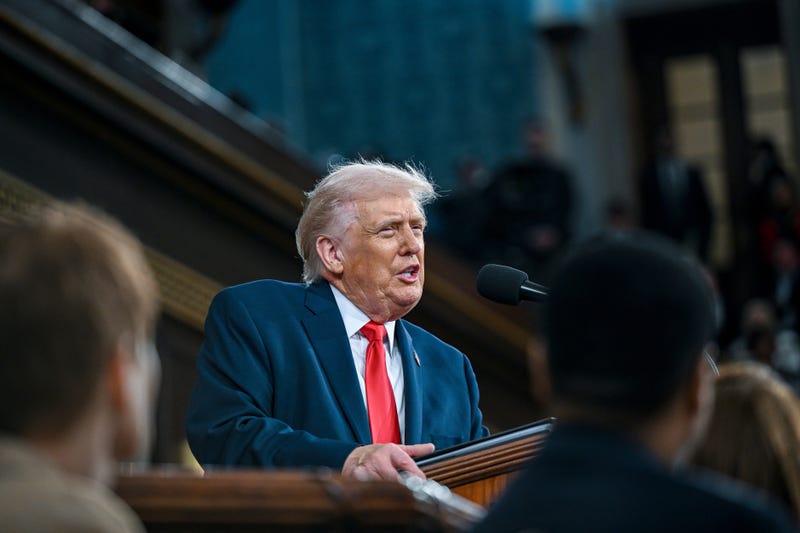
WASHINGTON (AP) — President Donald Trump sought in his first State of the Union address to sell Americans on the idea of a booming economy, falling prices, and soaring jobs, yet he faces a skeptical public with a much gloomier view.
Barely 12 hours before his speech, in fact, The Conference Board, a business research group, released its latest consumer confidence report. It showed that overall confidence in the economy remains historically low, and is barely above the level it plunged to in the depths of the COVID recession.
In February, its index ticked up to 91.2, which is noticeably below a four-year peak reached in November 2024 of 112.8. Americans remain dejected by high prices and see few jobs available, the survey found.
Other polling has yielded similar results: Only 39% of Americans approve of Trump's economic leadership, according to the latest Associated Press-NORC Center for Public Affairs Research survey. And the University of Michigan's consumer sentiment survey remains mired at recessionary levels.
Trump sought to overcome that gloom by pointing to economic data that paints a brighter picture, a tactic that President Joe Biden tried with little success. But on Tuesday night there were gaps between the president's claims and the economic reality many Americans are facing.
“Inflation is plummeting, incomes are rising fast, the roaring economy is roaring like never before," Trump said.
The economy grew last year, but more slowly
To begin with, the economy is growing but it is hardly “roaring.”
It expanded 2.2% last year, down from 2.8% in Biden's last year and 2.9% in 2023. To be sure, most Americans were deeply dissatisfied with the price spikes under Biden that pushed inflation to a peak of 9.1% in 2022, a four-decade high.
A roaring U.S. economy typically looks more like the late 1990s, when growth topped 4% for four years in a row, or in the 1980s, when it rose by 3.5% or higher for six years in a row.
Consumers are still struggling with high prices
Inflation has slowed in the past year, but many Americans still cite high prices in surveys as a key reason they are unhappy with the economy.
Trump correctly noted that core inflation, which excludes the volatile food and energy categories, fell to a five-year low in January. Yet other price measures show that inflation remains stubbornly elevated: A gauge of core prices closely monitored by the Federal Reserve was 3% higher in December than a year earlier, above the Fed's 2% target. It places less weight on housing costs, which have cooled, than the measure Trump cited.
Nearly half of the people responding to the University of Michigan's consumer sentiment survey in February “spontaneously mentioned high prices eroding their personal finances,” Joanne Hsu, director of the survey, said in a statement.
Trump noted that the price of eggs has fallen sharply from its peak, which is true, but most necessities Americans rely on — groceries, rent, electricity — remain much more expensive than they were five years ago. And electricity prices rose another 6.3% just in the past 12 months.
Trump's tariffs have also pushed up the cost of many imported items, including furniture, auto parts, tools, and clothes. And groceries such as ground beef, coffee, and bananas have risen sharply in the past year. Ground beef prices, for example, are up 17%.
Hiring ground nearly to a halt last year
One reason for the consumer gloom is likely the sharp slowdown in hiring last year. Employers added just 181,000 jobs in 2025 — or 15,000 a month – making it the worst year for job growth outside of a recession since 2002.
And despite Trump’s pledge to revive American manufacturing, factories lost 108,000 jobs in 2025 on top of the 202,000 lost in the last two years of the Biden administration. Auto and auto parts plants have cut nearly 74,000 jobs the past two years.
Trump’s tariffs are partially to blame because they force many factories to pay more for imported raw materials and parts. But high interest rates have also hurt manufacturers over the past couple of years. And many of them hired aggressively — perhaps too much — in 2021 and 2022 when the U.S. economy was roaring back from pandemic lockdowns. Automation also means that many factories need fewer workers.
Hiring did come in unexpectedly strong in January at 130,000 new jobs, and factories added jobs for the first month in more than a year.
Benefits of tariffs remain unclear
Trump suggested his tariffs have directly contributed to an economic boom for the U.S., but most Americans have likely seen little benefit.
“Moving forward, factories, jobs, investment and trillions and trillions of dollars will continue pouring into the United States of America,” Trump said.
Trump once again made his tariffs sound painless, insisting that they are paid by foreign countries. In fact, they are paid by U.S. importers who often try to pass the burden along to their customers through higher prices. Foreign companies might take a hit if they have to cut prices to maintain sales in the United States. But import prices haven’t fallen significantly, suggesting that overseas exporters aren’t feeling much pain.
A study by Harvard University economist Alberto Cavallo and two colleagues found that U.S. consumers were eating 43% of the higher tariff costs and that U.S. companies were absorbing most of the rest.
And so far Trump’s sweeping import taxes haven’t delivered much progress toward his goal of reducing the vast and longstanding U.S. trade deficit — the gap between what America sells to foreign countries and what it buys from them.
The U.S. trade deficit in goods such as automobiles and appliances — the focus of Trump’s protectionist policies — actually hit a record $1.24 trillion last year, increasing 2% from 2024.