


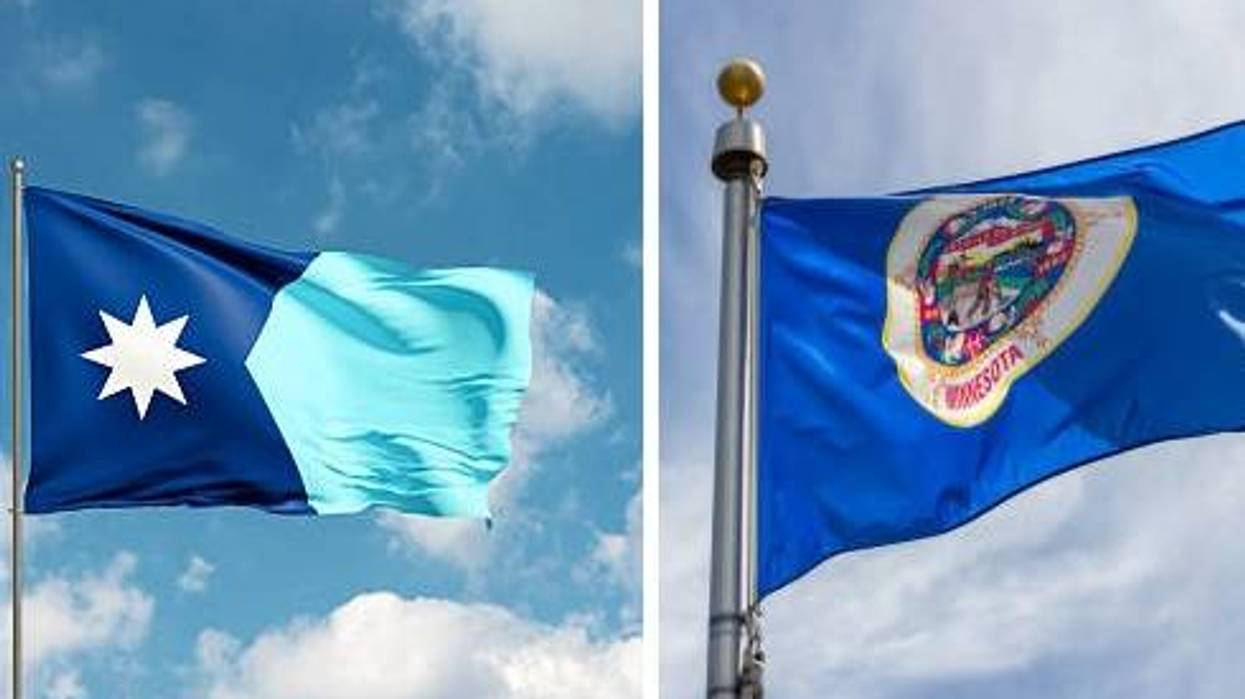
More and more cities across the state are formally opting to fly the 1983 state flag instead of the new official "North Star" flag.
Leaders from more than 20 cities across the state say it comes down to a disregard of public input, and a desire to preserve regional heritage.
"The viewpoints on why are different," Champlain Mayor Ryan Sabas says. "Some people just don't like the way it looks. Some people have the complaint that it looks like a Somalian flag. Some people don't like the process."
In February, the Champlin City Council voted 3-2 to continue flying the pre-2024 Minnesota state flag on city property, rejecting the new state flag adopted in May 2024.
Hamline political science professor David Schultz says the move reflects a deep-seated desire for more direct civic involvement, even as House Democrats introduce a bill that could strip 10% of state funding from noncompliant cities.
"The flag becomes a force of disunity as another issue to fight over for the 2026 elections," explains Schultz.
He says the ongoing friction indicates that partisan control of the legislature could determine whether Minnesota sees yet another flag change in the near future.
In Crosslake, in north-central Minnesota, Mayor Jackson Purfeerst says the historical 1983 flag, which uses an old 19th century territorial logo, actually honors local Native American heritage, and that the redesign process lacked public input.
That community voted unanimously to continue flying the pre-2024 Minnesota state flag.
"We've actually had a few people in town that have thanked us that are of Native American descent for not erasing their history," Mayor Purfeerst said. "We didn't think that the public were really incorporated in with a possible flag change."
Critics, including Native American activists and advocates, argued that Minnesota's old state flag was racist and offensive due to its depiction of a Native American riding into the sunset while a white settler plowed land with a rifle nearby.
Schultz suggests this movement has become a political "rallying cry." In other words? It is not going away.
"The debate over the flag is about contrasting images that both sides use going into 2026 elections," he says.
Schultz also says the standoff appears to be headed for a legal or financial showdown as more cities choose to stand by the 1983 flag.
At least one member of the commission that came up with the new state flag can't believe her work is still being questioned.
"Well, I guess in a word, my reaction is I'm frustrated," said Anita Gaul, a voting member on the State Emblems Redesign Commission. "I thought we would have moved on by now. It's been two years."
Gaul told WCCO's Vineeta Sawkar on The Morning News recenlty that the months-long process was not done in secret.
"We issued a call for public submissions where we got over 2,100 flag designs," Gaul explains. "We immediately put all of them up on a website where people could comment on them, and every round, as we narrowed down those thousands of submissions. We opened it up for public comment."
Back in Champlin, Sabas says that the new flag has become a symbol of disunity and is calling for a more inclusive process that respects Minnesota’s history.
"This should have been voted on by the House, the Senate, and the governor," Sabas adds. "Instead, they created a small committee that got to decide what the flag was."
Sabas adds that he expects this discussion to move to the state capitol at some point, where potential funding cuts for defiant cities may spark a much greater battle.
"The flag's become a force of disunity as another issue to fight over for the 2026 elections"
"The flag's become a force of disunity as another issue to fight over for the 2026 elections"


