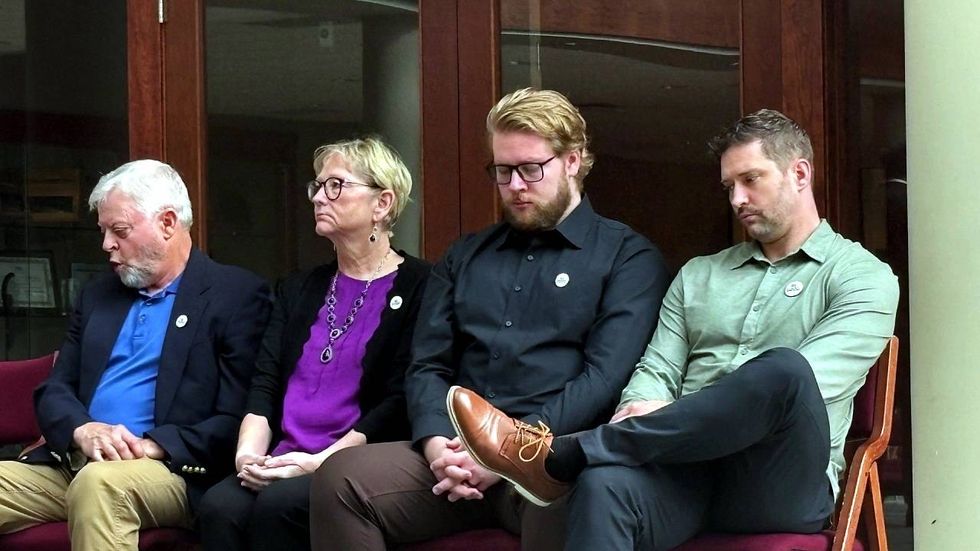


On Thursday, Renee Good's family sued the U.S. government and the architects of President Donald Trump’s immigration crackdown, saying “the time is absolutely now for accountability” after her killing in January by a federal agent in Minneapolis.
The lawsuits — one against the government, the other against Immigration Agent Jonathan Ross, who shot Good, and officials including White House Deputy Chief of Staff Stephen Miller, ex-Homeland Security Secretary Kristi Noem and White House border czar Tom Homan — seek unspecified damages for wrongful death, conspiracy and other violations.
The suits and what could result from them raise significant legal questions, and involves people at some of the highest levels of U.S. Government.
To help make sense of the complicated legal matters, and what comes next, WCCO's Adam and Jordana spoke to Gregory Sisk, Distinguished Chair in Law at University of Saint Thomas School of Law.
He broke down a number of legal scenarios:
One of the legal standards being applied by the firm representing of the family is the Ku Klux Klan Act of 1871. Why is it being invoked in this lawsuit and does the family have legal grounds to use it?
Sisk: It's being invoked because the pathway to obtaining accountability against the federal government is convoluted and complex, and there are certain types of claims, as the lawyers explained during the press conference, if this were a state or local official, bringing a constitutional Tort claim directly against the officer and against the city would be rather straightforward. But unfortunately that statute, that particular statute, does not apply against federal officers. But by contrast, some of these other post-Civil War statutes, including conspiracies to deprive individuals of their civil rights, does not apply only to state officers but does include federal officers. So it opens the door up for those claims to be brought here, and argue that this was part of a deliberate targeting of certain demographic communities in the Twin Cities to deprive them of their civil rights.
I think one of the things that makes this an unusual case, and I haven't had a chance to read every paragraph of the 100-plus page complaint that was filed, but we're all aware of the things that led up to this and the things that we've learned since is the remarkable amount of communications between high level government officials and statements made by the president, by those on the president's staff. That evidenced a certain antipathy towards people of certain backgrounds, and makes this a more plausible case than would typically be brought against federal officials.
Are you saying that the president's past words of some people coming from (expletive) countries, or Minnesota being poorly run and being a sanctuary city, are you saying those words could be used against the federal government in this lawsuit?
Sisk: Absolutely. It doesn't mean that it will in the end be successful, but they certainly would be relevant to indicate that this was not a legitimate law enforcement investigation, that was neutral and targeting as they said officially, the worst of the worst among undocumented aliens who had committed crimes. But that it was for another purpose which was to intimidate and bully an entire group of individuals, Somali individuals, Latino individuals. So yes, it is certainly relevant now whether that will persuade a judge to allow it to go to a jury or persuade a jury that those extreme statements made by the president himself actually influence those underneath the president, within the Department of Homeland Security, and otherwise to take these steps with a malicious purpose. That goes to the merits of the case, but I think it is an unusual circumstance in which you have so many statements made by high level officials that struck many of us observing this as surprising, shocking kinds of things to say. Whereas typically when federal officials are accused of having engaged in some conspiracy there's a lot of speculation involved, not so much here.
When you hear this and you hear this act being invoked, how surprising was it to you? In your estimation, is this a good route to go using this act?
Sisk: I was a little surprised by it. It's not something that I thought about, but I think part of that is because we all knew that this day was going to come, in which there would be a civil lawsuit or multiple lawsuits arising out of Renee Good's tragic death. The focus has been on accountability, for the harm directly to her, and then of course to her family and loved ones in being deprived of her continued support and consolation. Whereas the accusation of conspiracy against the Somali community, against the Hispanic community, doesn't lead directly to a recovery for the death of Renee Good, there's certainly some claims within that second lawsuit that do assert those issues. But those claims in particular would not be claims that lead directly to recovery for that, whereas I expected and anticipated the first lawsuit, the Federal Tort Claims Act lawsuit, because that is the most direct and straightforward way to hold the United States government liable for the death of Renee Good.
Let's talk specifically about that, the Federal Tort Claims Act, FTCA, and sovereign immunity. How straightforward is establishing government liability for assault and battery and wrongful death under Minnesota Tort law?
Sisk: It is wonky, and it requires jumping through a number of hoops, but I think this case has every prospect of being able to do so. So you cannot sue, as the lawyers rightly said, you cannot sue the United States Government without a waiver of sovereign immunity. The federal government has sovereign immunity unless Congress has enacted a statute waiving it. The Federal Tort Claims Act does exactly that. And what the Federal Tort Claims Act says is the United States is to be held liable for the acts of its officers, its employees under state Tort law. So it adopts the state Tort law as the standard for determining liability. It also includes a number of key exceptions, one of which is you can't ordinarily sue under the Federal Tort Claims Act for assault and battery, which of course is exactly what is the claim being asserted here. But then there's an exception to the exception called the Law Enforcement Proviso saying you can do that if the federal employee was a law enforcement officer. And so they're able to bring all of these things together and say he was acting within the scope of employment.
He was Jonathan Ross, the federal agent was acting within the scope of employment. He was a law enforcement officer. There's no question about that, which takes some of those pieces off some of those obstacles off the table. And then it does turn on application of state Tort law. And one of the things which I've focused on, and which I didn't see every moment of the conference, but I don't think was touched as much on, is under state law it's often the case, and my understanding is this is true of Minnesota law, that justifiable use of force is an affirmative defense that the defendant has to establish. So the burden of proof would be here on the government to show that their force was justified. Not on the plaintiffs to show that the force was unjustified, and that shifting of the burden of proof can make a lot of differences. I've been involved in cases in which it has.
We have so many listeners who say 'yes, we respect the rights of people to film this and document this.' What you can't do is obstruct and step in when these official or these law enforcement officials are doing their jobs and people say, 'hey, look, we didn't want her to die, but she was obstructing what they were doing.' Is the government standing on that?
Sisk: Yes, of course there's a lot of doubts about whether she was actually engaged in any obstructive behavior at the time. But even if she was, that hardly authorizes federal agents to use lethal force. Even when an arrest is being made of an individual who is engaged in a serious crime and are being properly arrested for that serious crime, excessive force cannot be used. And so under these circumstances, as I understand it, we've of course all seen these videos and the experts who have broken them down frame by frame. The fatal shot appears to have been fired from the side of the car, not from the front of the car, and even the trajectory of the bullet hitting her in the left side of the head and exiting through the right suggests it was fired from the side. So there was no justifiable basis for using lethal force. And at that point in time, the only thing that she had at most engaged in was some kind of obstruction of the law enforcement process, which would not justify using lethal force to perform an arrest.
In terms of the shifting of the burden of proof, there was an occasion in which I was representing a prisoner in a federal prison, so the Federal Tort Claims Act applied, in which he was present during a riot, but he was not participating in the riot. When correctional officers broke into the area to put down the riot, they yelled, 'run to your rooms.' He did exactly that and in the process was shot five times in the face with rubber munitions that caused him to be to be blinded in one of his eyes. This is tried before a federal judge, not before a jury, and the federal judge held he had the burden of proving that the government had used excessive force, and he could not make that proof and ruled against him. The U.S. Court of Appeals said the judge got it wrong. The burden was on the government to prove that they had used justifiable force, not on him to prove it was unjustified. And on remand, the district judge said that makes all the difference to me. I now conclude that he wins. The government failed to show that they to prove that they had justifiable use of force. And so that shifting of the burden from the plaintiff to prove that what you did was wrong to the government to prove what they did was right can make a difference in the outcome of a case.
What about this defense that we've heard the government use in the past that the car was driving toward agents? We heard the defense say that the car wheels were turned a different way. She was going slow. How will the defense or the U.S. Government try to claim that they had to use this kind of force?
Sisk: I think you put your finger right on it. Their argument will be that she was driving the car at him, or at least he reasonably perceived that she was driving the car at him. And he opened fire in essentially in self-defense. There's going to be at least two problems with the government's argument in that regard. The first is that we have pretty good indication that the fatal shot was fired at a point in time when he was to the side of the car. The car was in no way approaching him at the time he fired that fatal shot. The other is that you can also assert claims, and the plaintiffs have, of negligence. One of the things a law enforcement officer is trained to do when it involves a car stop, don't walk in front of the car. That's a dangerous place to be. Mistakes can be made. And yet this officer, Jonathan Ross, walked directly in front of the car at one point. That was poor, negligent behavior on his part. And so he created a situation in which he later perceived a danger, but he had created that situation by placing himself in that position to where she, acting by all indications in an innocent way, attempting to leave the scene, might have been misperceived because of the situation that he'd created. That's a legitimate part of the plaintiff's claim, I think, as well.
How important is it which federal district this suit is filed in and the judges that will hear it?
Sisk: I don't think greatly so. It's filed here in the District of Minnesota, and that's the most logical place for it to be filed. It's not clear to me there's really any other place it could have been filed, given that the venue statutes, that's a technical term for which federal district you file it in, provide that you against the federal government, you can file it in the place where the plaintiff resides. Which of course is Minnesota, or where the incident occurred, which again, of course, is Minnesota. So I don't think there's any other place that it could be filed. We have an incredibly talented, experienced federal bench in the District of Minnesota. The only way that it could make any difference, is that the judges would by necessity have some general understanding of what was occurring during this time period. But, in the end, it's going to be decided not by a jury. A Federal Tort Claims Act suit is tried to the bench, so the judge makes both the legal rulings about whether the government has any defenses, and they will raise additional defenses to the ones that I've mentioned. They will come up with, I'm assuming they're going to come up with some policy arguments and so on as well.
The facts will also be decided by the judge. That's the reason I brought it up is because you mentioned the original reason we were going to have you on is this complaint filed against these federal judges and the fact that the Department of Justice wants these judges to recuse themselves from immigration type cases. What role does that complaint that's filed play in this? I would expect the government to move to have every judge on the Minnesota bench recused. And is that possible to happen?
Sisk: I mean, in theory, that could happen, and then you bring in a judge from another district to Minnesota to hear the case. I don't see any basis for doing that. The particular episode that occurred isn't, as the lawyers rightly said this morning, isn't about immigration policy, which is what the New York Times article is about. It isn't about who was targeted. I mean, parts of this lawsuit are, but not the Federal Tort Claims Act part of it's not. It's about a particular incident that occurred. It's not saying that the law enforcement officers were engaged in unlawful behavior at the time that they were conducting the law enforcement operation. It's just that they used excessive force, or it's at the heart of it that they used excessive force. So, I wouldn't presume to speak for the federal judges in the district as to whether they would individually recuse themselves, but my view would be that there would be no legitimate basis for them to do so. And they would be perfectly appropriate to stay on it, and I would be very surprised if an appellate court here, the Eighth Circuit, were to hold that that was an abuse of discretion not to recuse themselves.
If they don't recuse themselves and stay there, can the judge or judges be removed by the federal government?
Sisk: No. I mean, the federal government can file a motion asking for the judge to recuse him or herself, and then the judge can rule on that. And at some point, typically at the end of proceedings in the district court, that could be a subject for appeal before the U.S. Court of Appeals for the Eighth Circuit, that the judge should have recused themselves. I would not expect that there would be a strong enough basis for the recusal. The Eight Circuit would second guess that if there was a recusal to occur. There have been cases in which an entire district court bench have been recused because of something that has occurred. Then you simply bring in a federal judge from another district who flies into Minnesota for the trial and conducts that. That's not a terribly unusual thing to occur. I don't think it would make any difference in the outcome here.
The attorney mentioned other people who have been shot by ICE, and Alex Pretti is one of them. Is this going to be a class action lawsuit?
Sisk: No. For class action you'd have to have a group of people that was much larger than this. And in any event, you have to make an individual administrative claim, what they referred to as the SF-95 Claim, to the court, to the administrative agency has to be made individually by each plaintiff. So those involved in the Alex Pretti matter will have to do that separately and damages, of course, be separately looked at. In addition, it wasn't a single episode that occurred. I mean, there's certainly a relationship between the two in terms of whether DHS was acting too aggressively, but they were entirely separate episodes, and so I would not expect that these would be tried together.
What is the end goal of this lawsuit? What happens if the United States government loses this case?
Sisk: If they lose the case, but particularly the Federal Tort Claims Act case, it will be a damage award. That's the only remedy under the Federal Tort Claims Act. I haven't had a chance to read the other complaint to see if they're seeking injunctive relief to prevent the government from behaving in this way in the future. That would be an appropriate thing to ask for under the Ku Klux Klan line of cases, that there could be liability for the actions that they took. But also to enjoin them from engaging in that behavior in the future. I didn't get to the remedy part of the complaint to see if they had asked for that there, but under the Federal Claims Act, it is solely a damage remedy, and the judge who hears the case, if the judge found that the facts and the law justified liability, would assess what those damages were for a loss of life like this. We would certainly be talking about millions of dollars, and that would be paid by the U.S. Treasury.
The suits and what could result from them raise significant legal questions, and involves some of the highest levels of U.S. Government
The suits and what could result from them raise significant legal questions, and involves some of the highest levels of U.S. Government