



Measles cases continue to climb across Minnesota, echoing a pattern seen across a number of U.S. states.
The Minnesota Department of Health report earlier this week that there are now 122 confirmed cases of measles since mid-September.
Todd County has seen the biggest outbreak this year, with 115 total cases, including 58 confirmed cases just in the last week due to what health officials say is a widespread lack of vaccination.
139 total cases have been reported this year in total, compared to just 26 all of last year. This marks the highest total in Minnesota since 1990, and is nearly double the highest in the last decade.
The news comes as health officials reported on Thursday that an infant has died from measles in southwestern Wisconsin, marking that state's first measles-related death since 1990.
Other areas in the Northeast have been hard hit as well.
Lancaster County in Pennsylvania has been the epicenter of the nation's worst measles outbreak in 35 years. It's also home to the largest Amish population in the U.S. Some Amish and related Mennonite groups, with historically lower rates of vaccination, have been hit hard.
Vaccination rates also declined in the general population amid the resurgence of a contagious virus considered “eliminated” from the U.S. since 2000. Pennsylvania leads the U.S. this year with over 1,350 cases.
A child in rural northern New York has also died after contracting measles, marking that state’s first death from the disease in 30 years.
Measles spreads easily when people who have it breathe, cough or sneeze, or through contaminated surfaces.
“Measles is really the lion king of infectious diseases when it comes to transmission,” said Michael Osterholm, who directs the University of Minnesota’s Center for Infectious Disease Research and Policy. “No one in the United States of America who is susceptible to the measles virus, either having not been vaccinated or not having previously had it, should feel safe from measles. No one.”
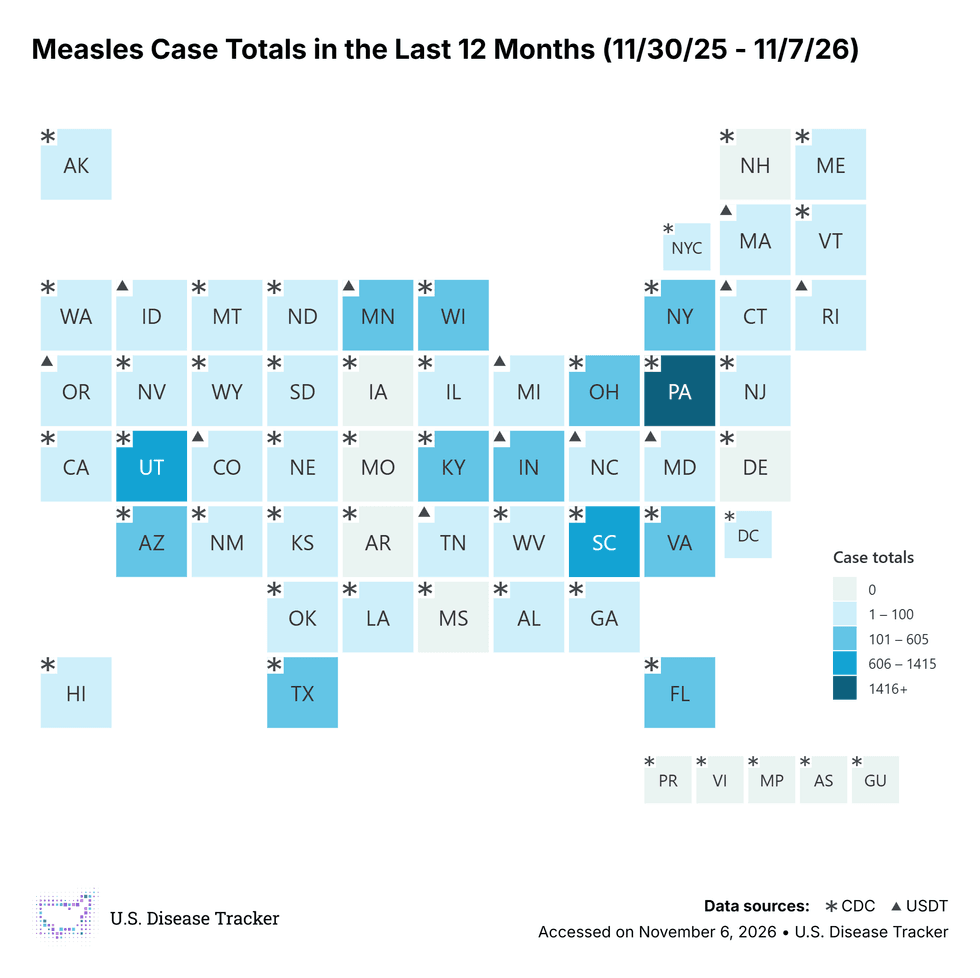
The U.S. is currently experiencing a resurgence of measles, with the number of confirmed measles cases reported in the U.S. in both 2025 and 2026 exceeding that of any year since 1991.
The risk grows as vaccination rates decline. Vaccine hesitancy that rose across populations during the pandemic still lingers.
That's eroded “herd immunity,” which occurs when enough people in an area have immunity to measles that it no longer spreads easily.
Although nothing short of 100% immunity guarantees the virus won’t spread, an outbreak is considered unlikely if a community has a 95% MMR rate. According to the Centers for Disease Control and Prevention, 92.4% of U.S. kindergarteners in 2025-26 received the required MMR shots. That’s down from 95.2% in 2019-20.
The Associated Press contributed to this story.