


It’s clear now that another wave of COVID has been circulating around the country, and the Upper Midwest has been hit particularly hard. Health officials across the state have been sounding the warning alarms for a few weeks. States surrounding Minnesota have seen skyrocketing cases, hospitalizations and deaths. The numbers are the highest since the early stages of COVID back in May.
In fact, Minnesota reported its single-day case record with 2,872 cases and 32 deaths. The previous high-case mark was just under 2,300 just 2 weeks ago.
Thursday marks the third time in less than 10 days with at least 30 COVID deaths. Minnesota’s single-day high for fatalities is 35.
Hospitalizations in Minnesota are of particular concern. Hospital admissions and ICU admissions over the last two weeks are the highest they’ve been across the state since the pandemic began.
Thursday on the Morning News with Dave Lee, Dr. David Hilden of Hennepin Healthcare told us to get ready for a rough start to the winter.
“Minnesota is in for a rough go of it in the coming months,” said Hilden. “I'm a little bit concerned.”
Currently, it is rural Minnesota that seems to be getting hit the hardest by coronavirus cases.
“Indeed they are,” Hilden told Dave Lee. “We have a conference call every week with the eight large healthcare systems in Minnesota. There are eight and roughly in the smaller hospitals, which are called critical access hospitals because truly they’re critical to getting people in greater Minnesota care. They are seeing cases which is new. And they didn't have that last May. It was in the Twin Cities and now that's not the case. It's throughout Minnesota."
Hilden, who is the host of WCCO's "Healthy Matters" on Sunday morning, is warning that hospitals are starting to run into space issues all across the state.
“So the metro area hospitals are filling up,” Hilden says. “This is not just more testing. We’re filling up, and the big hospitals in St. Cloud, Rochester in Duluth. They are getting more cases, like they had not seen before. I had a conversation with a colleague in Duluth and a conversation with a colleague at Mayo in Rochester. They're seeing cases like they had not seen this past spring, and so that is spilling over too. All the critical access hospitals, those smaller hospitals that do such a good job caring for Greater Minnesota. They are starting to see cases, and so that's a concern. Our hospitals are facing strains like we like we haven't seen since May.”
There has been a large increase in testing capabilities across Minnesota, with a new saliva testing site opening in Brooklyn Park October 20th.
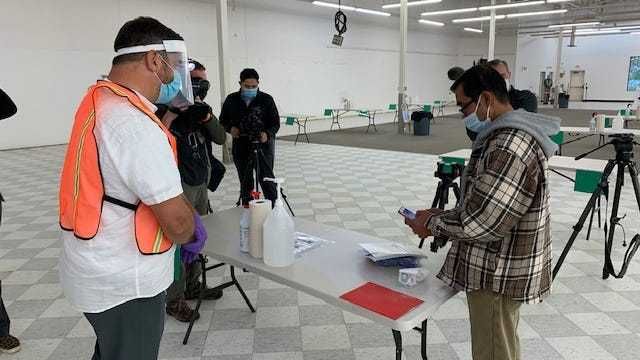
Dr. Hilden, who is a primary care physician and an acute care hospitalist at HCMC in downtown Minneapolis, says more tests are a big part of the strategy for combatting COVID.
“Testing, then with appropriate response to what we learn, that's how we control this thing,” Hilden said. “So if we can do rapid tests, which aren't quite as accurate as the nasty nasal swabs or even a saliva test. But they're good. They're pretty good. If we could do that, it could be one of the ways we get back to some sense of normalcy, schools and the like, because most of our problems, if you will, are the result of us not doing as a community what we know we need to do. And so we can test, test, test, and it will find more cases. But the problem that we're seeing is that the number of hospitalization and the number of deaths is rising, and it's rising at a rapid rate. If we don't find out who has this and isolate them and keep them away from others, we're in for another three months of a very rough winter and and a lot of Minnesotans are not going to survive it. So the rapid testing is one part of that that could really help.”
Hilden also told WCCO that it is crucial we test children more, not necessarily because they are at risk, but because they are carries of the virus.
“Kids, like we've talked about, they don't get symptoms very much. Maybe a couple of little samples here and there, but they carry the virus and give it to others. So if we could identify them that would be really helpful. As long as then we do what we have to do with the data that we learn. So I'm hopeful about that strategy.”