
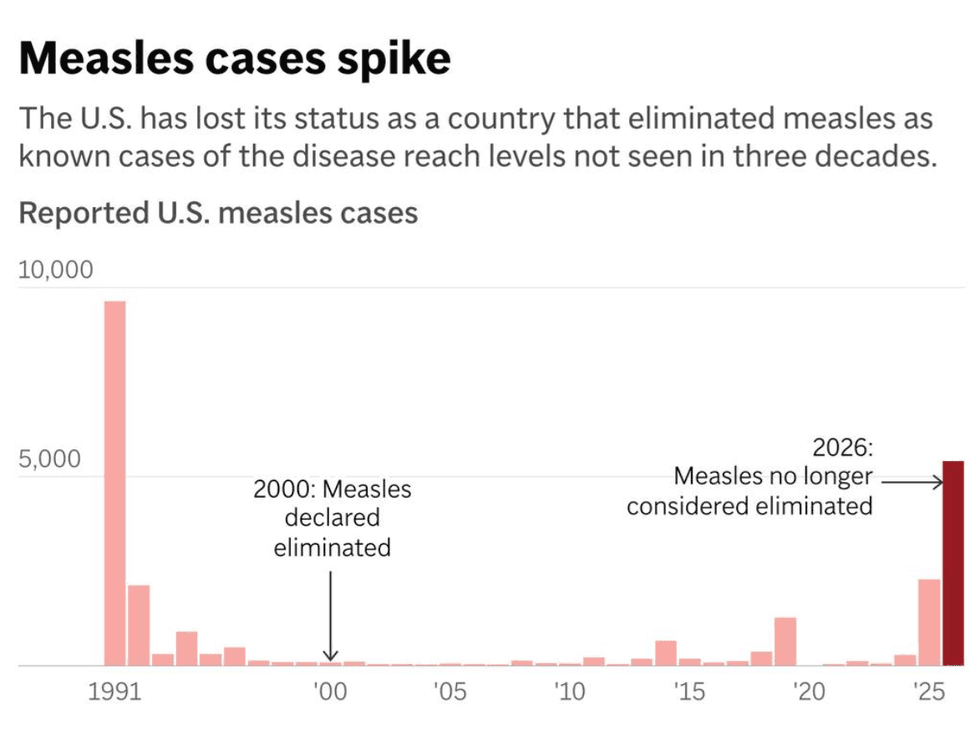
More people could be at risk of getting measles, as the United States lost its measles-free status on Tuesday, two decades after nearly eliminating the illness entirely.
"We were expecting it, but still getting the news, it is quite devastating," said Minnesota Department of Health epidemiologist Dr. Ruth Linfield.
She says it took decades to completely eliminate the illness in the U.S. That happened back in 2000.
Still, she says it's possible to get back there. Unfortunately, this reoccurrence of measles is simply because of choice.
"But we need the will," Lindfield explains. "We need people to realize what a serious disease measles is, how contagious it is, and how powerful our tools are to prevent measles."
Center for Infectious Disease Research and Policy Director Dr. Michael Osterholm tells WCCO Radio that this may be just the start of a more serious situation.
"There were a number of us in the public health world that recognized even 6 months ago that this was going to happen based on what we saw coming down," says Osterholm. "Just to give you some perspective, Canada last year had 5,400 cases of measles with a population of 40 million people. We have 350 million people, and had we the same rate of measles as in Canada, that'd be over 50,000 cases here in the U.S. And I'm not so sure the next year that might not happen. Things are going to get a lot worse before they get better in terms of measles."
Minnesota has experienced its highest number of measles cases in 36 years, with 143 confirmed cases, most of those in rural Todd County. There have been serious, much more significant breakouts in other parts of the country, including Texas, Utah, South Carolina, Pennsylvania, and more.
Measles has been spreading throughout the Americas since 2024. The outbreaks in North America started in close-knit Mennonite communities and have since spread to areas with low vaccination rates. Last year, Canada lost its measles-free designation for the first time since 1998.
International health officials consider measles eliminated when the virus is not locally spreading among residents. The designation hinges on whether a single measles chain has spread uninterrupted for at least 12 months.
In a statement, the Minnesota Department of Health noted that decades of research have proven that two doses of the measles, mumps and rubella (MMR) vaccine will prevent measles in 97% of the population.
"Most families choose to protect their children with MMR immunization; however, there has been a decrease in the percentage of children vaccinated over the past several years," said MDH. "In Minnesota, our most recent data shows that only 81% of children born in 2023 had received their first dose of the MMR vaccine by the time they were 2 years old. In some counties and communities, those rates are much lower. Because measles is so contagious, the disease spreads quickly when immunization rates decrease."
Osterholm calls the situation completely preventable.
"Our vaccines for measles are so effective, very safe, and that's the real challenge we have," he said Tuesday afternoon in an exclusive interview with WCCO Radio. "We don't have to have this."
But, low vaccination rates across the U.S. are going to make this outbreak continue, and in Osterholm's words, be just the beginning.
"This is going to play out for months and months and months to come," Osterholm explains. "And I fear desperately the fact that one day we're going to wake up and say, 'boy, I wish it could only be as bad as it was at the end of 2026.'"
He also had a message for those people that are vaccinated:
"Congratulations. You're a vaccine hero. "You have taken that step to protect yourself, your family, others. That's to be commended," he said.
Critics say the US response is falling short
U.S. Health Secretary Robert F. Kennedy Jr. was a leading voice in the anti-vaccine movement before President Donald Trump appointed him to oversee federal health agencies.
Kennedy and other federal leaders have argued that vaccination rates were waning for years before Trump took office a second time, that measles is not an “American phenomenon," and that the U.S. government is handling measles better than other countries. In January, a U.S. Centers for Disease Control and Prevention leader told reporters that the loss of the nation's elimination status would be the “cost of doing business” globally.
It's true that other countries are struggling with measles, and some also have lost their measles-elimination status. But public health experts and others say the outcome in the U.S. wasn't inevitable.
“This humiliating determination is the tragic yet predictable result of an ongoing campaign by grifters, quacks and charlatans to put their own greed and self-worth ahead of the health and safety of children,” said Sen. Ron Wyden, a Democrat from Oregon.
The government has been taking some steps. In August and September, the CDC awarded $100 million to support state and local measles-response work. And Kennedy and CDC Director Dr. Erica Schwartz have made statements that vaccination is the best way to prevent measles from spreading.
“The measles elimination designation is not what protects Americans. Vaccination does,” Schwartz said in a statement Tuesday. "We know where transmission is occurring and we’ve invested $100 million in state and local health departments to reach those communities.”
But state and local health officials say the cost is far higher and that the moment demands a louder federal voice — and a bigger push for vaccinations — than Kennedy and Schwartz are providing.
“When the people at the front of the room are not speaking loudly and frequently in support of vaccination, the program starts to falter. And that’s what we’re seeing in the U.S.,” said Noel Brewer, a University of North Carolina public health professor who chairs a committee that presented an analysis of U.S. measles data to PAHO last week. “How many kids have to die before they start getting concerned?”
Some experts noted that neither Kennedy nor the CDC has scheduled a news conference to address their plans to fight measles. After the PAHO news conference, though, he posted on social media that “We will stop measles outbreaks, protect American families, and work to regain U.S. measles elimination status.”
What's next?
After hugely successful vaccination campaigns, the Americas became the first region in the world to be free of measles in 2016. Health officials estimate the measles vaccine prevented 6.2 million deaths in the Americas between 2000 and 2023.
Now, the entirety of North America faces the task of earning back the designation.
Associated Press writers Mike Stobbe and Devi Shastri contributed to this story.