

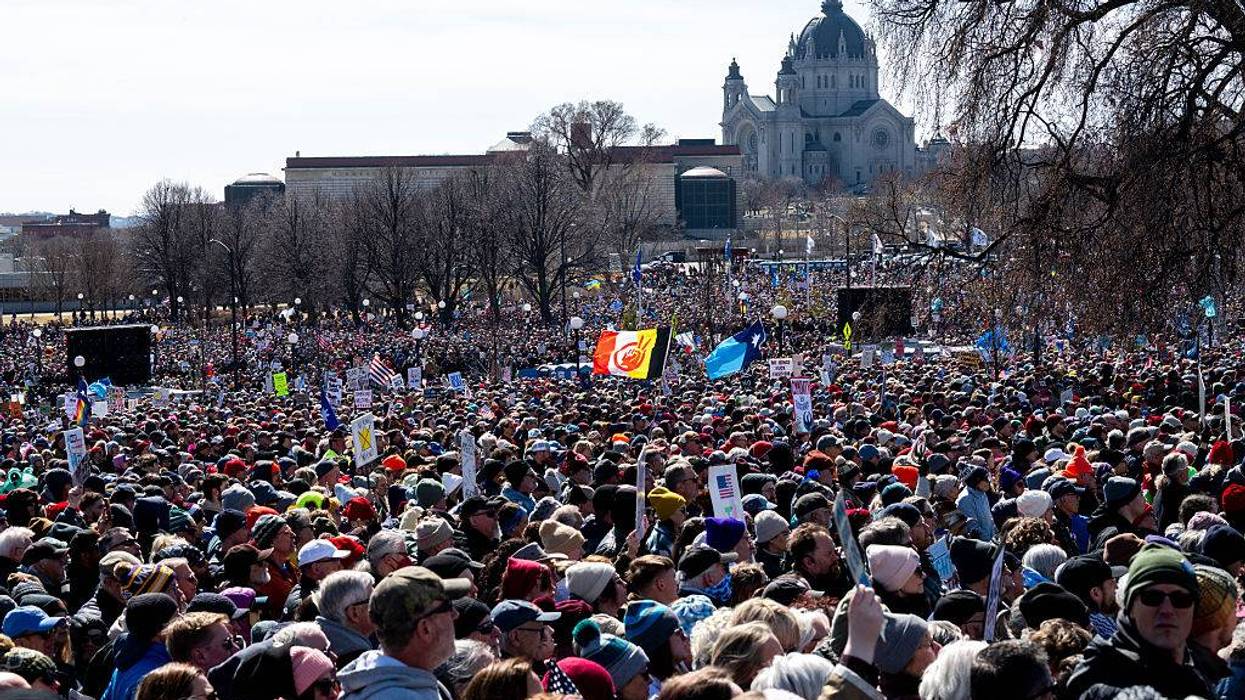
State Patrol estimates that over 100,000 people turned out for Saturday's "No Kings" rally in St. Paul, one of thousands of protests around the country voicing opposition to President Donald Trump and his administration's policies.
Calling it the national flagship rally, organizers say it turned out to be the largest rally in Minnesota history.
The rally drew in big names, including singer-songwriter Bruce Springsteen, actor and activist Jane Fonda, and Democratic Sen. Bernie Sanders, who all took to the stage during the nearly three-hour event.
Fonda read a statement from Rene Good's wife. Good was shot by ICE agents in south Minneapolis in January.
"Everyone who was there when my wife was taken from me has had their lives destroyed that day, including those agents. What we need is to stop destroying life," Fonda read.
Among the speakers in St. Paul was Governor Tim Walz.
"At this moment, that we are still in, when democracy itself seems to be at risk, it was Minnesota who said not on our watch. Not on our watch," said Walz.
Minnesota's flagship event on the Capitol lawn in St. Paul drew Springsteen as its headliner. He and other speakers praised the state's people for taking to the streets over the winter in opposition to a surge of U.S. Customs and Immigration Enforcement agents.
Springsteen performed “ Streets of Minneapolis,” the song he wrote in response to the fatal shootings of Renee Good and Alex Pretti by federal agents. Springsteen lamented Good and Pretti’s deaths but said the state's pushback against ICE gave the rest of the country hope.
“Your strength and your commitment told us that this was still America,” he said. “And this reactionary nightmare, and these invasions of American cities, will not stand.”
Before Springsteen took the stage, organizers played a video in which actor Robert DeNiro said he wakes up every morning depressed because of Trump but was happier Saturday because millions of people were protesting. He also congratulated Minnesotans for running ICE out of town.
Protesters held up a massive sign on the Capitol steps that read, “We had whistles, they had guns. The revolution starts in Minneapolis.”
“Donald Trump may pretend that he’s not listening, but he can’t ignore the millions in the streets today,” said Randi Weingarten, president of the American Federation of Teachers.
People rallied from New York City, with almost 8.5 million residents in a solidly blue state, to Driggs, a town of fewer than 2,000 people in eastern Idaho, a state Trump carried with 66% of the vote in 2024.
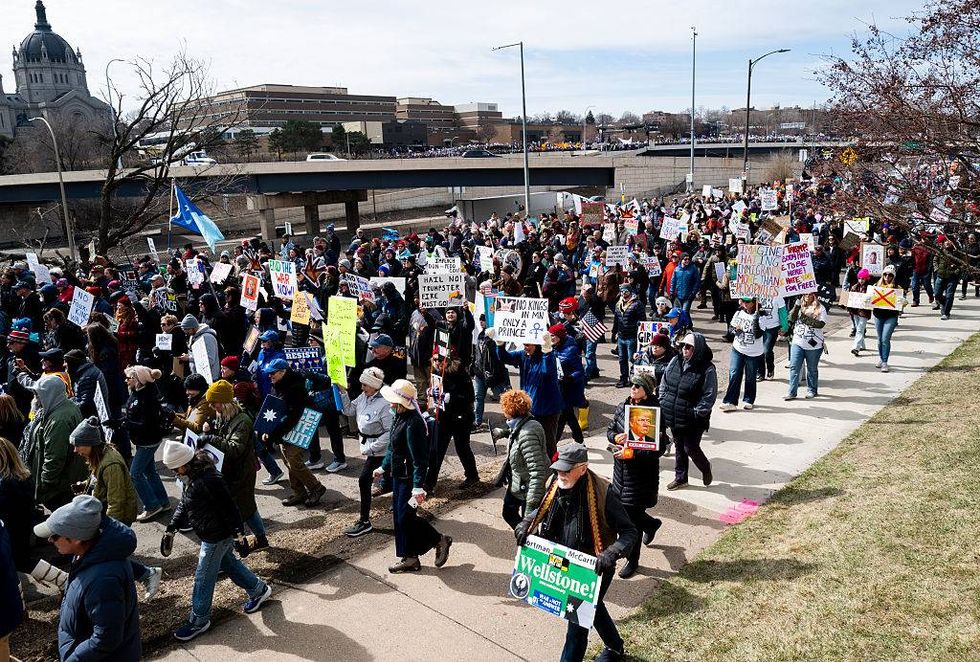
Demonstrators march to a "No Kings" protest outside the State Capitol building on March 28, 2026 in St Paul, Minnesota. This is the third nationwide "No Kings" protest held against the Trump administration.
(Photo by Stephen Maturen/Getty Images)
Big but mostly peaceful crowds
U.S. organizers have estimated that the first two rounds of No Kings rallies drew more than 5 million people in June and 7 million in October. They expected 9 million participants Saturday, though it was not clear whether those expectations were met.
Organizers said more than 3,100 events — 500 more than in October — were registered, in all 50 states.
Protests were mostly peaceful, but some arrests were reported.
In Los Angeles, authorities deployed tear gas near a federal detention center downtown. One man had a leaf blower, attempting to clear the air. The Los Angeles Police Department later arrested people for failing to disperse. Earlier in the day, a band was playing and people were dancing to Spanish-language music.
The Denver Police Department said on the social platform X that it declared an unlawful assembly and deployed smoke canisters after a small group of protesters blocked a road and did not leave as asked. Some threw the canisters back at officers, police said. At least eight people were arrested, as was a ninth person later on who police said was throwing objects.
GOP officials dismissive of protests
White House spokesperson Abigail Jackson called them the product of “leftist funding networks” with little real public support.
The “only people who care about these Trump Derangement Therapy Sessions are the reporters who are paid to cover them,” Jackson said in a statement.
The National Republican Congressional Committee was also sharply critical.
“These Hate America Rallies are where the far-left’s most violent, deranged fantasies get a microphone,” spokesperson Maureen O’Toole said.
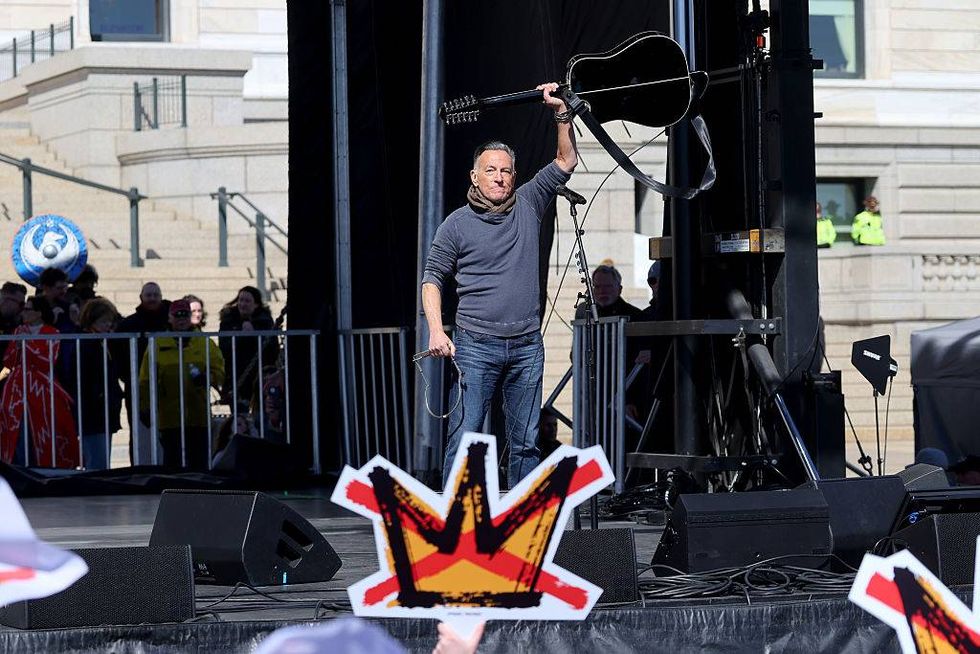
Bruce Springsteen performs onstage as Hundreds of Thousands Protest as part of the No Kings Rallies on March 28, 2026 in St. Paul, Minnesota.
(Photo by Adam Bettcher/Getty Images for No Kings)
Protesters have a long list of causes
Trump's immigration enforcement push, particularly in Minnesota, was just one item on a long list of grievances that also included the war in Iran and the rollback of transgender rights. Speakers at the Minnesota rally decried billionaires' economic power.
In Washington, hundreds marched past the Lincoln Memorial and into the National Mall, holding signs that read “Put down the crown, clown” and “Regime change begins at home.” ”
Bill Jarcho was there from Seattle, joined by six people dressed as insects wearing tactical vests that said, “LICE” — spoofing ICE — as part of what he called a “mock and awe” tour.
“What we provide is mockery to the king,” Jarcho said. “It’s about taking authoritarianism and making fun of it, which they hate.”
About 40,000 people marched in San Diego, police there said.
In New York, Donna Lieberman, executive director of the New York Civil Liberties Union, said during a news conference that Trump and his supporters want people to be afraid to protest.
“They want us to be afraid that there’s nothing we can do to stop them,” she said. “But you know what? They are wrong — dead wrong.”
In Topeka, Kansas, a protesters dressed up in an inflatable frog costume and a baby version of Trump. Wendy Wyatt showed up with a “Cats Against Trump” sign. Many things upset her about the administration, she said, but the rallies are “very hopeful to me.”
Organizers said two-thirds of RSVPs for the rallies came from outside of major urban centers. That included communities in conservative-leaning states like Idaho, Wyoming, Montana, Utah, South Dakota and Louisiana, as well as suburbs in electorally competitive Pennsylvania, Georgia and Arizona.
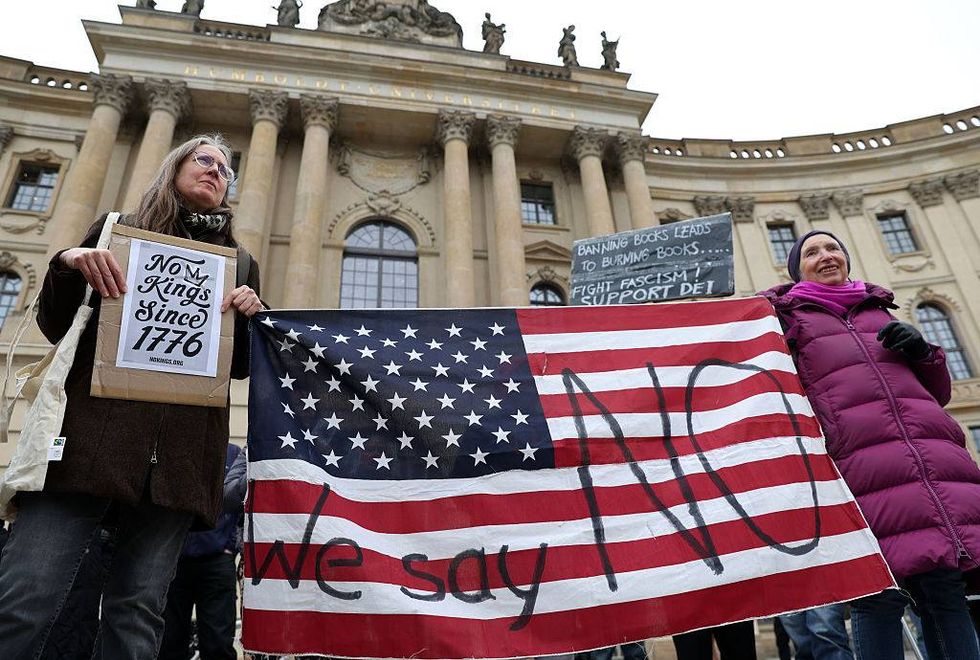
Activists attend a "No Kings" protest against the current U.S. federal government on March 28, 2026 in Berlin, Germany. Millions worldwide, including in all 50 U.S. states, are expected to participate in over 3,000 such protests against the Trump administration's actions and policies and in support of topics ranging from abortion access and gun control to immigration and voting rights, in the third instance of the demonstration organized by labor unions and other grassroots organizations.
(Photo by Adam Berry/Getty Images)
Rallies overseas
Demonstrations were also held in more than a dozen other countries, according to co-executive director Ezra Levin of Indivisible, which spearheaded the events.
In Rome, thousands marched with chants aimed at Premier Giorgia Meloni, whose conservative government saw its referendum for streamlining Italy's judiciary fail badly this week. Protesters also waved banners protesting Israeli and US attacks on Iran.
In London, demonstrators held banners with slogans such as “Stop the far right” and “Stand up to Racism.”
And in Paris, several hundred people, mostly Americans living in France, along with labor unions and human rights organizations, gathered at the Bastille.
“I protest all of Trump’s illegal, immoral, reckless and feckless, endless wars,” organizer Ada Shen said.
Richmond reported from Madison, Wisconsin, and Hanna from Topeka, Kansas. Associated Press journalists Jennifer Sinco Kelleher in Honolulu; Nicholas Garriga in Paris; Mike Pesoli in Washington; Colleen Berry in Milan; Amy Taxin in Santa Ana, California; and Jill Connelly in Los Angeles contributed.