

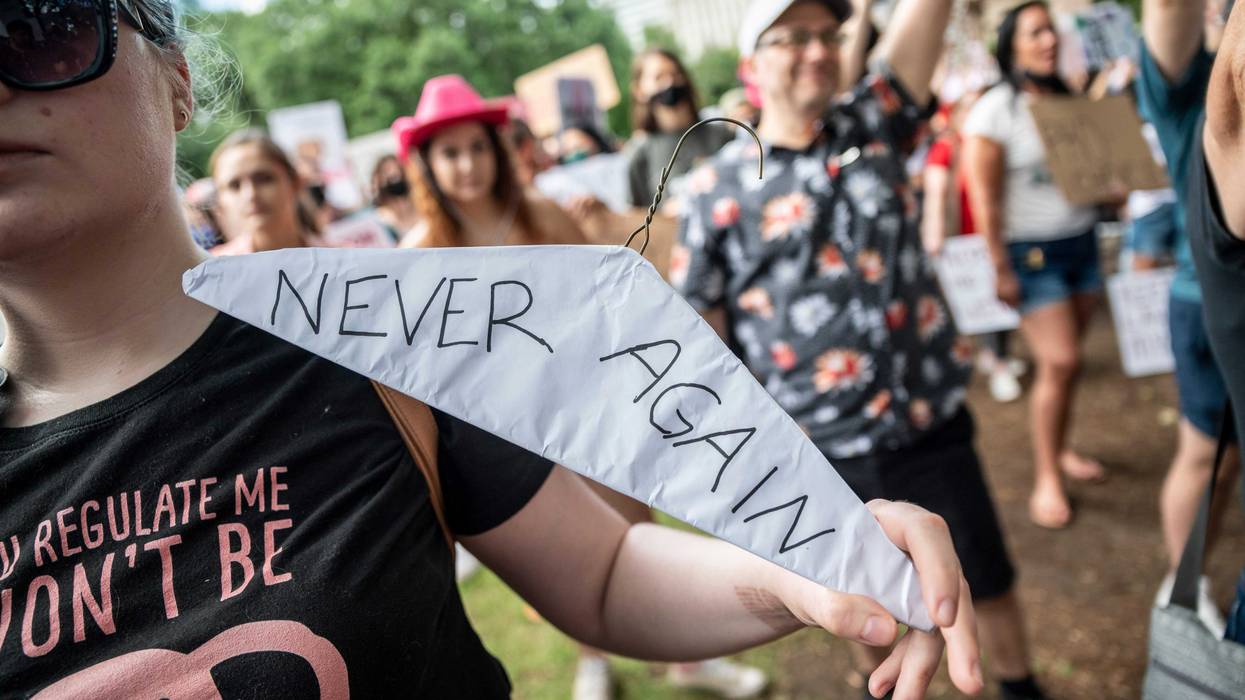

The US Supreme Court this month agreed to review a case originating in Mississippi banning abortion after 15 weeks, something that could overturn Roe v. Wade.
Minnesota reproductive rights advocates say if that happens in the state whose abortion laws are unique in the region, more out-of-state residents could seek abotions here, or state lawmakers could seize on the momentum of the Supreme Court’s decision to pass more restrictions.
For nearly 50 years, the landmark ruling Roe v. Wade established the constitutional right to abortion under the 14th Amendment, and was affirmed in 1992’s Planned Parenthood v. Casey. Still, numerous attempts at the state level have tried to weaken it, even as recently as this week when Texas Gov. Greg Abbott signed a bill prohibiting abortion when a heartbeat is detected, which can be early as six weeks.
While anti-abortion activists are applauding the Supreme Court’s conservative bend, plus the Dobbs v. Jackson Women’s Health Organization case, pro-choice advocates are concerned it could be the culmination of decades of chipping away at abortion access.
“Why would they take up a case to answer a question that they’ve answered over and over again if they don’t have a different answer?” Erin Maye Quade, campaign manager for Unrestrict Minnesota, a coalition of organizations focused on reproductive rights, said. “It’s really terrifying. We've been seeing this coming. People have not been quiet. Anti-abortion extremists and politicians have not been quiet about their intent to eliminate legal abortion altogether in the United States and now they have the court to do it.”
Minnesota is already an island in the Upper Midwest. The 1995 state supreme court case Doe v. Gomez made the right to abortion constitutionally protected.
“The decision states that no lawmaker and no law can put its finger on the scale and try to force a woman or compel a woman towards certain pregnancy outcome, either carrying the pregnancy or having an abortion,” Maggie Meyer, executive director of NARAL Pro Choice Minnesota , said.
North Dakota and South Dakota have what are called “trigger laws” that would make abortion illegal if Roe is overturned. Wisconsin and Michigan are among the states with long-standing state bans that were superseded by Roe. If it is overturned, those bans would be reinstated. Minnesota does have restrictions including a 24-hour waiting period, a gestational limit, and counseling.
Terminating pregnancies has been in existence since ancient times. Sen. Tina Smith, a former Planned Parenthood executive, said restricting abortion does not make them disappear; the laws make abortions harder for less-advantaged people to obtain.
“Women who have the means who have the ability and the resources to get transportation, who can fly to other states, will always have access to abortion. They will always be able to find a way,” Smith said.
In 2019, the latest data available from the Minnesota Department of Health, show under 10,000 abortions in Minnesota in back-to-back years. There’s been an overall decline the last 40 years after a peak of 19,000 in 1980. In 2018, the number of non-Minnesota residents seeking abortions here topped 10 percent of the total. Though it went back under 1,000 in 2019, advocates are concerned Minnesota’s eight clinics will be overwhelmed if Roe is overturned.
“Overturning Roe means the Upper Midwest would go from being served by 40 clinics to just the eight in Minnesota which could make abortion more difficult and especially more expensive,” Meyer said. “We are really, really concerned about the pressure on the clinics and the time it takes to get folks in for appointments with that type of increased case volume and patient volume.”
Pro-choice advocates are worried if Roe is overturned, Minnesota Republicans would seek more restrictions statewide like additional licensure for clinics. Sen. Smith said she is maintaining optimism that a 50-year precedent will stand.
“Every person needs to be able to follow their own beliefs, their own moral code, their conscience when making important life decisions including life decisions around abortion,” Smith said. “It’s not my place as a lawmaker to interfere with anybody’s moral decision making. To me, that is a place where we ought to find common ground.”