

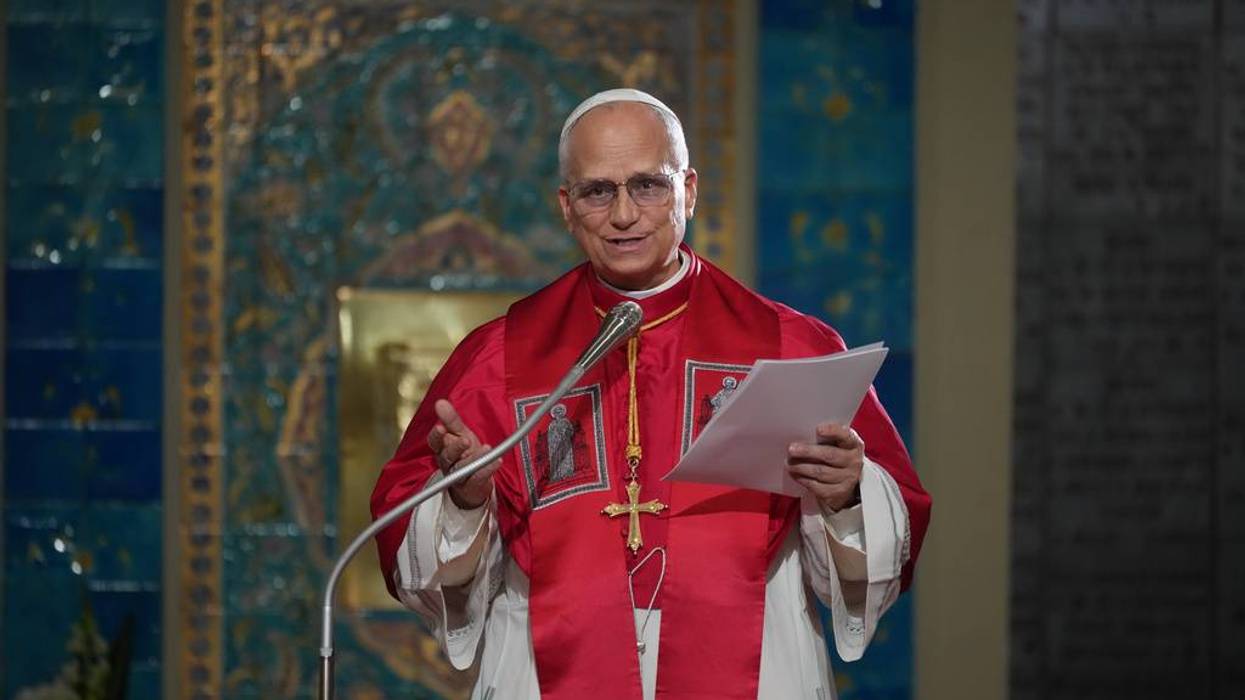

A majority of U.S. Catholic voters supported Donald Trump in his 2024 presidential victory. Yet across the broad Catholic political spectrum – even among conservative-leaning bishops – there is dismay over Trump’s unprecedented verbal assault on the Pope Leo XIV, the first American to lead their church.
Leo says he is sharing a Gospel message and not directly attacking Trump or anyone else with his appeals for peace and criticism of attitudes fueling the war.
Criticism of Trump came from Archbishop Paul Coakley, head of the U.S. Conference of Catholic Bishops, and from Minnesota-based Bishop Robert Barron, who only a few days ago was applauding Trump as an Easter guest at the White House. Barron called the president’s remarks “entirely inappropriate and disrespectful” and urged him to apologize.
The dismay extended into an even more solid base of Trump support – conservative Christian evangelicals. Many were appalled that Trump followed his Truth Social attack on Leo by posting an image depicting him as a Christ-like savior.
“TAKE THIS DOWN, MR. PRESIDENT,” posted David Brody, a prominent Trump-supporting commentator with the Christian Broadcasting Network. “You’re not God. None of us are. This goes too far. It crosses the line.”
By midday Monday, the image had been taken down from Truth Social. And speaking at the White House, the president claimed that he never intended to liken himself to Jesus when he posted the picture.
“How did they come up with that?" he asked. “It’s supposed to be me as a doctor, making people better. And I do make people better. I make people a lot better,.”
Trump: No apology needed
On his clash with the pope, Trump was equally defiant: “There’s nothing to apologize for. He’s wrong.”
The president's feud with American religious communities comes just six months before voting begins in this fall's midterms as Trump grapples with low approval ratings and dissension from his MAGA base over the war with Iran. But few groups of voters have been more loyal to Trump — and important to his political success — than those on the religious right.
For now, some Trump allies are optimistic that the dispute will soon be forgotten.
“There is a deep reservoir of appreciation for the president and his faith-based policies that transcends and eclipses any disagreement over a social media post,” Ralph Reed, who sits on the president’s faith advisory board, told The Associated Press.
Through American history, numerous U.S. presidents have had policy differences with various popes. But experts on the Vatican and religious history could recall no exchange comparable to the back-and-forth between Trump and Leo over the pope’s condemnation of America's role in the Iran war.
“This is unprecedented criticism of a Pope from a US president,” David Campbell, a political science professor at the University of Notre Dame, said via email.
“There have been signs that many lay Catholics have been standing by Trump in recent weeks and have been critical of their bishops who critique the president,” Campbell added. “If this attack on the pope does not shift that dynamic in a marked way it will truly be a watershed moment ... with American Catholics choosing a Catholic-baiting president over their own pope.”
Looking far back into world history, Trump’s attempt to “strong-arm Pope Leo” isn’t anything new, said Kathleen Sprows Cummings, a professor of American Studies and History at Notre Dame.
“Emperors, monarchs, and despots have long threatened popes in an effort to force them to bend to their will,” she said via email. “In an American context, however, Trump’s invective does represent a historic reversal.”
“For most of this country’s history, Americans viewed the pope as war-mongering, money-grubbing, anti-democratic menace who had designs on the White House,” she added. “Today, the menace is in the White House, and the pope is the one defending the ideals of liberty and human dignity.”
At a prayer service Saturday, the pontiff denounced the “ delusion of omnipotence ” that he said was fueling the war with Iran. Without citing Trump or the U.S. specifically, the pope said: “Enough of the display of power! Enough of war!”
On Monday, he was specific in responding to the president’s criticisms, saying “I have no fear of the Trump administration.”
Questions arise about Catholic convert JD Vance
There was no immediate comment about the pope-Trump rift from Vice President JD Vance, a Catholic convert who occasionally has sparred with Catholic leaders over their criticism of the Trump administration’s immigration crackdown.
Catholics Vote Common Good, a nonprofit group that generally supports progressive causes, urged Vance to speak out on the rift.
“At a moment when the Holy Father is being attacked and the dignity of the Church is being undermined, silence is not neutrality. It is complicity,” said Denise Murphy McGraw, the organization’s national co-chair.
Some vocal evangelical supporters of Trump criticized the meme depicting him as healer apparently resembling Jesus, even while maintaining support for Trump himself.
“It isn’t hard to condemn this outright,” said Willy Rice, a candidate for president of the Southern Baptist Convention and pastor of Calvary Church in Clearwater, Florida.
“Many Christians appreciate the President’s administration and have supported him in meaningful ways, but this is wrong,” Rice posted on X.
Also weighing in was Doug Wilson, co-founder of the Communion of Reformed Evangelical Churches, a staunchly conservative Calvinist denomination with an outsized influence in the current administration. Its churches’ members include Defense Secretary Pete Hegseth.
“I was very grateful to see how many conservative Christians immediately denounced the blasphemous Jesus/Trump image,” Wilson posted on X.
Megan Basham, a conservative evangelical commentator, posted that she agreed with Trump’s criticisms of Leo as “Weak on crime, and terrible for Foreign Policy.” But she assailed his meme as “OUTRAGEOUS blasphemy” and urged Trump to “ask for forgiveness from the American people and then from God.”
A look at the numbers for religious blocs as election nears
Such public dissension against Trump from evangelical leaders is rare.
In 2024, white evangelical Protestants were a significant component of Trump’s winning coalition, according to AP VoteCast. About one-third of Trump voters, 34%, identified as white evangelical or born-again Christians, compared with only 8 percent of Harris voters. White evangelicals made up about 2 in 10 voters that year, and the vast majority, 79%, voted for Trump.
A February AP-NORC poll found that about two-thirds of white born again Protestants approve of how Trump is handling his job as president, while about one-third disapprove.
Catholics were much unhappier with Trump’s performance in that poll. Only about 4 in 10 approved of his handling of the presidency, similar to Americans overall.
Among these urging Trump to apologize to Leo was The Catholic Association, a national advocacy whose mission is “being a faithful Catholic voice in the public square.”
“Insulting the Pope, and all Catholics by extension, with the hope of making the Church bend to American political agendas, is discouraging and counterproductive, said Ashley McGuire, a senior fellow with the group.
Phil Klay, a Catholic author and Marine Corps veteran, suggested Leo would take a long view of the dispute.
“The church’s role is not to win a news cycle or a social media slap fight, but to calmly articulate timeless truths," he told a Georgetown University panel on Monday. "I think that’s what Pope Leo is doing and I think we should listen and pray.”