


MADRID (AP) — Rising fuel costs, discontent with the state of schools, declining public services and a housing crisis have created perfectly stormy weather for an autumn of protests in Europe.
Crowds have taken to the streets for weeks in major cities, resulting in arrests, looting, injuries, and violence across France, Italy and Albania. In Spain and Portugal, tent camps have sprung up in protests against unattainable rents and housing costs.
Young people “feel disappointed with the (social) model and experience a strong sense of uncertainty and a lack of control,” said María Silvestre, professor of sociology at the University of Deusto in Spain. “And when specific situations come together, a spark suddenly ignites that is capable of channeling that discontent and driving people into the streets.”
Cities have turned into battlefields as several top EU economies, including France, Italy and Spain, approach pivotal elections, while far-right parties have made electoral gains in Germany and could do so elsewhere. It also comes as Europe faces a critical moment in its support for Ukraine, with President Donald Trump making overtures to President Vladimir Putin even as Russia is blamed for increasingly frequent hybrid attacks in NATO countries.
Right-wing politicians have seized on the chaos. While protests in France have appeared broad-based, Trump portrayed immigrants as responsible for the destruction, writing on his Truth Social platform: “The migrants have taken over France. They must CLOSE THE BORDERS, FAST!” on Monday.
Many of the protests have been fueled by frustrated young people. Other elements including black-clad, masked agitators have fomented violence, but French authorities and police have not blamed immigrants.
A look at what's driving the unrest.
Students say education resources are dwindling
In France, which has a long tradition of popular protest, high schoolers have staged blockades and demonstrations for more than three weeks, demanding more resources for schools they call understaffed and dilapidated, especially in lower-income neighborhoods.
The protests then broadened as France's CGT labor union and other activists joined in while students paused for a fall break. The movement now includes demands over rising living costs and public services.
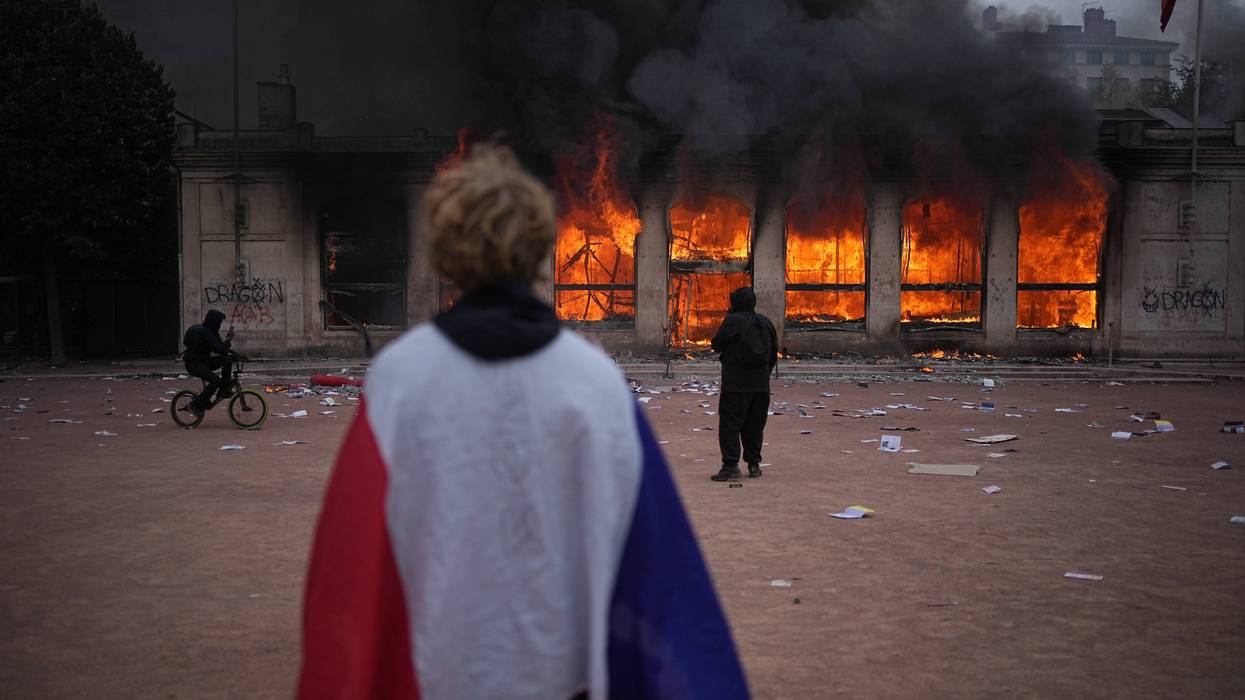
Despite hundreds of thousands of people marching peacefully, the weekend’s unrest led to 2,400 arrests and serious disturbances in parts of France, including looting in Paris, Marseille, Lyon and Bordeaux. In Limoges, flames engulfed the 19th-century City Hall and nearly destroyed the building. Some schools were set on fire. As students and rioters threw firebombs and law enforcement responded with tear gas, hundreds have been injured.
French President Emmanuel Macron condemned Saturday’s violence, accusing far-left activists of trying to foment chaos by attacking buildings and police.
“Those who looted will have to pay for the damage, and those who sought to bring down the Republic will be held accountable,” Macron said Sunday in a rare televised address.
In Spain, elementary and secondary schoolteachers began an indefinite strike in Madrid last week to demand better pay and working conditions. Discontented teachers staged similar walkouts elsewhere in Spain this year.
Unaffordable housing stymies young people
In Madrid's central Puerta del Sol, tarpaulin tents have blanketed the square for weeks t o protest rising housing costs, sparked by the eviction of Maricarmen, an 87-year-old woman who later died while hospitalized. Smaller protest camps followed in other Spanish cities.
Some things have changed since the encampment began: public pressure led the ruling Socialist government to approve affordable housing measures, but a lack of support in Parliament meant they didn't pass, triggering a snap election announced by Prime Minister Pedro Sánchez for November. A general strike will also take place in November — the first in 14 years.
Major housing protests also have taken place in Barcelona, a focal point of Spain's overtourism and housing challenges.
In Spain, the minimum wage is 1,221 euros ($1,370), while the average monthly rent for an 80-square-meter apartment is around 1,130 euros (about $1,270), according to an analysis by the business newspaper Expansión.
“Most of my paycheck goes to the rent. My roommate struggles to make ends meet just like I do,” said Diana Manzanares, a 20-year-old waitress at the Madrid encampment. “This is my reality and the reality of most of us living in this city.”
Similar housing protests have sprung up in Portugal's largest cities, Lisbon and Porto.
Untenable living costs as inflation rises in Italy
“Italia in Piazza,” or Italy in the Streets, has galvanized thousands of demonstrators, voicing demands for better employment, healthcare, education, and access to housing, as well as higher wages to deal with rising costs. Inflation in Italy rose to 4.2% in September, surpassing the eurozone’s 3.8%, according to government data.
The peaceful marches turned violent over the weekend in three northern cities: In Turin and Bologna, and in Milan — Italy’s finance and fashion capital, where rioters clashed with police, looted stores and set property on fire.
In Milan, 271 people were arrested during two days of unrest — most of them minors, police said. Fourteen members of the security forces were reportedly injured.
And now a newly formed group calling itself the “Oct. 17 Movement” has announced what it describes as a “permanent mobilization,” calling supporters to demonstrate every Saturday at 3 p.m. in cities across Italy, starting in Milan.
Students in Albania join anti-corruption protests
In Albania, anti-government protests continued Sunday for a sixth consecutive day in Tirana, featuring more clashes between demonstrators and police. The violence escalated after high school and university students joined the broad anti-government “Flamingo” movement calling for Socialist Prime Minister Edi Rama to resign.
Rama has condemned the protests, saying participants had been “ideologized and radicalized” by antifa, an umbrella term for loosely organized far-left militants in the United States, where President Donald Trump has designated the movement a terrorist organization.
Ending corruption is a major demand of the Albanian civic movement — named for the natural habitat of flamingos in an area where Rama's government agreed to allow a major luxury tourism development linked to Jared Kushner, Trump's son-in-law. They also want protections for healthcare, education, and public pensions, according to its website.
In Serbia, university students who have led mass anti-corruption protests for nearly two years are now challenging a return by the Balkan country’s powerful populist leader Aleksandar Vucic in early parliamentary elections this month.
The former authoritarian president is eyeing a return as prime minister after the Oct. 25 vote. The youth-backed Students’ List party is believed to be running close to Vucic’s party, making the outcome uncertain and fueling fears of possible violence.