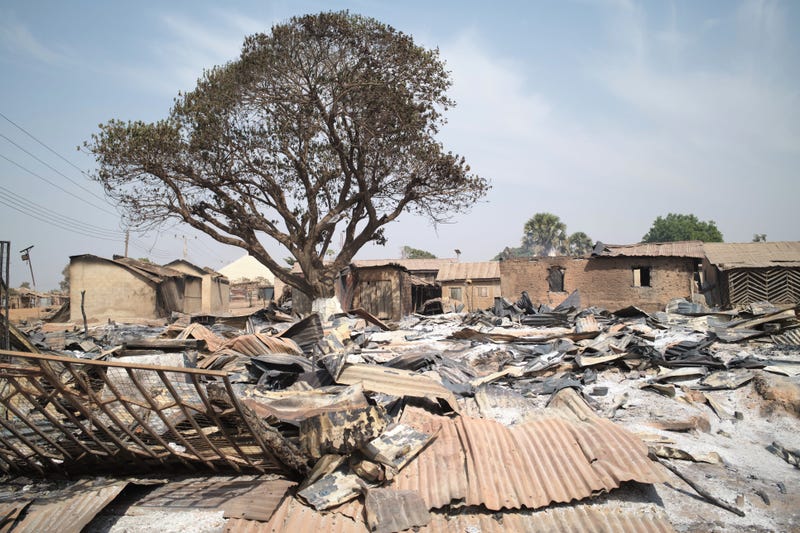
WORO, Nigeria (AP) — Weeks after residents of two Nigerian villages ignored a letter from militants announcing they would come to spread their extreme form of Islam, gunmen arrived on motorbikes and embarked on a 10-hour frenzy of killing.
The attackers went from door to door, shooting and setting homes and shops ablaze in the mostly Muslim villages of Woro and Nuku. Later, residents told The Associated Press, they went into a mosque, announced the call to prayer and shot everyone who turned up.
In the deadliest attack in Nigeria in several months, the extremists rounded up villagers, tied their arms behind their backs, lined them up and shot them in the head. Authorities say they slaughtered at least 162 people, while villagers say the toll is higher and that the men kidnapped many others.
The attack is the latest in a surge in violence in the state of Kwara, as well as other conflict hot spots, as armed groups in Nigeria challenge the state's authority and compete with one another.
The attack came out of the blue
Immediately before the attack, life had been quite normal in the quiet neighboring villages, where most residents are farmers, roughly 500 kilometers (300 miles) from the state capital.
Umar Bio Kabir, a 26-year-old schoolteacher, was playing football with his friends when they saw the attackers. They ran for their lives, but not everyone who was playing made it.
“God said I would survive or else I would have been among the dead,” he said.
According to several residents interviewed by the AP, the killing went on for the next 10 hours.
Residents said they had no help throughout the operation, and no security operatives showed up.
“We did not see anybody from when it started in the evening till the morning when it ended,” said Iliyaus Ibrahim, a farmer in the village whose brother died and whose pregnant sister-in-law was kidnapped along with her two children.
Reached by phone, Kwara state police spokesperson Adetoun Ejire-Adeyemi said: “That is not possible. Security operatives were on ground.” She would not say anything further.
‘Everyone who lived here has been killed’
Only about 20 men remained in the villages by Thursday, left with the arduous task of burying scores of dead people. Though the official toll is 162, residents told the AP they have buried nearly 200 people and have more to bury, including completely charred remains.
Kabir joined in burying several of his close friends in Woro. “Even as I am speaking to you, we have not finished packing the bodies. There are not enough people left in the village. Yesterday, we loaded bodies into two Hilux (pickup) trucks. Today, we are doing it again,” he said.
Two days after the killings, a body still lay in blood on Thursday. The remaining men said they were too tired to return to the site.
Residents struggled to breathe as the harmattan wind blew the ashes of burned houses and shops, with a lingering stench of blood. Zinc roofs clattered lightly against each other in the wind, the only sound in the dead-quiet village.
Survivors were gathering their essentials onto bikes, taxis and trucks and heading away from the village to restart life elsewhere.
Zakari Munir had come into Woro to help his brother pack to move to Kaiama, where the local government office is located. He pointed to a section of burning buildings and told the AP: “Everyone who lived here has been killed.”
Nigeria's security crisis is spreading southward
The attack in Kwara, which borders Benin, has sparked concerns about the spread of Nigeria’s security crisis. The armed groups were previously confined to regions farther north, but analysts say they have moved their operations south as military pressure and territorial competition among groups ramp up.
Nigeria now plays host to multiple armed groups, both homegrown and cross-border. The West African nation has been fighting an insurgency for more than a decade, with Boko Haram and its splinter group, the Islamic State of West Africa Province, in addition to several amorphous groups commonly referred to as bandits.
In 2024, the Nigerian military announced the presence of the Lakurawa group, which had come from Niger, and in 2025 Jama’at Nusrat al-Islam wal-Muslimin claimed its first attack on Nigeria, in Kwara. The wider area of West Africa and the Sahel is also facing multiple threats from various Islamic extremist groups.
Several thousand people have been killed in Nigeria's protracted conflict, according to data from the United Nations. Analysts say not enough is being done by the government to protect its citizens.
On Wednesday, the Nigerian government announced a new military operation in Kwara to stem the spread of the crisis there. Last year, Nigerian President Bola Tinubu announced a state of emergency, aiming to add thousands more police officers.
A complicated crisis that goes beyond faith
Nigeria has been a focus of the U.S. government recently after President Donald Trump accused the West African nation of not protecting Christians from an alleged genocide. The Nigerian government rejected the claim, and analysts say the claim simplifies a very complicated crisis that targets people regardless of their faiths.
In Woro and Nuku, for instance, the Muslim victims appear to have been killed for resisting the preachings of the extremists.
Nigeria has entered a partnership with the U.S. on military cooperation. The U.S. launched airstrikes against militants affiliated with the Islamic State group on Dec. 25 and has provided Nigeria with weapons.
On Friday in Kaiama, Maryam Muhammed and other survivors gathered for Islamic prayers for her husband, one of the victims. The 57-year-old also lost her house.
Muhammed was taken by the attackers before being let go in the pandemonium. In the morning, she looked for her husband, who had been responsible for performing the call to prayer at the local mosque. She searched through still-smoldering bodies until she found him.
“When I did not hear his voice (at the mosque) when the day broke,” she said, “I knew there was trouble.”
——
Adetayo reported from Lagos, Nigeria