


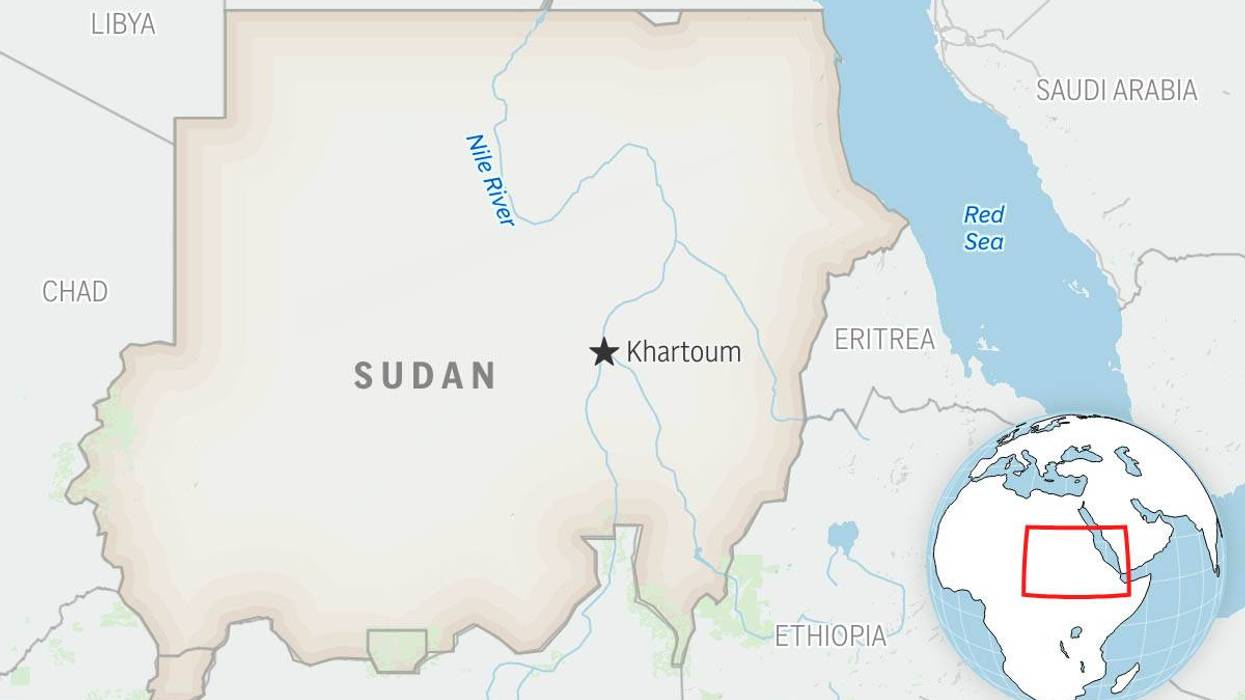

SHENDI, Sudan (AP) — More than 100 people were killed in Sudanese military drone strike on a busy market in Nyala, the capital city of the South Darfur province in the southwestern Sudan, said Emergency Lawyers, a rights group tracking violence in the country, in a statement Tuesday.
The strike, which it says happened Monday evening, also injured 113 people. The group said many of those killed and injured were women and children. The group blamed the Sudanese military for the strike on the market, condemning the attack.
Doctors Without Borders, which is also known as Médecins Sans Frontières, or MSF, said earlier that 36 bodies arrived at its hospital in Nyala and reported seeing 150 injured in its emergency room.
Drone warfare has been a staple of this war but in recent weeks, a massive escalation of drone strikes by both the Rapid Support Forces and Sudanese army has killed hundreds.
Previous strike leaves parts of Sudan without power
Large parts of Sudan’s capital were without electricity for more than 12 hours Tuesday after a drone strike on a major power substation, according to an electric company official.
The attack left hospitals and bakeries dependent on generators and limited water supplies across Khartoum.
The state-run Sudanese Electricity Distribution Company acknowledged “serious damage and technical faults” to the distribution network and several main stations and power lines but didn't explain the reason in a statement. It apologized to residents across Khartoum state for repeated and prolonged outages.
A company official, speaking to The Associated Press on condition of anonymity because he was not authorized to speak to the media, said a drone attack hit the Al-Markhiyat transformer station in Omdurman, on the outskirts of Khartoum. He said it is the second to hit the station this year, blaming it on the country's paramilitary Rapid Support Forces.
The RSF has been at war with the Sudanese military for more than three years. Sudan’s war began in April 2023, when simmering tensions between the military and the RSF exploded into open fighting in Khartoum and spread across the country.
Deadly drone attacks across Sudan have been carried out by the two rival forces. But those attacks have become rare in Khartoum since the Sudanese military took control of the capital in May 2025, after years of brutal fighting between the military and the RSF.
The U.N. has expressed concern over the use of drones across Sudan, saying they have been killing civilians, including children, and are disrupting essential services.
The official who spoke to AP said technical teams are still assessing the damage, describing the strike as major. He estimated that 60% of power supply in the capital could be affected, predicting that water stations will be most affected.
A resident living near the Al-Markhiyat transformer station in Omdurman said he heard a drone shortly before the blast.
“At around 4:30 in the morning, on my way to dawn prayers, I heard the sound of a drone very close by, and just moments later a huge explosion, and the power went out,” Abdel-Hafiz Abdel-Mutaal told AP. “I saw fire burning at the transformer station.”
The city descended into darkness after sundown.
Adel Ali, a resident of south Khartoum, said he was without power and water for 17 hours.
“My main concern is how to preserve my insulin supply which needs a fridge,” Ali, a diabetes patient, said. “Life without electricity is totally paralyzed, and a bread crisis is emerging as many bakeries have shut down.” He said this would drive the price of bread even higher.
The electricity company, in its statement, said power rationing would be longer than usual in all areas until repairs are finished. It did not say when that would be. Technical teams were working around the clock to restore power, it added.
The conflict has killed at least 59,000 people, according to conflict monitor ACLED, though aid groups say the true toll is likely higher. Over 67% of the country's population is dependent on aid, while 825,000 children face acute malnutrition.
The Integrated Food Security Phase Classification, or IPC, a global food crisis monitor warned last week that the “deteriorating humanitarian situation” across greater Darfur and Kordofan states is worsening, with food insecurity putting these areas at risk of famine.
In a joint statement, over 30 countries, including the United States, United Kingdom and the European Commission, urged parties to the conflict in the country “to lift all impediments on humanitarian assistance.”