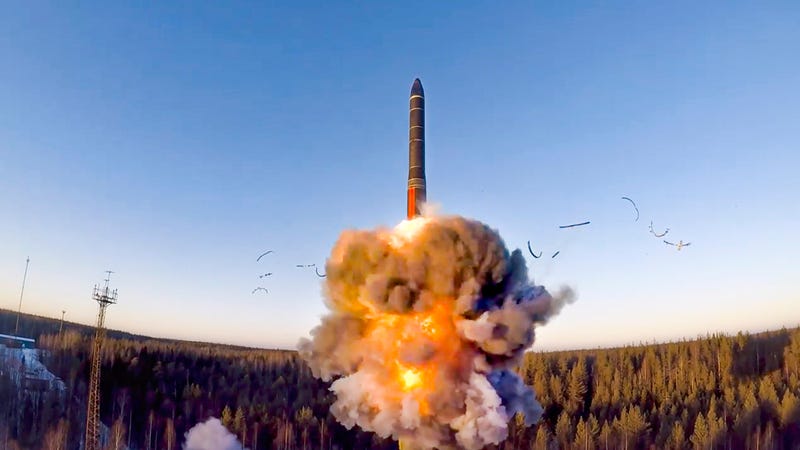
MOSCOW (AP) — The last remaining nuclear arms pact between Russia and the United States expires Thursday, removing any caps on the two largest atomic arsenals for the first time in more than a half-century.
The termination of the New START Treaty could set the stage for what many fear could be an unconstrained nuclear arms race.
Russian President Vladimir Putin last year declared readiness to stick to the treaty’s limits for another year if Washington follows suit, but U.S. President Donald Trump has been noncommittal about extending it. He has indicated that he wants China to be a part of it — a push Beijing has rebuffed.
Putin discussed the pact’s expiration with Chinese leader Xi Jinping on Wednesday, Kremlin adviser Yuri Ushakov said, noting Washington hasn’t responded to his proposed extension.
Kremlin spokesman Dmitry Peskov said Thursday that Moscow views the expiration of the treaty “negatively” and regrets its.
“In any case, the Russian Federation will retain its responsible, thorough approach to stability when it comes to nuclear weapons. And, of course, it will be guided primarily by its national interests,” Peskov said.
Russia's Foreign Ministry on Wednesday night said in a statement that “under the current circumstances, we assume that the parties to the New START Treaty are no longer bound by any obligations or symmetrical declarations within the context of the Treaty, including its core provisions, and are fundamentally free to choose their next steps.”
New START, signed in 2010 by then-President Barack Obama and his Russian counterpart, Dmitry Medvedev, restricted each side to no more than 1,550 nuclear warheads on no more than 700 missiles and bombers — deployed and ready for use. It was originally supposed to expire in 2021 but was extended for five more years.
The pact envisioned sweeping on-site inspections to verify compliance, although they stopped in 2020 because of the COVID-19 pandemic and never resumed.
In February 2023, Putin suspended Moscow’s participation, saying Russia couldn’t allow U.S. inspections of its nuclear sites at a time when Washington and its NATO allies have openly declared Moscow’s defeat in Ukraine as their goal. At the same time, the Kremlin emphasized it wasn’t withdrawing from the pact altogether, pledging to respect its caps on nuclear weapons.
In offering in September to abide by New START’s limits for a year to buy time for both sides to negotiate a successor agreement, Putin said the pact’s expiration would be destabilizing and could fuel nuclear proliferation.
New START followed a long succession of U.S.-Russian nuclear arms reduction pacts. Those have been terminated, as well.
Trump has indicated he would like to keep limits on nuclear weapons but wants to involve China in a potential new treaty.
“I actually feel strongly that if we’re going to do it, I think China should be a member of the extension,” Trump told The New York Times last month. “China should be a part of the agreement.”
Beijing has balked at any restrictions on its smaller but growing nuclear arsenal, while urging the U.S. to resume nuclear talks with Russia.
“China’s nuclear forces are not at all on the same scale as those of the U.S. and Russia, and thus China will not participate in nuclear disarmament negotiations at the current stage,” Foreign Ministry spokesperson Lin Jian said Thursday.
He said China regrets the expiration of the treaty, calls on the U.S. to resume nuclear dialogue with Russia soon and to positively respond to Moscow’s suggestion that the two sides continue observing the core limits of the treaty for now.
___
This version of the story corrects the last paragraph to say China's Foreign Ministry spokesperson Lin Jian said Beijing calls on the U.S. to respond positively to Moscow’s proposal to keep adhering to the treaty, not that China views it positively.
___
Associated Press writer Ken Moritsugu contributed to this report from Beijing.