

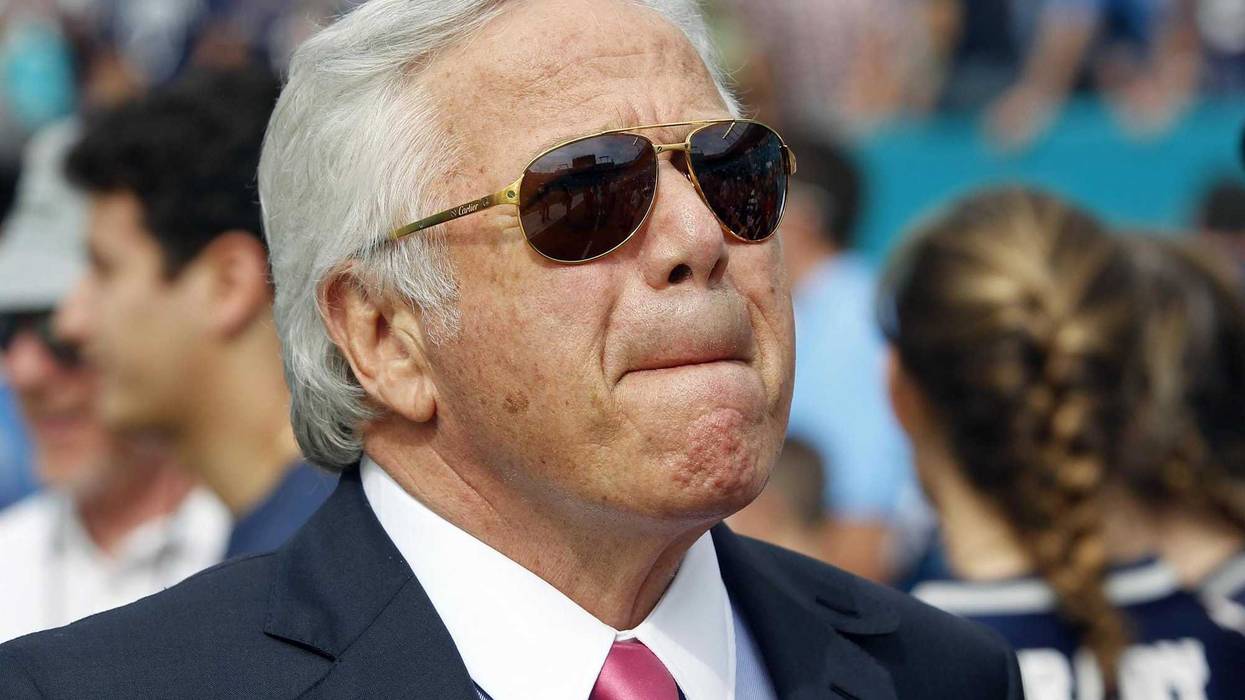

Patriots owner Robert Kraft spent part of his day Tuesday stumping for imprisoned rapper Meek Mill to be released from jail. That sentence isn't nearly as strange as it appears at first glance.
Scores of celebrities have rallied around #FreeMeekMill ever since he was sentenced in November to two-to-four years over probation violations stemming from a 2008 arrest for drugs and gun possession. For criminal justice reform activists, Meek's case is a textbook example of the broken system.
"Amazing young man. I know how I'd feel if I was in the situation he is," Kraft said after visiting Meek Tuesday alongside 76ers co-owner and entrepreneur Michael Rubin. "Every time I see him, I just come away more impressed. He's very intelligent. … This guy's a great guy. (He) shouldn't be here."
Robert Kraft On #MeekMill Visit: 'This Guy Is A Great Guy And Shouldn't Be Here' https://t.co/lLSjQjHR1G pic.twitter.com/PPAUrtKDDM
— CBS Philly (@CBSPhilly) April 10, 2018Arrested under shady pretenses
Rolling Stone published a lengthy story last month detailing Meek's extensive history with law enforcement. Growing up in the Philadelphia projects, Meek's father was killed during a stickup when he was five years old. His mother worked multiple jobs and raised two kids on her own.
The legal trouble for Meek began in 2007, when a drug officer named Reggie Graham claimed he saw the then-19-year-old street rapper selling crack to a confidential informant. At the time, Meek was living with his older cousins, who sold marijuana.
According to Graham, Meek sold crack to an informant at 4:45 p.m. on Jan. 23, 2007. That's the first hole in the cop's story. Meek and three of his cousins say he was in court at the time, providing support for one of his cousins who was on trial. There's no evidence besides Graham's word connecting Meek to the supposed crack deal. The drug that was allegedly sold was never lab-tested, or at least the lab-test never made it to court. The Philadelphia District Attorney's office actually barred from Graham from testifying at trials, because he was deemed too dishonest.
Still, Graham was able to obtain a warrant and searched Meek's house the following night. Meek admits he was illegally carrying a gun at the time, which is categorized as a misdemeanor in Philadelphia. The raiding drug officers also took $30,000 from Meek's cousin's closet.
Meek told Rolling Stone he was represented by a public defender who never contacted any of the witnesses who could have placed him in court when the alleged drug deal occurred. Judge Genece Brinkley found Meek guilty on seven charges, four involving the gun, and sentenced him to two years in county prison and eight years of strict probation. Graham's former partner says his testimony was farcical, but it apparently was convincing enough for Brinkley.
"That boy (Graham) lied like it was second nature!," Jeffrey Walker told Rolling Stone. "If you had your weapon drawn, (Meek's) never pulling a gun. The second he raised that weapon, he would've had one breath to live. Straight up and down, they'd have aired him out. We're talking closed casket, not open."
Since then, Meek has been unable to escape the system.
Meek's rise and introduction to Kraft
After getting released from jail in fall 2009, Meek recorded three mixtapes in one year. Shortly thereafter, rap mogul Rick Ross visited Philly and heard one of Meek's tracks. Meek went on to collaborate with Ross and signed with RocNation. The one-time street rapper was now pulling in $50,000 per show and releasing a new single every quarter. Meek was prolific.
Meek's affiliation with Ross explains how Kraft first became aware of him. The Patriots owner is friendly with Ross and a long-time fan of rap music and hip-hop. Last summer, Kraft was photographed partying with Meek in Miami.
Inability to escape the system
Over the next several years, Meek constantly ran afoul of Brinkley's strict probation due to minor infractions. In 2012, he was stopped by police outside of Philadelphia's airport, and was arrested after they allegedly smelled weed in his car. Meek was released with no charges when an extensive search of his vehicle turned up clean. But Brinkley ordered he take two additional drug tests and barred him from touring, costing him an estimated $7 or $8 million.
In 2016, Meek was placed on 12 months' house arrest for trying to pass of water as a urine test, showing up late to a probation meeting and hanging up on his probation officer during a phone call. Around this time, Rubin came in contact with Mills, whom he noticed attended every 76ers home game.
The following year, Meek got into an altercation at St. Louis International Airport with two airport employees who wanted a photo with the rapper. The misdemeanor assault charges were eventually dropped.
A costly dirt bike trip
Last August, Meek was in New York City for a "Tonight Show" taping and decided to ask a group of kids on dirt bikes if he could ride with them. Meek rode with the kids, popping wheelies and performing other tricks on the city streets. His cameraman posted the video on Instagram, which prompted his arrest the next day.
Originally, Meek was charged with reckless endangerment, but the felony was later dropped to a misdemeanor and then dismissed. But Brinkley still ordered Meek back to Philadelphia. She sent him to jail, despite protests from the Philly DA and Meek's probation officer.
Where the case stands now
Meek now has a powerful law enforcement official in his corner. Philly's new DA, Larry Krasner, said last week he would not oppose Meek being freed on bail.