
Judging draft picks right after they're made can be a fool's errand. Judging them based on where various pre-draft rankings and mock drafts have players ranked can also be a fool's errand.
No two people or groups of people are going to evaluate an entire draft class the exact same way. What seems like a reach to one evaluator or team might seem like great value to another.
But there's a reason that "reaches" are considered reaches, and there's a reason they are easy picks to both first-guess in the moment and second-guess down the road if they don't pan out.
If seemingly everyone else has a player ranked much lower than where you draft him, did you really make the most of your pick? Even if that was the highest-ranked player left on your own draft board, could you have gotten him later and taken another highly ranked player first? Could you have traded out of the pick, accumulated more assets, and still gotten that player later?
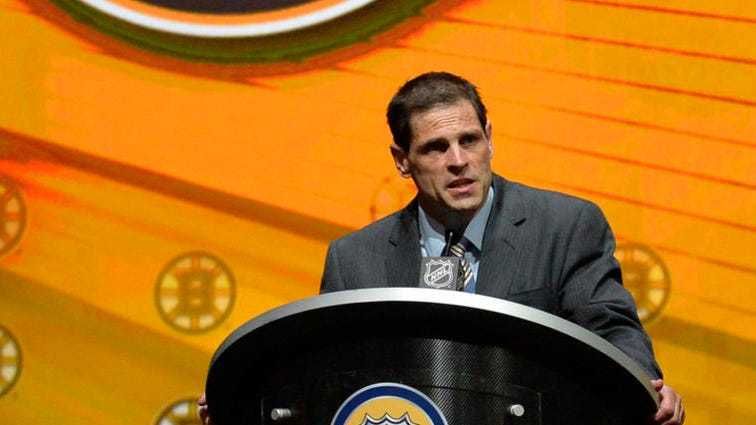
Those are the questions fairly being asked of Bruins general manager Don Sweeney and his staff after the 2020 NHL Draft, and more specifically after the team's first pick. Their selection of Mason Lohrei in the second round (58th overall) was widely considered one of the biggest "reaches" of the draft.
The 19-year-old defenseman was unranked or ranked outside the top 100 in every major pre-draft ranking. Central Scouting had him ranked 132nd among North American skaters (meaning that doesn't even account for goalies or European skaters).
Lohrei may turn out to be a very good pick. There certainly seem to be some things to like based on the scouting reports. He's 6-foot-4 and he's regarded as a very good puck-carrier and passer who has poise and smarts in the face of a forecheck. Last season he tied for the USHL lead in assists by a defenseman with 29 -- to go along with eight goals -- in 48 games for the Green Bay Gamblers.
But there are question marks as well. He said himself that he is still working to add more strength and physicality to his game so he can better take advantage of his size. He is also something of a late bloomer who is a little behind the typical schedule you might expect for a second-round pick.
Already considered an "overage" prospect after getting passed over in last year's draft, Lohrei is still a year away from even beginning his college career, as he is committed to head to Ohio State as a 20-year-old freshman next fall.
For the Bruins' sake, they better hope Lohrei turns out to be a good pick. When you're seemingly all alone out on a limb in having a player ranked as a second-rounder (and we say "seemingly" because obviously we don't know for sure where each of the other 30 teams had him ranked), you open yourself up to more criticism when you miss.
It's a dynamic the Bruins unfortunately know well. In 2015, the Bruins had three straight picks in the middle of the first round. The first two, Jakub Zboril and Jake DeBrusk, were considered mild reaches -- DeBrusk moreso than Zboril. The third, Zach Senyshyn, was considered a major reach, as virtually every pre-draft ranking had him as a second- or third-rounder.
Had Sweeney and the Bruins hit on all three picks, they would've looked like geniuses. Instead, only DeBrusk has developed into an NHL regular. Zboril and Senyshyn have played a grand total of eight NHL games, while the three players picked right behind them -- Mathew Barzal, Kyle Connor and Thomas Chabot (all of whom were projected to go right in that range or even earlier) -- have been bona fide first-line or top-pairing players for years now.
The Bruins' rankings were obviously different than everyone else's then, and the Bruins' rankings were wrong.
This isn't exactly the same, of course. Missing on one pick late in the second round wouldn't be nearly as devastating as missing on two in the middle of the first round. But given that the Bruins didn't have a first-round pick this year and only made four picks total, there is some pressure to make sure you get something from your top selection.
While rankings tend to diverge more as you get into the middle and later rounds and picks increasingly become something of a wild card, there is generally still something resembling a consensus in the second round.
The optimistic view of the Bruins "reaching" for Lohrei is that they're not going to let the past deter them from doing what they honestly believe is the best thing to do right now. After all their scouting and research and interviews, they thought Lohrei was the best player available, they really liked him, and so they drafted him, consensus rankings be damned.
Call it the Bill Belichick approach. That may sound like a good thing, but the Patriots coach has certainly missed on his fair share of "reaches" over the years, too.
"We're trying to look at the best player available," Sweeney said after the draft. "…Obviously, the central scouting and different groups that put together mock draft lists and do an exhaustive studies on their own behalf, I think they're all resources. Ultimately, we're really in this business, you're paid for your expertise and your opinion. I think we put together a list, we went over it exhaustively and went back over it in terms of the players we thought had a chance to be in the spots.
"You have to have a wide list, and you can't just fall in love with one player. It just can't happen. That player can disappear right in the pick in front of you. You have to be prepared to have a group of players every time your pick comes up and do the work. That's what we hopefully tried to do and we looked at a longer-term play with some of these players. We felt like the development upside, if we provide the resources and if the player is committed to being the player they can become, then we have a chance to have some really good hockey players."
The pessimistic view is that the Bruins don't deserve the benefit of the doubt based on the fact that when they "reached" in the past, it blew up in their face. Not only have Zboril and Senyshyn not become NHL contributors, but they haven't even been highly regarded prospects that hold the kind of significant trade value someone picked in those spots should have.
We're not going to know for at least a couple years whether the Bruins ultimately got it right with their approach, process and pick. But it will certainly be worth monitoring -- praising them if they did, and criticizing them if they didn't.