

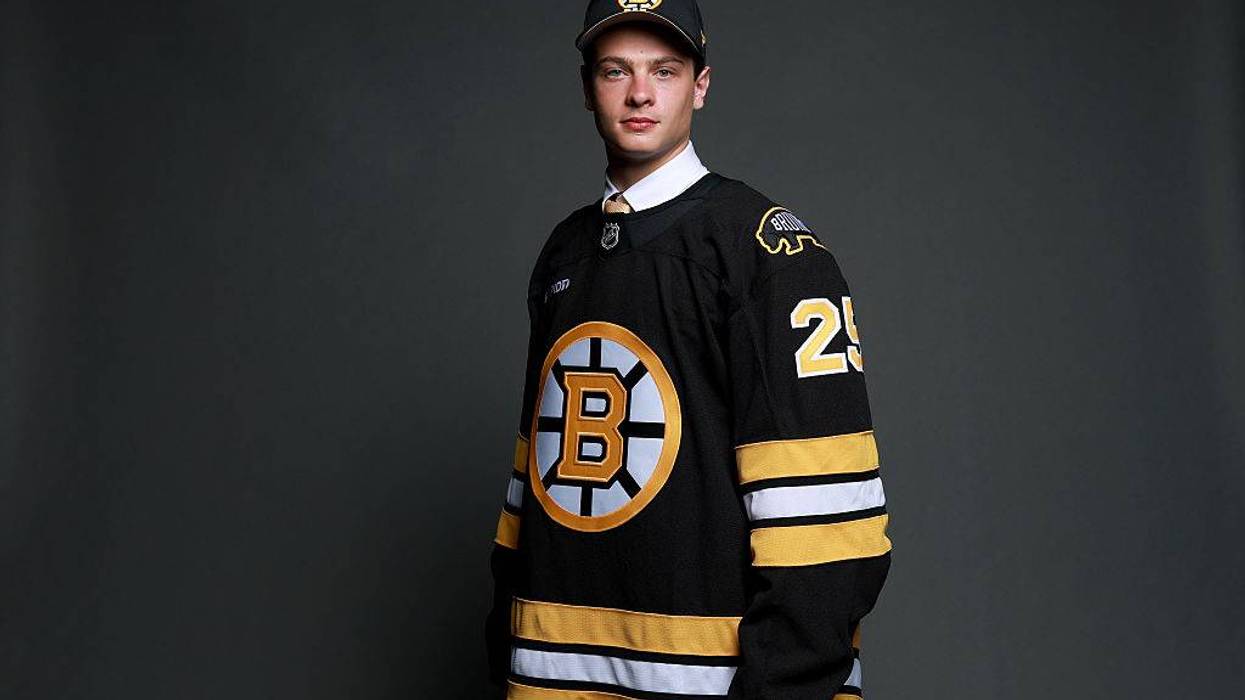

The Boston Bruins announced late Monday night that they have signed 2025 seventh overall pick James Hagens to an AHL amateur tryout agreement (ATO).
Hagens will practice with the Providence Bruins on Tuesday and is expected to make his AHL debut Wednesday night in Springfield.
When Hagens might make his NHL debut with the Boston Bruins remains to be seen. He would still need to sign his entry-level contract (ELC) before doing so. The ATO is a short-term, AHL-only deal.
One option would be for Hagens to play the rest of this season in Providence on the ATO and not start his ELC until next season. Another option would be for the Bruins to sign Hagens to his ELC after a short time in Providence and call him up for his NHL debut before this season is over. Starting with the ATO leaves their options open, something general manager Don Sweeney referenced in a statement announcing the signing.
“We’re very excited to have James join the Bruins organization and take this next step,” Sweeney said. “James is an important part of our future, and this is a great opportunity for him to get immediate experience at the professional level in Providence and continue his development, while keeping all options open."
Hagens on if this could be a short term stint in Providence before a call up to Boston:
"You let agents talk and deal with that stuff. I just want to be able to play hockey and to be able to have this opportunity, it's something that you just have to try to run with...… pic.twitter.com/Gn7HmurqNP
— Bridgette Proulx (@bridgetteproulx) March 24, 2026
So, why not just throw Hagens right into NHL game action? That is certainly what some very vocal Bruins fans on social media had been clamoring for ever since Hagens' sophomore season at Boston College ended on Friday night. The excitement and anticipation is certainly understandable given that Hagens is the Bruins' best prospect in a decade.
That is almost certainly what Hagens himself wanted, too. But the Bruins wanting Hagens to start in Providence is understandable as well. They are in the middle of a tight playoff race, just two points above the cut line with 12 games to go. Their priority right now is winning games and making the playoffs, not giving Hagens what he wants.
Hagens might be able to help the Bruins do that. MIGHT. There is no guarantee of that, because there aren't a lot of recent examples that mirror this situation. For starters, let's be clear about what this situation would be if Hagens started in Boston: a 19-year-old, top-10 pick, in the season after getting drafted (aka D+1 season), jumping right into an NHL playoff race.
I thought it would be a useful exercise to go through other highly drafted college players to see what their path to an NHL debut actually looked like. And here's what really stood out to me: most of them debuted on non-playoff teams, or two years post-draft (D+2 season), or both. There are a couple notable outliers, including Hagens' soon-to-be teammate, Charlie McAvoy.
Here's the list, including some picks just outside the top 10, going back 10 years:
2016 Draft
Clayton Keller: drafted 7th overall, played 1 year at BU, then joined a bad Coyotes team late in 2016-17 season
Tyson Jost: drafted 10th, 1 year at North Dakota, then joined a bad Avalanche team late in 2016-17 season
Charlie McAvoy: drafted 14th, 1 year at BU, then played 4 AHL games in Providence before joining Bruins in 2017 playoffs
2017 Draft
Cale Makar: drafted 4th, 2 years at UMass, then joined Avalanche for 2019 playoffs
Casey Mittelstadt: drafted 8th, 1 year at Minnesota, then joined a bad Sabres team late in 2017-18 season
2018 Draft
Brady Tkachuk: drafted 4th, forgoes sophomore year at BU to turn pro immediately, makes bad Senators team out of camp
Quinn Hughes: drafted 7th, 1 year at Michigan, then joined a bad Canucks team late in 2018-19 season
2019 Draft
Alex Turcotte: drafted 5th, 1 year at Wisconsin, waited until offseason to sign, spent all of next season in AHL
Trevor Zegras: drafted 9th, 1 year at BU, waited until offseason to sign, started 2020-21 season in AHL before NHL debut
Matt Boldy: drafted 12th, 2 years at BC, turned pro late in 2020-21 season but only played in AHL, eventually made NHL debut with Wild midway through 2021-22 season
Cole Caufield: drafted 15th, 2 years at Wisconsin, played 2 AHL games late in 2020-21 season before debuting for playoff-bound Canadiens
2020 Draft
Jake Sanderson: drafted 5th, 2 years at North Dakota, signed in offseason, broke camp with Senators to start 2022-23 season
2021 Draft (aka the Michigan Draft)
Owen Power: drafted 1st, 1 year at Michigan, joined a bad Sabres team late in 2021-22 season
Matty Beniers: drafted 2nd, 1 year at Michigan, joined a bad Kraken team late in 2021-22 season
Luke Hughes: drafted 4th, 2 years at Michigan, joined a playoff-bound Devils team late in 2022-23 season
Kent Johnson: drafted 5th, 1 year at Michigan, joined a bad Blue Jackets team late in 2021-22 season
2022 Draft
Logan Cooley: drafted 3rd, 1 year at Minnesota, signed in offseason, then broke camp with a bad Coyotes team in 2023-24
Cutter Gauthier: drafted 5th, 2 years at BC, traded from Flyers to Ducks over disagreements regarding path to NHL
Rutger McGroarty: drafted 14th, 2 years at Michigan, traded from Jets to Penguins over disagreements regarding path to NHL
2023 Draft
Adam Fantilli: drafted 3rd, forgoes sophomore year at Michigan to turn pro immediately, makes bad Blue Jackets team out of camp
Will Smith: drafted 4th, 1 year at BC, signed in offseason, then broke camp with a bad Sharks team in 2024-25
Ryan Leonard: drafted 8th, 2 years at BC, joined a playoff-bound Capitals team late in 2024-25 season
2024 Draft
Macklin Celebrini: drafted 1st, forgoes sophomore year at BU to turn pro immediately, makes Sharks out of camp
Zeev Buium: drafted 12th, 1 year at Denver, practices with Wild late in 2024-25 season before making NHL debut in playoffs
From the 2025 draft, there were two other college players picked in the top 10: Michigan State's Porter Martone sixth overall to Philadelphia, and Providence College's Roger McQueen 10th to Anaheim. They are both in the NCAA tournament, so neither they nor their NHL teams are yet faced with the decision Hagens and the Bruins had.
*********************************
That's a lot of names – 24, in fact. But I think the vast majority can be categorized as apples-to-oranges comparisons for one reason or another. A bunch of them didn't turn pro until their D+2 season, including Ryan Leonard, Hagens' linemate at BC in 2024-25. He was a year older than Hagens is now, and that matters when we're talking about players this young.
Leonard also joined a Capitals team that was safely in the playoffs, not one right on the bubble like the Bruins are now. That also matters, because the Capitals could afford to let Leonard learn on the job and make mistakes. The Bruins might not be able to cut Hagens as much slack right now. And Leonard needed that slack. He didn't produce much last spring, recording one point in nine regular-season games and one more in eight playoff games. Hagens would need to produce more than that if the Bruins are going to roll with him in a top-nine role.
Of those that did turn pro in their D+1 season, most joined bad teams that were not in a playoff race. They did not face pressure to immediately help their team win. Hagens would be facing that pressure.
The only two players on this whole list who really hold up as good comparison points for Hagens are McAvoy nine years ago and Zeev Buium last year. McAvoy played four AHL games on an ATO before signing his ELC and joining the Bruins for the first round of the 2017 playoffs – and even that may not have happened if not for a slew of injuries on the Boston blue line that spring. Buium did not play any AHL games, but he did practice with the Wild for a week before seeing his first game action in round one of the playoffs.
Neither McAvoy nor Buium jumped immediately into NHL games. It seems reasonable, then, that the Bruins were reluctant to throw Hagens right into game action. Given how well things worked out with McAvoy, you can see why the Bruins would want Hagens to follow the same path.
There are also the two worst-case scenarios worth highlighting: Cutter Gauthier and Rutger McGroarty. Their situations weren't exactly the same, but in both cases, disagreements over the player's development path led to deteriorating relationships and ultimately trade requests.
Hagens being willing to sign an ATO and report to Providence would seem to be a pretty clear indication that he and the Bruins are nowhere close to heading in that direction. But, the Bruins do need to be aware that Hagens wants to be in the NHL as soon as possible, and might not be thrilled if he has to spend the rest of this season in the AHL, and maybe even the start of next season.
In the weird, new world of ever-changing NCAA eligibility rules, it's also possible that Hagens could remain eligible to return to Boston College next season even after signing an ATO. But as noted by College Hockey Insider's Mike McMahon, that's only the case if Hagens just practices with Providence. Once he plays an AHL game, returning to BC is off the table.
The best outcome for everyone involved would be for Hagens to play well in the AHL, prove that he understands the Bruins' system (Providence plays the same one as Boston), get called up in the next week or two, and help Boston down the stretch and into the playoffs. The first step in that process takes place at a Tuesday morning practice at Amica Mutual Pavilion in Providence.
I asked Hagens if any of the Bruins reached out to him after he signed, and he said:
"Yes, Charlie McAvoy reached out and he sent a really nice text. Him being the Long Island guy too, it was something that was really cool, but I haven't looked at my phone much since." pic.twitter.com/CkpVLJbMLr
— Bridgette Proulx (@bridgetteproulx) March 24, 2026