

The NFL doesn’t appear to think the Patriots will be very good this season. They are scheduled for the same number of primetime games as the Washington Football Team, and perhaps most tellingly, their highly anticipated matchup against Tom Brady is taking place in early October — not during the all-important November sweeps period.
It looks like the NFL wants to protect itself against another sub-.500 slog in Foxboro.
The annual release of the NFL schedule is now one of the most important dates on the TV calendar, since professional football remains one of the few products people are willing to watch live. Last year, NFL games accounted for 69 of the 100 most-watched TV broadcasts.
Brady’s return to Gillette Stadium is the signature game on this season’s calendar, and there are already conspiracies flying about the league’s apparent efforts to try and ensure the Patriots are still competitive when it happens.
That’s right: NFL executives seemingly have so little faith in Cam Newton, they’re willing to help out Bill Belichick. At least, that’s how the theory goes. The Buccaneers will play the Rams in Los Angeles before flying across the country for their Sunday night tilt against New England.
“Are they setting Tom Brady up to lose?,” asked Pat McAfee on his radio show. “Do the schedule-makers want the worst Tom Brady we can have? Everybody assumed that the NFL was anti-Tom, but they always assumed that was anti-Tom and the Patriots. Now, it’s very clear the schedule-makers have an agenda. That agenda is to get Bill Belichick at his best, and Tom Brady at his absolute worst.”
It’s clear the Patriots were not a draw last year without Brady — and that was before they fell out of the playoff race. In four of their five primetime games, they drew a smaller audience than the season average:
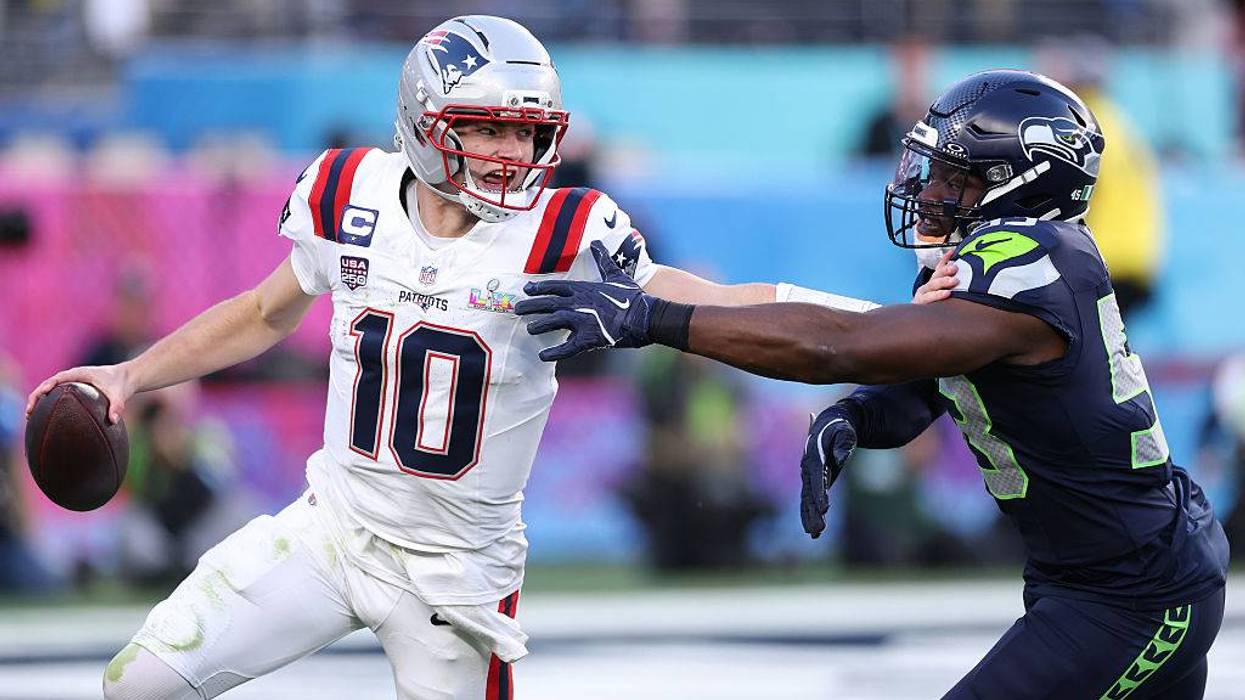
Patriots vs. Seahawks (Week 2): 14.09 million viewers (“Sunday Night Football” average was 16.8 million)
Patriots vs. Jets (Week 9): 10.84 million viewers (“Monday Night Football” average was 12.2 million)
Ravens vs. Patriots (Week 10, SNF): 13.7 million viewers
Patriots vs. Rams (Week 14): 9.12 million viewers (“Thursday Night Football” average was 14.1 million)
As you may recall, both Sunday night games came down to the wire: the Seahawks bested the Patriots 35-30 when they stopped Cam Newton on the goal line, and the Patriots snuck past the Ravens 23-17. Yet, they still drew inferior crowds to the average game.
The one time the Patriots surpassed the primetime season average came Week 16, when the Bills trounced them by 29 points on MNF (the torch-passing affair attracted 14.5 million people).
There were signs of national Patriots fatigue even while Brady was still on the team. Their win over the Rams in Super Bowl 53 was the lowest-rated in 10 years. Of course, it was also an exceptionally boring defensive struggle, but let’s not allow nuance to get in the way of a good thesis.
For what it’s worth, Tampa Bay’s win over the Chiefs drew the worst Super Bowl rating in 15 years, though streaming numbers reached an all-time high. TV viewership also plummeted across the board during COVID-19, and the game was a blowout as well.
TV ratings are complicated — except when it comes to measuring Brady’s impact locally. The 7-9 Patriots saw their ratings drop by 26 percent in 2020. The Buccaneers’ local ratings, meanwhile, were up 28 percent.
Though the Patriots shelled out a record-setting $160 million on free agents, their drawing power is uncertain. With Julian Edelman retired, the team finds itself bereft of stars with cultural cache.
Mac Jones could become a superstar, but he might sit behind Newton for the first half of the season. There’s also the possibility he struggles like other Alabama quarterbacks. He was, after all, the fifth QB selected in this year’s draft.
The NFL primetime schedule doesn’t only feature surefire Super Bowl contenders. The Saints and 49ers are slated for five primetime games, and the Bears and Raiders will each be featured four times.
The Patriots will be in primetime three times, tying them with the Giants, Chargers, Titans, Browns, Cardinals and Washington.
In other words, they league thinks they’ll be just as captivating as Ryan Tannehill and Fitz Magic. It’s clear the Patriots will have to work to make Jim Nantz a frequent flier in Foxboro again.
———————————————————
NFL scheduling drama is sheer brilliance: Years ago, the NFL put a schedule release show on its own TV network, daring other outlets to cover a televised press release.
And it’s worked. If the NFL Draft was the signature sporting event of April, then the NFL schedule release was the signature sporting event of May.
Roger Goodell used to muse about dominating every season on the calendar, and now, that’s exactly what’s happened. With a 17-game regular season, the NFL campaign will now stretch into mid-February — bringing it right up against Presidents’ Day Weekend. That means there will only be one month between the end of the season and start of free agency.
If you still harbor any doubts about the NFL’s cultural dominance, look no further than this comparison: The NFL Draft drew 15.6 million viewers on Night 1. The Academy Awards were watched by a mere 9.85 million.
Really, no questions?: Last Friday, Kemba Walker sat the podium following Boston’s excruciating loss to the lowly Bulls. And he wasn’t asked a single question.
The “Green Teamers” often get mocked on the talk radio airwaves, and most of the time, it’s a tired trope. The Celtics don’t escape criticism in this town. They are ripped when they underperform on talk radio and in column spaces, just like every other team.
However, scenes like Friday night add to the "Green Team" reputation. Reporters want press access restored, and yet, asked Walker no questions when given the chance. That’s what we call a bad look.
Kenny Mayne’s exit signifies downfall of ESPN: The eulogies for the golden era of ESPN were written long ago. But with Kenny Mayne’s exit from the network — and revelation that executives wanted him to take a 61 percent pay cut — solidifies the deal.
ESPN is bleeding subscribers, with millions of people cutting the cord. The WorldWide Leader was in nearly 100 million homes in 2013. Now, the number stands at around 83 million.
In recent years, many ESPN personalities have achieved greater stardom outside of Bristol: Dan Patrick, Colin Cowherd, Skip Bayless, Dan Le Batard and Trey Wingo are just a few names who have signed big deals with competitors. As Mayne acknowledges to Richard Deitsch, there is an abundance of opportunity right now for high-priced talent. The rise of streaming and podcasting is creating an entirely new market.
Instead of representing the culmination of one’s sports media career, ESPN could now be more of a stepping stone.