
BIB Notes: The stark reality of trying to make trades in May

For most in baseball, even those at the highest level of decision-making in Major League Baseball, the news came out of nowhere.
On May 4, 2024, just 35 games into their season, the Marlins were trading Luis Arraez to the Padres for four prospects. One year later, it's still an eyebrow-raiser.
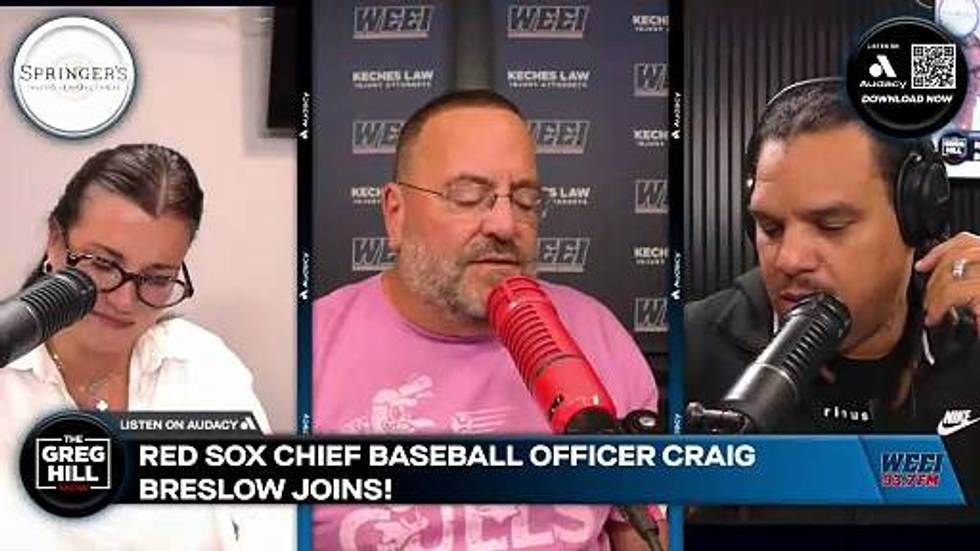
"A little," said Red Sox chief baseball officer Craig Breslow when asked if the deal took him by surprise. It also reminded the then-first-year chief decision-maker that such an maneuver could actually be executed so early in the baseball calendar.
"I didn't really think about what time of the year it was outside of just realizing, 'OK, you feel like there is this created calmness because out of spring training we're just going to roll with this for a while.' And then you see a trade and you're like, 'OK, we don't have to,'" he added.
"There is no moratorium on trades. It's rare because you don't want to over-read 30 days into the season."
Breslow certainly wasn't alone in his thought process, as Blue Jays GM Ross Atkins could also attest.
"They don't really happen," Atkins said on the Baseball isn't Boring podcast regarding big May trades. "They don't happen and I think it's because of a couple of things. One is that everyone will say it's early. We're in April and May and you don't want to overreact to a smaller sample size. So most teams lean to internal adjustments or internal change. So bringing up a younger player, or somebody becomes healthy, or just making an adjustment that is development based. The second is that you're paying a massive premium. If it's already difficult to line up, if you're going to put a tax on that beyond of just the return of having the player for a longer period of time it becomes more difficult to do and it's hard to present to ownership because you're going to step out of your processes."
He added, "It's one of the most difficult times in the year for executives because there is only so much you can do and you need to make sure you're setting the right tone for your environment. You can't just sit on your hands, either. But you have to find ways to make the organization better that aren't potentially quite as overt."
All of it is why the Red Sox' solution to their most recent problem - the season-ending injury to Triston Casas - won't likely come in the form of an Arraez-level blockbuster.
To San Diego's credit, it wasn't going to let any of the aforementioned May trade roadblocks aggressively pursue the need for a player like Arraez. The Padres needed a first baseman who made contact, so they gave up four prospects to get him. Starting with that first game in his new uniform, Arraez has paid off, going 4-for-6 on the way to a 142-game stretch that has seen him hit .312 with the fifth-most hits in baseball. (Jarren Duran has the fourth-most over that span.)
It was also the sweet spot for the Marlins, who were floundering at 9-25 with a new GM in Peter Bendix who was clearly ready to rip the Band-Aid off. (Note: None of the four minor-leaguers has distinguished themselves, with the headliner, 2023 first-round pick Dillon Head suffering through a hip injury before starting this season in Single-A.)
Trades these days already have to be the Perfect Storm. Add in the lack of desperation due to too much time before the trade deadline, these deals become the ultimate abberation.
"You're largely still riding with the blueprint that you had in the offseason and spring training," explained Breslow. "You're likely to move if your team reaches the threshold that warrants execution. Then you do it. But it's very rare you completely pivot from what your plan was. Going into the season, you have a pretty good idea of the path you're going to take. ... You consider it. But it's so rare. I think you're still trying to figure out what your team is. You don't want to be reactive.
"I don't want to speak for anyone else, you kind of know if you are likely to trade a player. You probably know that going into spring training, coming out of spring training, approaching the deadline. You have a pretty idea of how competitive your team needs. So if your team needs it does it matter if it's July, June or May? Not really outside the possibility that you can do better if you wait and remain patient and discipline. But there is no guarantee it doesn't go the other way."
Before Arraez, perhaps the most referenced May trade came in 2021 when Tampa Bay sent Wily Adames and Trevor Richards to the Brewers for J.P. Feyereisen and Drew Rasmussen. And guess who was part of that Rays' front office? Bendix.
The Red Sox' history of making May trades isn't a long one, unless you count the kind of Pablo Reyes (May 12, 2023) and Garrett Cooper (April 27, 2024) deals that simply helped plugged injury-induced roster leaks.
And, yes, Breslow has already made a trade this season, sending Quinn Priester to the Brewers for minor-leaguer Yophery Rodriguez. But that had very little to do with the kind of here-and-now deals the likes of Arraez and Adames represent.
The Red Sox' most notable blockbuster before June? You probably have to go back to the May 29, 2003 trade sending Shea Hillenbrand to Toronto in exchange for Byung-hyun Kim. Again, different motivations and different times.
"It's just a different language now," Atkins said. "Twenty years ago it was looking through comparable trades that had happened in the past and trying to sync them up based on industry takes on players and saying, 'OK, these guys are Top 20 talent and we're getting two of them for this asset.' Now the projections are much more nuanced. There is public information. There is internal information. Quite frankly, it is pretty efficient because it is pretty similar. I think trades happen when there is misalignment. When there is alignment in value there is more holding. But, if for whatever reason, you're valuing a certain acquisition more than the other team than there is a higher likelihood of that happening. That gap is seemingly happening less because the industry is looking at a lot of similar things. Now we have to find the next opportunity. There are teams that are better at that than others. So you're making sure you're not hanging your hat too heavily on, 'I have got to have evidence to make this move.' You have to be willing to take some risks in today's game."
And the reality is that very few in baseball are ready to take those sort of risks in the second month of the season.
HOW CARLOS NARVAEZ BECAME ONE OF MLB'S BEST DEFENSIVE CATCHERS
Speaking of trades, few took note of the trade that sent minor-leaguer Elmer Rodriguez to the Yankees for a 26-year-old catcher named Carlos Narvaez, who had six games of major league experience. Probably because it was the exact same day - Dec. 11 - the Red Sox were making another trade: For ace pitcher Garrett Crochet.
"Right away," Narvaez said in regards to understanding the importance of the opportunity. "At first I was shocked, but then I realized it was the same day Crochet was coming in so something great was happening."
The first goal was to change his body, ultimately going from 230 pounds to 215. Then there was some tweaks in terms of his hitting, which had already paid dividends in the form of a .377 batting average and 1.118 OPS in the Venezuelan Winter League over 24 games. Defensively, blocking and framing wasn't a problem. He was always good at that.
The last piece of the puzzle was throwing. Specifically, getting more velocity behind his throws. That's where the Red Sox and Narvaez decided to go a bit outside of the box.
"Historically, in his time in the New York, he was always one of the highest-rated metric guys there," said Red Sox catching instructor Parker Quinn, who, like Narvaez, came from the Yankees organization in the offseason. "Of course when guys come up and get prolonged time in the big leagues you don't know how it will play out. He has always been a high-level receiver. As guys move up there is an expected regression, but that hasn't been the case with him.
"If you want to say there was deficiency in his game it was (throwing velocity). There certain elements of his throwing that were elite, but arm strength wasn't one of them. So we identified some mechanical things there we thought we could address and actually got with the pitching department regarding some things we could game-plan. How would they go about if this guy do X, Y, and Z from a mechanical standpoint how would they approach it? We don't have some of the biomechanical stuff that is available to the pitching side, but they are so in-tune with what it looks like it's something we're trying to integrate."
It has worked. After seeing his throws sit around 75 mph, Narvaez has routinely clocked in at 80 mph when looking to gun down baserunners. It is a unique part of what has become a unique story.
"I'm super proud," he said with a smile. "It has been a journey. "
HOW PAUL MOLITOR CAME TO MENTOR MARCELO MAYER
Paul Molitor was the third pick in the 1977 MLB Draft. Forty-four years later, Marcelo Mayer became the Draft's fourth overall pick. But while the introduction to professional baseball is a generation apart, that doesn't mean the two can't have a connection.
Let it be said, let it be done.
"John Boggs, his agent, has been a friend of mine for 35 years and when he comes to Florida to visit some of his clients he always stops in Fort Myers and P.F. Changs always seems to be the choice," Molitor said. "Just a really impressive kid. Super humble. No question he is destined to be a big star.
"We teach the game. We teach the fundamentals. We try and prepare them as well as we can. But when you get up here, no matter how talented or what your experiences might be, you're going to have some failure and to me it's almost the mental side as much as the physical side. When things get rough are they going to have enough foundation to minimize their down periods. With social media, everybody knows your name when you get up here and it's how you deal with failure when you get up here."
The advice imparted to Mayer was pertinent, but the Hall of Famer admits the life he is living is far different from when the Brewers called him up as a 21-year-old.
"It was nothing back then," he said. "I was the third pick and got to Milwaukee the following year but I don't think anybody had any idea who I was. But when Marcelo Mayer gets to Boston ... The expectations in Boston are a little different than in Milwaukee as far as what they expect from their team. But he will be ready. I have all the confidence in the world with him."
THE REASON FOR THOSE FUNKY LEADS AT THIRD BASE
You might be wondering why the Red Sox baserunners at third base are taking their lead well into fair territory instead of the traditional foul territory. Well, according to third base coach Kyle Hudson, the idea was born from witnessing how Tampa Bay was playing their third baseman in spring training.
With lefty hitters up and a runner on third, the Rays' third baseman would routinely position themselves near the third base bag for a possible throw down behind the runner. The Red Sox decided it would be a good idea to take the lane away, making appreciably more difficult get the ball to the bag while also blocking the view of the fielder during each pitch.
Speaking of Hudson, it turns out he had some previous experience when it came to attempting a steal of home prior to Jarren Duran's successful dash in Cleveland. Unfortunately for the University of Illinois two-sport star, his attempt didn't go as well.
"I straight stole home in Low-A and I was safe but they called me out. They didn't have replay," Hudson said. "When we're going to go, we want to make sure we're safe. The best part of that whole play for me was watching the whole dugout, everybody's face. That gets some momentum going."
OTHER STUFF ...
- Newly-promoted Abraham Toro only had two teams show interest in him this offseason: The Red Sox and Yankees. He picked the Red Sox. What he didn't choose was the widely talked about "Torpedo" bat. He had been one of the few Red Sox who used it during spring training, but hasn't deemed it necessary to break it out for game action yet in regular games.
One player who hasn't shied away from using the "Torpedo" is former National League hitting champ Jeff McNeil, who has started out red-hot in his return to the Mets while using the new tool. In his first six games he has a .905 OPS while bouncing between second base and outfield.
"He is super excited," said Syracuse Mets manager Dick Scott regarding McNeil's embracing the new bat. "He was excited with it, and it was good to see. He hit the ball well here. ... This, he just feels like it's the one."
- Catcher Blake Sabol, who was just returned to Triple-A Worcester, is best friends with former Patriots wide receiver Ju-Ju Smith-Schuster, who took Sabol out on the town after the former Pirates draft pick signed his first deal in Pittsburgh. What did they do? According to Sabol, after seeing a homeless man with his three-legged dog, Smith-Schuster made it a priority to find a store to buy dog food to give to the man's pet before hitting the town.
- If you want to know the art that goes behind a baseball broadcast, listen to the Baseball Isn't Boring podcast with SNY Mets director John DeMarsico. It will make you view the games in a different light ...
- And if you want to hear some sense when it comes to how MLB teams should be approaching pitchers (prioritizing health) but aren't (prioritizing velocity), listen to Toronto starter Chris Bassitt on Baseball Isn't Boring ...
- When asked about Michael Kay's rant regarding the uselessness of relievers running in from the bullpen during bench-clearing incidents, most Red Sox relievers agreed, with one calling it "useless." The issue is, as they point out, that there the presence is needed to show support for those involved. The biggest issue, according to some, are the way some of the bullpens are constructed, with places like Baltimore, Philadelphia and Toronto having staircases each reliever has to walk down before even getting to the field.
For the Red Sox, an example of the expectation that everyone will be part of the fray came during the Joe Kelly/Tyler Austin fight in 2018. After that melee, the Sox held a team meeting to emphasize that not everybody was quick enough getting into the action, with some relievers bullpen personnel passing position players.
- A reminder: Ceddanne Rafaela had hit one home run in his life by the time he was signed to become a professional baseball player.
- Some stats: 1. The Red Sox are tied with the Yankees and Cardinals for best average bat speed (72.5 mph) of all MLB teams. 2. Their pitchers are also the second-fastest in terms of tempo at 14.6 seconds, with Hunter Dobbins - whose agent is former Red Sox pitcher Alex Wilson - leading the group at 12.9 seconds between pitches; 3. Rafaela leads all fielders in getting jumps per Baseball Savant, easily topping the No. 2 candidate, Chicago's Pete Crow-Armstrong.
- Yes, 45-year-old Rich Hill is still throwing and working out, actively looking for an interested team to play for this season.