


The Nets seem to be expert tankers.
If, you know, they had a reason to tank.
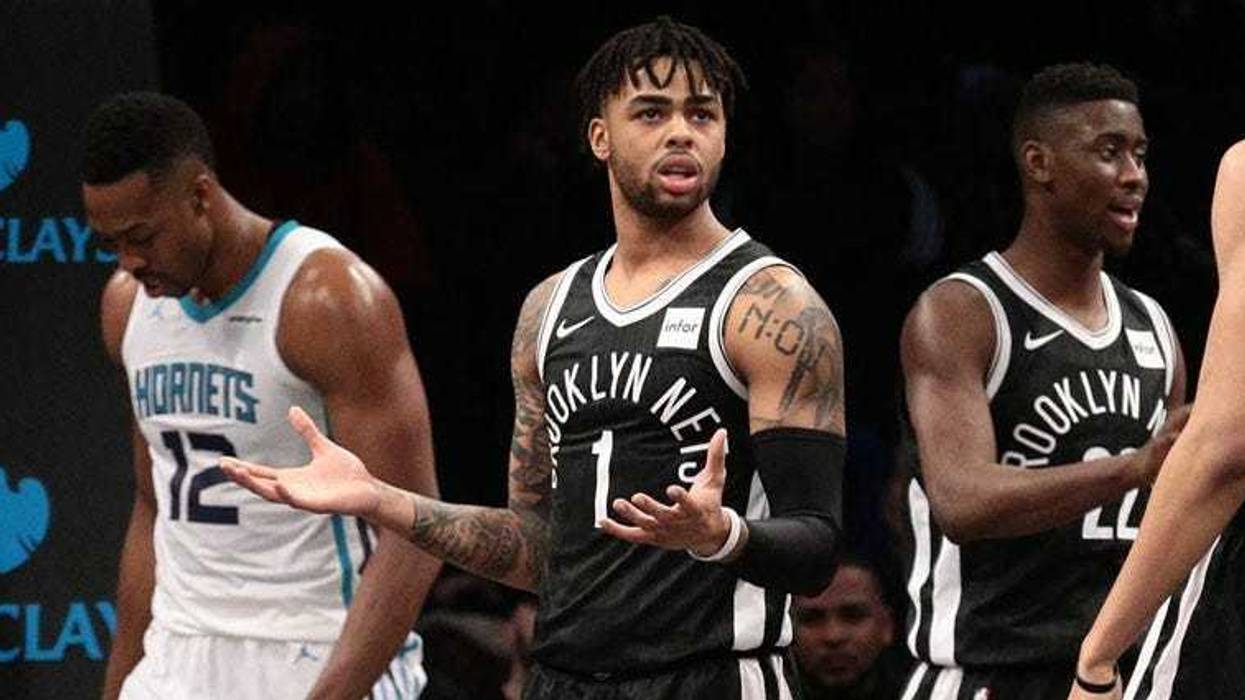
Since Brooklyn's 2018 first-round draft pick belongs to Cleveland, awful losses such as Wednesday's 111-105 choke job to Charlotte serve no purpose other than to infuriate those fans who trekked through the nor'easter to the Barclays Center.
The Nets allowed a 23-point third-quarter lead to dwindle to 11 points with about five minutes remaining in the game. In those final five minutes, lottery-bound Charlotte outscored Brooklyn 22-5.
If you're digging into why the Nets sit at 23-49, their failures in closing out games stand out. Wednesday's contest marked the 45th Nets game this season that contained a margin within five points with less than five minutes to play. Only Miami has played more tight games.
With the Hornets loss, the Nets fell to 16-29 in such games. Their .356 winning percentage ranks 27th among the 30 NBA teams, with just Dallas, Memphis, and Orlando -- tankers all -- owning worse success rates.
I'd like to pin all the blame for such dreadfulness on the refs, especially after FiveThirtyEight.com confirmed Nets fans' suspicions in their analysis of the NBA's Last Two-Minute Reports through Feb. 28. It showed that the Nets were the most wronged team in the league, with 28 incorrect calls or incorrect noncalls, and that guard Spencer Dinwiddie was the league's most disadvantaged player.
However, I'm not prepared to suggest that these injustices altered more than a couple of outcomes. Rather, the Nets' problems lie within, from their philosophies to their executions.
The Nets don't seem to know what works down the stretch of games. More specifically, after playing three-plus quarters of pace-and-space featuring drives-and-kicks, the Nets tend to take the air out of the ball late in games while relying more on one-on-one matchups.
As a result, Brooklyn is shooting 39.7 percent from the floor in "clutch situations," defined by NBA.com as a five-point differential or less in the last five minutes or overtime, with only two Nets (forwards Rondae Hollis-Jefferson and DeMarre Carroll) converting on better than 40 percent of their field-goal attempts. Of the seven teams with a worse efficiency, only Indiana occupies a playoff position.
The players who you'd think would best fit the role of closer -- Dinwiddie and D'Angelo Russell -- are shooting 35.2 and 34.3 percent, respectively, in clutch situations. Russell has compounded his bricklaying by committing 10 turnovers in 57 such minutes.
So it was guard Caris LeVert's turn to bungle two consecutive possessions in Wednesday's final minute by attempting to take matters into his own hands. He's now 11-for-29 with eight turnovers in 76 crunch-time minutes.
"(The Hornets) were switching everything," Nets coach Kenny Atkinson said. "We run a play -- we run six different options, they switch everything, now you've got to make a play. Now you've got to drive it and beat your man, and if you miss it, you should be able to take advantage of the switch and offensive rebound, because now they've got a small guy on the big. That's just the game today. Caris' drive at the end of the game -- I love it. We just got to get to a level where we're finishing those plays."
The Nets, as I noted in my previous post, do not routinely switch when their defenders are screened, though they have been mixing it up somewhat in recent games. Still, opponents own a 44.8 percent field-goal percentage, including 35.1 percent from 3-point range, in clutch situations, both of which place in the lowest quartile in the league's rankings.
For most of Wednesday night, Nets wing Allen Crabbe did a fabulous job snaking his body through ball screens to contain Charlotte's All-Star guard, Kemba Walker. On the most important possession, however, Crabbe died on a Dwight Howard pick above the 3-point line, allowing Walker unfettered access into the paint. Walker's and-one with 18 seconds remaining put Charlotte up 107-105, its first lead since the first quarter.
Crabbe appeared frustrated after the game. He sent out, and then quickly deleted, a tweet that expressed his feelings, although the exact meaning has been given varying interpretations.
It is clear that despite the Nets' talent deficit on most nights, Atkinson can do a better job managing crunch time. As NetsDaily.com noted, a big part of culture development, for tankers and non-tankers, is avoiding the acceptance of losing..
For a FAN's perspective of the Nets, Devils and Jets, follow Steve on Twitter @SteveLichtenst1.